Fool’s Gold: The Hidden Costs of AI Data Centers for New Jersey

Introduction

Robust, responsible economic development must ensure businesses bear the costs they create, protect the environment, and uphold sound fiscal policy so that state tax dollars do not subsidize private profits. Data centers and the technological products they support may seem exciting and new, but they also impose costs on local communities and the state as a whole. As with prior economic development booms, from warehouses to shopping malls, an accurate accounting of the hidden costs of these buildings can empower policymakers to make better decisions and protect residents.

Behind the promises of jobs and economic growth, the dramatic expansion of data centers has harmed states and communities: these facilities use large amounts of energy, do not deliver meaningful long-term benefits, and cause the state to lose money from subsidies and credits. The growth in artificial intelligence (AI) products has driven rapid growth in data centers, but that growth strains local communities and infrastructure.[1]

New Jersey residents and small businesses are already paying more for electricity because of data center energy consumption. Data centers were the main driver of the 20 percent jump in electric bills that New Jerseyans experienced in June 2025.[2] And with more data center demand pushing construction across the country, New Jersey will see increased exposure to the risks associated with data centers.

To address these hidden risks to the state’s communities and residents, utility costs, and fiscal stability, NJPP recommends the following:

  1. Create a standard definition of a data center for the purposes of state regulation.
  2. Build strong guardrails for data center companies around cost sharing, transparency, and energy resource requirements.
  3. Standardize energy load forecasting.
  4. Remove or restrict data center subsidies.

The Basics of Data Centers

When a user types a prompt into an AI tool, a data center’s computers use an enormous amount of computing power to generate the tool’s response. What may appear to the user to be magic has very real costs in electricity, water, and infrastructure. At its core, a data center is just a different kind of industrial or commercial facility, designed to maximize profits for its owners and operators. Understanding the costs data centers impose on communities and the reality of their operations can help policymakers develop laws and regulations that protect residents and the places they live.

What is a data center?

Simply put, a data center is a big room filled with computers. As more computing power is needed to conduct operations for artificial intelligence programs, more of these rooms are needed to keep up with demand, with more resource-intensive computers and all the infrastructure needed to run them, including electricity to power the computers and water for their cooling needs.[3] As a result, a medium-sized data center can consume more than 100 million gallons of water per year, roughly as much as a small town.[4]

Because definitions of a data center can include everything from a small server room to a huge warehouse, information on data centers can be difficult to obtain. Different states use different definitions of data centers for regulatory purposes. Some simply identify “large load customers,” defining a facility that needs a certain amount of energy (say, 100 megawatts) as a “large load customer,” without specifying that it must be a data center.[5] For certain tax exemptions, states may have different definitions, which might include specific industry codes, capital investment minimums, or jobs created.[6]

For the purposes of this report, NJPP uses a broad definition of “data centers” that includes a wide range of facilities designed to contain computing infrastructure. The rapid growth in data centers is driven by the computing demands of AI products, sometimes leading to the shorthand of “AI data centers” to describe newer, larger buildings.

Illustrated diagram of a data center

Where are data centers in New Jersey and where are they planned?

New Jersey currently has 48 data centers, with another 12 announced or under construction, according to Aterio, a research firm that tracks the industry.[7] Different publications and firms use different definitions for what constitutes a data center, and no universal database exists. Aterio’s count includes small, midsize, and “hyperscale” facilities categorized by power consumption and public-facing descriptions such as utility filings, public investor statements, and press releases.

Companies decide where to locate or “site” their facility based on a number of factors. Because data centers often require substantial space commitments, they tend to be located outside of denser urban or suburban areas, with new proposed sites in New Jersey in communities such as Vineland, Moorestown, and Clinton.[8] Companies also consider zoning, access to a high-quality network, and the ability of the utility to meet their energy needs; but one of the biggest factors is choosing a place where there are previously developed facilities.[9] This means data centers tend to be concentrated in one area, further straining local grids and communities. Loudoun County, Virginia has the highest concentration of data centers in the world, where new data centers are being constructed near schools, residential neighborhoods, and retirement communities, consuming enormous amounts of resources in the process.[10]

How much energy and water does a data center use?

Data centers use a significant amount of energy, but because of a lack of transparency in energy reporting, exact data is unavailable and the energy usage of data centers can vary widely. A typical large data center that focuses on AI uses as much energy as 100,000 households.[11] However, some larger ones that are currently under construction across the country could use 20 times that much energy.[12] In New Jersey, estimates project nearly 10 percent of New Jersey’s entire electrical usage will go to data centers by 2030, or the equivalent of the energy usage of the entire state of Rhode Island.[13]

In fact, in the next several years, data center energy consumption will grow four times faster than total consumption from all other sectors, and the United States is projected to be the global leader in that explosive growth.[14] According to New Jersey’s regional grid operator PJM, AI data centers accounted for nearly 70 percent of the increase in demand during the 2025/26 capacity auction — the same auction that resulted in a 20 percent increase in electric bills for New Jersey residents.[15]

Approximately 60 percent of the energy a data center uses goes to powering the servers, while the rest goes toward cooling systems.[16] These cooling systems demand large amounts of both electricity and water. In 2024, large AI data centers across the United States consumed about 14 billion gallons of water[17] — a number that could double by 2028.[18]

Precise water usage figures are difficult to verify because data center companies are not required to report them publicly. This lack of transparency is a problem for a state that has experienced several droughts in recent years, including the 2024-25 drought that resulted in crop losses and increased wildfire risk.[19] Any further strain on the state’s water resources could threaten its economic and environmental well-being.

What other costs do data centers impose on ratepayers?

Electricity rates are set by the utility providers in New Jersey and approved by the Board of Public Utilities.[20] Yet there are currently no mechanisms in place to protect everyday ratepayers, such as families and small businesses, from higher costs due to data center buildout. Experts find that despite utility companies saying they keep data center costs separate, these ratepayers are essentially subsidizing big tech companies’ data center projects through higher electricity bills.[21] Aside from the increase in electricity demand, data centers also often require upgrades to transmission infrastructure, and those costs are already being passed on to households and local businesses through increases in their electric bills.[22] If a data center company closes its facility, ratepayers can be left on the hook to pay for those upgrades without strong guardrails in place.

What kinds of jobs do data centers produce?

Data center construction, like any large building project, creates a short-term increase in construction jobs. But once the building is complete, relatively few jobs remain, as the data center is largely space for computers and their cooling and power infrastructure. The limited empirical research has shown no clear evidence of an association between data center development and local tech job creation.[23] Industry estimates place about 50 jobs in a 250,000 square-foot facility — roughly 5,000 square feet per job.[24] By comparison, warehouses generate one job for every 600 square feet, while offices provide one job for every 190.[25] A Brookings Institution report summarizes the existing research: data center development has produced mostly short-term construction jobs in recent years and relatively little long-term, high-value tech activity or large-scale employment.[26]

How Policymakers are Responding to Data Centers

As data center growth has rapidly accelerated, policymakers face a shifting landscape and have been slow to advance policies that address its rising costs. From electrical and water usage to economic development credits, the industry has outpaced policy constraints and regulation.

What makes data centers challenging for state and local policymakers?

Data centers are challenging for state and local policymakers in part because of a lack of transparency in the development process. One major issue is with predicting load growth, or how much electricity a region will need in the future. While it may seem that planning for higher energy use than is needed is a good thing, over-budgeting by too large a margin can artificially drive up costs and continue to increase ratepayer bills. Currently, load growth in New Jersey and surrounding states is predicted by each utility reporting to PJM how much energy it expects it will need in the future. However, this process is not standardized and utility companies often report projects at different stages of development.[27] The demand forecasts that PJM receives may be double- or even triple-counting data center projects because companies will often put in multiple bids for a single project and pull out of all but one once they have chosen their site.[28]

Forecasts through 2030 show demand six times higher than just a few years ago.[29] While there are several factors that contribute to this jump, including manufacturing and electrification, the main driver of this increase in expected demand is data centers.[30] Without a standard system that ensures large load projects like data centers are only counted once, forecasts will remain inflated, driving up costs further. And if policymakers continue to use new and existing oil, coal, and gas plants to meet demand that may never materialize, New Jersey could be locked into using these less reliable, more expensive, and more polluting power plants for decades to come.[31]

How do existing state, regional, and federal policies address AI data centers?

Recent advances in hardware have led to an explosion in the expected development of AI data centers.[32] AI requires dramatically more processing power than traditional computing, driving the skyrocketing demand. U.S. Department of Energy research projects up to 12 percent of total nationwide electricity going to data centers by 2028, or roughly five and a half times what New Jersey uses in a year.[33]

Lawmakers have been unable to keep pace with the rapid growth of data centers, and the regional grid operator PJM has failed to act to protect ratepayers.[34] During the December 2025 capacity auction, existing and planned resources fell short of the reserve needed for grid reliability.[35] This means that if nothing else changes, the region could soon face rolling blackouts on the hottest and coldest days of the year.

PJM recently attempted to adopt policies to address data centers through an expedited decision-making process, but could not secure enough votes on any single proposal.[36] Instead, the board issued a letter outlining six actions it plans to take; but the response falls short of what is needed to hold data centers accountable, protect ratepayers from future increases, and prevent further air pollution across the region.[37]

How do data centers affect environmental justice communities?

On top of higher utility costs, the increase in demand from data centers is delaying the transition to renewable energy, risking local resident health and climate goals. Decision makers, including PJM and the White House, are delaying closures of fossil fuel plants and considering reviving retired ones to meet growing demand.[38] More than half of all coal and gas plants in the PJM region are within a mile of an environmental justice community, which means residents there are not only facing higher bills, but continuing to breathe more polluted air than in other areas.[39]

Using a large generative AI model can produce as much air pollution as more than 10,000 round trips by car between Los Angeles and New York City — and a single model can draw power from multiple data centers.[40] Experts also found that in 2023, air pollution attributed to data centers in the United States caused about $6 billion in public health damages, and that number could increase up to $20 billion per year if lawmakers continue business as usual.[41] For comparison, vehicle emissions in 2016 alone caused $12 billion in health damages for New Jersey.[42] Any increase could be devastating to the health of every state resident.

Data centers have worsened health outcomes for surrounding communities. One facility outside the PJM region in Tennessee runs without pollution controls due to a federal loophole; local residents report that the increase in emissions has made their existing conditions, like asthma, even worse.[43] In New Jersey, a proposed data center in Vineland plans to use diesel backup generators, which would increase local air pollution in a community already suffering from worse health outcomes.[44] A 2022 report found that residents there experience asthma, heart disease, and lung cancer at rates higher than the state average — all conditions worsened by diesel exhaust.[45] Vineland residents have also reported ongoing noise from construction, which can cause permanent hearing damage.[46]

How are states subsidizing and supporting data center growth?

Seeking economic development, many states have rolled out corporate subsidy and tax benefit programs for data centers.

Most states have focused on reductions in sales taxes, particularly those with limited or no taxes on corporate profits. Other states have exemptions on electricity taxes, while others offer property tax reductions.[47] New Jersey’s economic development tax credit program provides tax benefits for data center construction.

The Next New Jersey program allows artificial intelligence or “AI-related” businesses to apply for tax credits of up to $250 million to cover construction, building, or employment-related costs, with a total cap of $500 million in credits.[48]

To define what qualifies as an “AI data center,” the law requires that a facility must handle AI tasks and lists the types of services the facility offers and the systems it houses — namely computing systems and the computers’ support infrastructure.[49] This definition captures a broad range of potential facilities, while not clarifying their size, electrical and water usage, and environmental impact.

Eligibility criteria include:

  • At least 50 percent of the business’s employees are engaged in “artificial intelligence-related activities” or 50 percent of the business’s revenues come from “artificial intelligence-related activities”;
  • At least $100 million in capital investment at the facility; and
  • At least 100 new full-time jobs in New Jersey (construction, building services, etc. may count, but only up to 50 percent of employment).[50]


In addition to Next New Jersey, data centers can qualify for subsidies that apply to all industries, such as the Emerge and Aspire economic development tax credit programs, which create incentives for businesses to locate in New Jersey.[51]

How much do data center subsidies cost states?

As the data center industry has grown, so have the costs of these subsidies for states. Incentives that seem small-scale can quickly balloon as the boom in construction clusters in certain areas, leading to substantial budget instability.[52] At least 10 states have lost more than $100 million in data center subsidies.[53] Virginia is a dramatic example, with its sales tax exemption costing the state $1.6 billion[54] — more than 20 percent of its total sales tax revenue of $7.6 billion.[55] Illinois has seen similar losses, with nearly $1 billion drained from its state budget.[56]

Because of these rapidly rising costs, some states have begun pulling back their subsidies for data centers, including Minnesota, which removed its electricity sales tax exemption.[57]

Currently, New Jersey’s data center tax credit does not anticipate revenue costs in Fiscal Year 2027, though the program is relatively new and has not yet issued any credits.[58]

Solutions for Policymakers to Protect New Jerseyans

The problems data centers create are not going away, and there are many lessons that both New Jersey and PJM can learn from other states and regions. While experts predict future demand could continue to explode and drive up costs, good policy could be the difference between modest increases with no additional pollution and higher costs with higher pollution.

The following are proposals to mitigate the hidden costs of data centers:

1. Create a standard definition of a data center for the purposes of regulation.

New Jersey’s current definition of an “AI data center” for the purposes of administering the Next New Jersey tax credit program does not effectively capture the broad range of facilities, nor does it assist in regulation of their electrical, water, or environmental costs to communities.[59] NJPP recommends creating a standard statutory definition of a data center for specific regulatory purposes (such as electrical and water usage) to ensure that regulations are consistently applied to this class of buildings and the costs associated with them.

2. Build strong guardrails for data center companies around cost sharing, transparency, and energy resource requirements.

Data centers are driving up electricity prices for families and small businesses, and lawmakers can require them to pay more to offset those increases — but as it stands right now, there are no safeguards in place. At the end of his term, Gov. Murphy refused to sign a bill that would have created a new rate for data centers, charging them more for their energy usage to help offset the increases on household and small business energy bills.[60] New Jersey would not be the first state to do this – at least 33 other states have either proposed or implemented different rate structures for large load customers including data centers.[61] In fact, Minnesota enacted a fee on data centers with funds going towards energy efficiency for low-income residents.[62] A rate structure such as this ensures that families and small businesses are not paying more for their electricity and instead puts the cost on the companies that are causing rates to increase. It also incentivizes energy efficiency and other innovative ways to reduce energy use, benefiting both the data center company and the state’s residents.

Second, New Jersey can join other states in requiring data centers to report their energy and water usage to the state’s Board of Public Utilities. By requiring more transparency, both lawmakers and community members can make informed decisions about future policy.

Finally, lawmakers can require data center companies to bring their own generation, specifically clean energy, if they want to build data centers in the state. Other states have learned hard lessons about what happens when a data center company is left unregulated and can run polluting energy sources unchecked, as in Tennessee, where gas turbine pollution has been a problem. New Jersey can set the standard now to protect energy affordability and cleaner air in the future.

3. Standardize load forecasting.

Because AI data centers are an emerging technology, and the idea of large load projects “shopping around” in multiple jurisdictions is a new problem, policies have not yet standardized how utilities and states report their future energy needs to entities such as PJM. Standardizing load forecasting can be done at the state level; it is even more powerful at the regional level, so each utility uses the same protocols to report its energy needs. While PJM has failed to address this issue, the BPU can work with PJM and utilities to reduce duplication of projects and ensure load forecasting is as accurate as possible in New Jersey. This will also reduce the need to keep older coal, oil, and gas plants online, protecting New Jerseyans and the entire PJM region from more air pollution. Additionally, the state and PJM can consider policies that will ensure any necessary blackouts during peak energy days prioritize families and small businesses over data centers.

4. Remove or restrict data center subsidies.

As the state approaches a substantial budget gap, programs that provide subsidies to private corporations need reevaluation.[63] Many states are already reevaluating these subsidies, and New Jersey’s relatively new program has yet to issue an approved credit, providing time to reduce its cost before substantial revenue losses occur.[64] Given the substantial hidden costs of these centers, reducing these incentives or increasing restrictions on their use may help alleviate the burden on communities and the state budget. National experts also have proposed guardrails in the absence of full repeal that can limit the negative impact of these subsidies on communities and their budgets, including lowering the duration and amount of subsidies, prohibiting non-disclosure agreements, requiring public listing of all recipients and applicants, and requiring community benefits agreements in line with other tax incentive programs.[65]

Conclusion

Because of AI data centers, communities are facing higher costs, a more unreliable grid, more pollution, and a lack of transparency that makes holding these companies accountable nearly impossible. New Jersey’s families and small businesses are already paying to subsidize them through higher electric bills. But these problems can be solved. The future of New Jersey’s affordable clean energy, along with its economic and environmental well-being, hinges on lawmakers prioritizing everyday New Jerseyans over for-profit technology companies. The path forward is clear: stronger rules, cleaner energy, and a commitment to putting people before corporate profits.


End Notes

[1] Leppert, R. What we know about energy use at U.S. data centers amid the AI boom. Pew Research Center. Oct. 24, 2025.

[2] Chavin, Sabine, et al. Tackling the PJM Cost Crisis. Evergreen Collaborative. Apr. 15, 2025. p.2.

[3] Metz, C. et al. “How A.I. Is Changing the Way the World Builds Computers,” New York Times. Mar. 16, 2025.

[4] Yanez-Barnuevo, M. Data Centers and Water Consumption. Environmental and Energy Study Institute. June 25, 2025.

[5] Utah Code Sec. 54-26-101 (2025).

[6] Compare N.C. Stat. Sec. 105-164.3(47) (2025) (defining data center as “a facility that provides infrastructure for hosting or data processing services and that has power and cooling systems that are created and maintained to be concurrently maintainable and to include redundant capacity components and multiple distribution paths serving the computer equipment at the facility”) with Ga. Rules and Regulations Rule 560-12-2-.117 (2025) (requiring that a “high-technology data center” “power, cool, secure, and connect” computer equipment, as well as certain investment thresholds).

[7] Aterio. US Data Centers Dashboard. Feb. 2026.

[8] FracTracker Alliance. Data Centers Identified by FracTracker Alliance. 2025.

[9] Leppert, R. What we know about energy use at U.S. data centers amid the AI boom. Pew Research Center. Oct. 24, 2025.

[10] Chen, A. “A.I. Is on the Rise, and So Is the Environmental Impact of the Data Centers That Drive It.” Smithsonian Magazine. Sept. 29, 2025.

[11] Copley, M. “Data centers are booming. But there are big energy and environmental risks.” NPR. Oct. 14, 2025.

[12] Leppert, R. What we know about energy use at U.S. data centers amid the AI boom. Pew Research Center. Oct. 24, 2025.

[13] Blanford, G. et al. Powering Intelligence 2026: Updated Scenarios of U.S. Data Center Electricity Use and Power Strategies. Electric Power Research Institute. 2026.

NJPP analysis of U.S. EIA data. See table C1. p.3.

[14] Ibid. See “Energy Demand from AI”

[15] Ambrose, A. Why Are New Jersey’s Electricity Bills Going Up, and What Does PJM Have to Do With It? New Jersey Policy Perspective. (2025).

[16] Leppert, R. What we know about energy use at U.S. data centers amid the AI boom. Pew Research Center. Oct. 24, 2025.

[17] Leppert, R. What we know about energy use at U.S. data centers amid the AI boom. Pew Research Center. Oct. 24, 2025.

[18] Ibid.

[19] National Integrated Drought Information System. New Jersey conditions. National Oceanic and Atmospheric Administration Accessed March 2026.

[20] New Jersey Board of Public Utilities. About NJBPU. Access Mar. 2026.

[21] Martin, E. and Peskoe, A. Extracting Profits from the Public: How Utility Ratepayers Are Paying for Big Tech’s Power. p.1.

[22] Ibid. p.15.

[23] Gargano, A. & Giacoletti, M. Subsidizing the Cloud: U.S. State Incentives to Data Centers. SSRN Working Paper No. 5881105. Feb. 2026. P. 39.

[24] Joint Legislative Audit and Review Commission. Report to the Governor and the General Assembly of Virginia: Data Centers in Virginia, 2024. Dec. 9, 2024. P. i.

[25] Fuller, S. NAIOP Research Foundation. Economic Impacts of Commercial Real Estate, 2021 Edition. 2021. P. 17.

[26] Goetzel, D. et al. Turning the data center boom into long-term, local prosperity. Brookings Institution. Feb. 5, 2026.

[27] National Association of Regulatory Utility Commissioners. Forecasting Load Growth: Assumptions and Risks, February 10, 2025. p.2.

[28] Ibid.

[29] Wilson, J.D. et al. Power Demand Forecasts Revised Up for Third Year Running, Led by Data Centers. Grid Strategies. Nov. 2025. p.3.

[30] Ibid.

[31] Goldsmith, I. and Byrum, Z. Powering the US Data Center Boom: Why Forecasting Can Be So Tricky. World Resources Institute. Sept. 17, 2025.

[32] Shehabi, A. et al. 2024 United States Data Center Energy

Usage Report. Berkeley Lab, Energy Analysis & Environmental Impacts Division. December 2024. P. 6.

[33] Shehabi, A. et al. 2024 United States Data Center Energy

NJPP analysis of U.S. EIA data.

Usage Report. Berkeley Lab, Energy Analysis & Environmental Impacts Division. December 2024. P. 5-6.

[34] Ambrose, A. Why Are New Jersey’s Electricity Bills Going Up, and What Does PJM Have to Do With It? New Jersey Policy Perspective. (2025).

[35] Hanawa, A. PJM’s 2027/2028 Base Residual Auction results: demand response prices climb for the third straight year. Enel North America. Dec. 22, 2025.

[36] Howland, E. “PJM stakeholders fail to agree on data center interconnection rules.” Utility Dive. Nov. 20, 2025.

Brandon, E. CUB Q&A: PJM’s Critical Issue Fast Path (CIFP) Policy Proposals on Data Centers. Citizens Utility Board. Nov. 13, 2025.

[37] Mills. D. Board Decisional Letter on Critical Issue Fast Path – Large Load Additions. PJM Interconnection, LLC. Jan. 16, 2026;

Yelda, R. PJM Board Announces Final Proposal to Address Data Center Demand. NRDC. Jan. 16, 2026.

[38] Yelda, R. PJM Board Announces Final Proposal to Address Data Center Demand. NRDC. Jan. 16, 2026.

Ebbs, S. Trump’s cozy deal with Big Tech promotes empty promises to tackle energy affordability. Southern Environmental Law Center. Mar. 4, 2026.

[39] Castigliego, J.R., et al. PJM’s Capacity Market: Clearing Prices, Power Plants, and Environmental Justice. Oct. 2021. p.i.

[40] Han, Y. et al. The Unpaid Toll: Quantifying and Addressing the Public Health Impact of Data Centers. Cornell University.

[41] Ibid.

[42] University of North Carolina Institute for the Environment. New study identifies leading source of health damages from vehicle pollution in 12 states and Washington, D.C. Jun. 8, 2021.

[43] Wittenberg, A. ‘How come I can’t breathe?’: Musk’s data company draws a backlash in Memphis. Politico. May 6, 2025.

[44] New Jersey Environmental Justice Alliance. Vineland Case Study. Accessed March 2026.

New Jersey Department of Health. Healthy Community Planning Report, Vineland, Cumberland County. 2022. P.6.

[45] New Jersey Department of Health. Healthy Community Planning Report, Vineland, Cumberland County. 2022. P.6.

U.S. Environmental Protection Agency. Learn About Impacts of Diesel Exhaust and the Diesel Emissions Reduction Act. Accessed Mar. 2026.

[46] Corin, C. Residents raise concerns about humming noise near South Jersey data center. 6abc. Mar. 12, 2026.

Pavlinich, E.J. The Dangers of Data Centers. Environmental Health Project. Feb. 27, 2026.

[47] N.C. Gen. Stat. § 105-164.13(55) (electricity exemptions); Fitzgerald, M. “Data center tax breaks are on the chopping block in some states.” Stateline. Feb. 24, 2026.

[48] P.L. 2024, c.49 (“a scalable facility specifically to handle the demanding computational needs of artificial intelligence applications, designed for tasks like machine learning training, deep learning algorithms, and complex data analysis utilizing purpose-built processing units, whose services are the storage, management, and processing of digital data; that is used to house: computer and network systems, including, but not limited to, associated components such as servers, network equipment and appliances, telecommunications, and data storage systems . . . .”)

[49] N.J. Annotated Code Sec. 19:31CC-1.2 (2026).

[50] P.L. 2024, c.49

[51] NJ Economic Development Authority. Emerge Program: At a Glance. Aug. 2025; NJ Economic Development Authority. Aspire Overview. Feb. 2025.

[52] LeRoy G. & Tarczynska, K. Cloudy with a Loss of Spending Control: How Data Centers Are Endangering State Budgets. Good Jobs First. Feb. 2025.

[53] LeRoy G. & Tarczynska, K. Cloudy with a Loss of Spending Control: How Data Centers Are Endangering State Budgets. Good Jobs First. Feb. 2025.

[54] Report of the Comptroller to the Governor of Virginia. An Annual Comprehensive Financial Report For the Fiscal Year Ended June 30, 2025. Dec. 15, 2025. P. 191.

[55] Report of the Comptroller to the Governor of Virginia. An Annual Comprehensive Financial Report For the Fiscal Year Ended June 30, 2025. Dec. 15, 2025. P. 31

[56] Illinois Department of Commerce & Economic Opportunity. Data Center Investment Program: 2024 Annual Report. 2025.

[57] Griffith, M. “Minnesota lawmakers extend tax breaks for Big Tech data centers.” Minnesota Reformer. Jun. 11, 2025.

[58] State of New Jersey. Tax Expenditure Report Fiscal Year 2027. Mar. 10, 2026. Pp. 11, 85.

[59] N.J. Annotated Code Sec. 19:31CC-1.2 (2026).

[60] Office of Governor Phil Murphy. Governor Murphy Takes Action on Legislation. Jan. 20, 2026.

[61] Smart Electric Power Alliance. Database of Emerging Large-Load Tariffs. Accessed March 2026.

[62] M.N. HF 16. Data center regulatory bill. 94th Legislature. Enacted Jun. 14, 2025.

[63] Biryukov, N. “Gov. Sherrill provides grim outlook on state finances ahead of budget speech.” New Jersey Monitor. Feb. 26, 2026.

[64] Fitzgerald, M. “Data center tax breaks are on the chopping block in some states.” Stateline. Feb. 24, 2026.

[65] Tarczynska, K. Data Centers: Key Reforms for State Subsidy Legislation. Good Jobs First. Sept. 23, 2025.

For the Many: Advocates Rally at NJIT Calling for Corporate Accountability and a Fair New Jersey Budget

NEWARK, NJ — Advocates, community leaders, and residents from across New Jersey gathered on Monday, March 30, at New Jersey Institute of Technology ahead of the final Senate Budget Committee public hearing to demand a state budget that prioritizes working families over corporate profits.

The rally comes at a critical moment in New Jersey’s budget process, as lawmakers weigh a proposal that includes some positive steps, such as scaling back certain tax breaks for wealthy interests and generating new revenue, but still leaves a projected $1.5 billion structural gap and critical programs on the chopping block.

Advocates say that shortfall underscores a broader problem: New Jersey’s budget continues to fall short of the bold investments needed to make life more affordable and equitable for residents.

“There is no shortage of need in New Jersey — only a shortage of political will. Families are struggling with the cost of child care, health care, housing, and underfunded schools, while corporations and the ultra-wealthy continue to benefit from a rigged system,” said Eric Benson, For The Many Coalition Manager. “ Asking households earning $2 million, $5 million, or $10 million a year — and corporations big enough to shift profits offshore — to pay their fair share, is how we can fund the investments that make New Jersey more affordable and more just.”

Participants also called on state leaders to support a more open and equitable process, one that produces a final budget that reflects the needs of the broader public. Budget hearings began before the full details of the proposed budget were even publicly available, limiting meaningful public input and transparency. Meanwhile, lawmakers have shifted hearing schedules and locations with little notice, making it harder for everyday residents to participate.

Federal funding cuts are already taking effect, with more expected. New Jersey cannot wait. A sustainable, equitable revenue strategy is not a luxury — it is the only responsible path forward.

“As the cost of living increases, it is becoming harder and harder for millions of working class families to survive,” said Juliette Meneses, a member of Make the Road New Jersey. “ Even with my job it is not possible to build a real safety net for my family to cover basic needs let alone emergencies or savings. As the federal government attempts to gut vital programs for New Jersey families like the Child Tax Credit, Medicaid and SNAP, we ask that the state pursue progressive revenue policies that ensure those with the most contribute their fair share.”

“Health Professionals and Allied Employees, New Jersey’s largest union of healthcare workers, supports the plan by For the Many coalition to protect our state’s working families by making the wealthy pay their fair share of taxes,” said HPAE Secretary-Treasurer Alexis Rean-Walker. “The New Jersey legislature and Gov. Mikie Sherrill must support working families by instituting a super millionaire’s tax and by closing corporate tax loopholes that allow them to get away with not paying their fair share of taxes. Proceeds from this tax on the wealthy must then be allocated toward funding critical needs in our state, including making sure a critical resource like University Hospital is funded to the needed level.”

“Families are choosing between prescriptions and rent; seniors are cutting pills in half,” said Laura Waddell, Health Care Program Director for New Jersey Citizen Action (NJCA). “Working people who do everything right are still drowning in medical bills. That is not an accident. That is a system that has been allowed to put profits over people for far too long. New Jersey has a choice: we can keep letting health care costs rise year after year, or we can take action to finally hold this system accountable.”

“The costs of climate change are rising every year, and right now those costs fall solely on New Jersey taxpayers. State lawmakers have the power to change that by finally making polluters pay,” said John Aspray, Senior Organizer with Food & Water Watch and Empower NJ. “We all pay for climate change through higher taxes, insurance premiums, and utility bills to repair and rebuild our infrastructure. We can shift those costs off of New Jersey families and onto the big corporations responsible for this crisis. It’s only fair.”

“A budget is a statement of priorities and New Jersey must prioritize real investments in our communities, from Census 2030 to education, childcare, and protections for immigrant families, while safeguarding the critical funds that support our long-term future,” said Erik Cruz Morales, Director of Democracy at the League of Women Voters of New Jersey. “But just as important is how that budget is made. Right now, the process is opaque, inconsistent, and shuts the public out. Decisions are being made without transparency or meaningful public input. New Jersey deserves a budget process that is open, accessible, and accountable to the people it serves.”

“With immigration detention capacity in New Jersey nine times greater now than it was this time last year, and a steep 400% increase in ICE arrests and detentions in the state, it is unacceptable that the funding for immigrant services remains lower than they were under the Biden Administration,” said Madison Linton, Policy and Research Associate at the New Jersey Alliance for Immigrant Justice. “Just six days ago, we passed and signed into law a series of immigrant protection bills that were years in the making, but those protections have been watered down and it is up to this Governor to fill the gap with investments in our communities, and especially into the communities who build up our state.”

“Housing is a human right and we should not have to fight to have a roof over our heads,” said Matthew Hersh, Housing & Community Development Network of New Jersey, Vice President of Policy & Advocacy. “We need the state to fully invest in the Affordable Housing Trust Fund and without raids to the fund in order to help provide affordable homes that need them most. When we go in to testify, we are sticking together because all of these basic investments are shared priorities.”

“When it comes to economic opportunity in this state, not everyone is standing on equal footing. We need our legislators and leaders to take on the state’s wealth gaps and economic inequality, and that needs to start with this budget,” said Damon King, Economic Justice Counsel at the New Jersey Institute for Social Justice. “There was a study in 2022 that showed that less than 1 percent of New Jerseyans held over $740 billion in wealth in this state.” “It’s not enough for New Jersey to be a wealthy state. It needs to be a state where economic opportunity is real, and real for everyone.”

“Childcare is essential so that working class families can go to work, but we are told there is no money for families and communities while million dollar corporations like the Prudential Center can get over $300 million dollars in tax breaks,” said Joanna Pearrich, Director of St. Paul’s Centenary United Methodist Church Child Care Center. “We the working class of New Jersey fulfill our obligations, contribute to the tax system and work hard, but still find ourselves at a disadvantage compared to large corporations that receive millions in aid.”

“What we need is affordability. We need health care. We need housing. We need accountability. We need justice. We need due process,” said Amitabha Bose, President of the NJIT Chapter of the Professional Staff Association. “We need all those things, and campuses like this that fund higher education are key to the growth factor.”

“The New Jersey budget is a moral document and we’re here to make sure that New Jersey holds up its fair share. We’re working to make sure that the state is not only protecting immigrant families by word, but that we are centering dollars to our communities to make sure we have the services in place to protect immigrant families here in New Jersey. It is about putting our money where our policies are,“ said Jesselly De La Cruz, Latino Action Network Foundation, Executive Director.

Watch a recording of the press event here.

Download photos of the press event here.


About For The Many
For the Many is a statewide coalition of more than 40 organizations committed to fixing New Jersey’s upside-down tax code and ensuring the state budget works for everyone — not just the wealthy few. Our members include labor unions, grassroots community groups, immigrant justice advocates, environmental leaders, anti-poverty organizations, and policy experts from across the state. Learn more at peoplesbudgetnj.org.

###

How Gov. Sherrill’s Fiscal Year 2027 Budget Measures Up

Before the Governor’s budget address for Fiscal Year 2027, New Jersey Policy Perspective produced a preview of the proposal, identifying key priorities to advance economic, social, and racial justice.

The report outlines three core priorities for the FY 2027 budget:

  • Guard fiscal responsibility, including reducing the multi-billion-dollar structural deficit and raising revenue from the wealthy.
  • Open the door to opportunity by protecting immigrants, expanding family tax credits, and improving health coverage.
  • Protect critical investments, including clean energy infrastructure and NJ Transit funding, to help make life more affordable in New Jersey.


With the release of the
governor’s Budget in Brief, the budget met some key benchmarks but fell short elsewhere.

(All citations refer to the Fiscal Year 2027 Budget in Brief unless otherwise noted.)

NJPP FY27 Budget Priority

Was it included in the budget?

Maintaining cash reserves and reducing deficits  Yes. A structural deficit of $1.67 billion remains, substantially lower than original projections of more than $3 billion (BIB p. 8). The FY 2027 budget proposal recognizes the need for long-term solutions to close the structural deficit, including nearly $2 billion in proposed reductions in expenditures and $700 million in additional revenue (BIB pp. 4, 48, 50-53). Projected cash reserves will be reduced to $5.4 billion from $7.3 billion at the end of this fiscal year (BIB p. 8).
Fully funding pensions and schools  Yes. Governor Sherrill continues Governor Murphy’s commitment to fully funding the pension and school funding formulas (BIB pp. 15, 11). School funding changes include a six percent cap on funding increases, and a three percent cap on decreases (BIB p. 19).
Raising new revenues from the wealthy  Partially Included. Governor Sherrill’s budget includes new revenues from closing loopholes in corporate and business taxes (BIB pp. 48, 50-53). These increases are a good first step, but more revenue remains untapped from big corporations and wealthy individuals.
Adjusting Stay NJ to control costs  Yes. The budget proposal includes changes to Stay NJ that reduce the income cap from $500,000 to $250,000 and reduce the maximum benefit from $6,500 to $4,000, saving more than $500 million that would otherwise go to wealthier homeowners (BIB pp. 11, 59).
Services for immigrants  Partially included. The budget proposes continued funding for Cover All Kids, which provides health insurance for children regardless of immigration status (BIB p. 26). It also includes continued funding for language access, deportation defense, and the Office of New Americans.
Expanding and improving family tax credits  No. The Governor’s budget maintains the Child Tax Credit and Earned Income Tax Credit at current eligibility and benefit amounts (BIB p. 5).
Increasing the WorkFirst NJ grant  No. The budget proposal does not increase the grant amount for very-low income families receiving WorkFirst New Jersey, despite the amount being frozen for more than seven years of high inflation.
Expanding affordable insurance options  No. While current health care options are maintained, the budget includes no additional coverage programs or affordability support to address lost federal subsidies on the GetCovered NJ marketplace or residents who lose Medicaid coverage due to work requirements beginning in 2027 (BIB pp. 26-27).
Reducing or eliminating costs for people involved in the criminal legal system  No. The budget does not propose funding to reduce or eliminate the cost of prison communication fees, municipal public defenders, or other burdens placed on families as a result of the criminal legal system.
Preserving Clean Energy Fund and RGGI funding for clean energy infrastructure  No. The budget continues to raid the Clean Energy Fund at similar levels to the FY 2026 budget, diverting money for energy affordability and energy infrastructure towards both the general fund and filling NJ Transit budget holes (BIB pp. 74, 81). No information was provided about Regional Greenhouse Gas Initiative funding.
Maintaining the Corporate Transit Fee and committing it to transit  Partially included. The budget continues to dedicate the Corporate Transit Fee (CTF) to transit, and while it appears the state subsidy for NJ Transit has increased, this increase offsets a shortfall in CTF (BIB p. 40). The overall state budget allocation for NJ Transit remains at a low level, similar to previous years.

With only the Budget in Brief available at the moment, more detailed analysis will depend on the full budget details. Some programs mentioned in the budget address do not yet have specific revenues or spending items associated with them, such as the Governor’s proposed utility affordability initiative. Additionally, the proposed $2 billion in cuts may fall on communities or programs in need. More detail is needed to identify which programs will be affected.

The Governor’s budget provides an encouraging start toward a sustainable fiscal future. But spending cuts alone cannot protect residents or strengthen state investments that communities depend on. Building a stronger New Jersey will require stronger revenues, especially from asking wealthy individuals and large corporations to contribute more through a fair tax system. NJPP looks forward to a final Fiscal Year 2027 budget that better supports working families looking for opportunity, while ensuring the wealthy and powerful pay their fair share.

Sherrill’s First Budget is a Start. Now Comes the Hard Part.

Earlier today, Governor Mikie Sherrill delivered her first budget address, unveiling a $60.7 billion proposal for Fiscal Year 2027. The budget includes approximately $700 million in new revenues from closing corporate tax loopholes and nearly $2 billion in spending cuts to address a growing structural deficit. Key proposals include reforms to the Stay NJ property tax relief program, expanded child care assistance, and measures to protect New Jersey’s health care and family tax credit programs amid anticipated federal funding cuts.

In response, New Jersey Policy Perspective (NJPP) issues the following statement:

Nicole Rodriguez, President, NJPP:

“Governor Sherrill’s first budget reflects a serious attempt to grapple with a difficult fiscal moment, and in several areas, it reflects the right priorities. Reforming Stay NJ to limit benefits for homeowners earning more than $250,000 is a smart, targeted fix that directs relief to those who actually need it. Expanding utility help, child care assistance, and preserving the Child and Earned Income Tax Credits send the right signal about whose side this budget is on. Closing corporate tax loopholes — reining in deductions that have benefited large companies at the expense of small businesses and working families — is exactly the kind of structural reform New Jersey needs more of.

“At the same time, this budget plan only gets us part of the way there. The Governor is right that much of New Jersey’s fiscal pressure stems from federal dysfunction and the Trump administration’s devastating cuts to programs that families depend on. But the answer to that pressure cannot only be spending cuts, particularly when immigrant families are under attack, one in nine New Jersey children still lives in poverty, and communities across the state are counting on the programs this proposal funds. And as the budget process moves forward, there are real questions about where nearly $2 billion in cuts will land, and who will bear the burden. To truly protect New Jerseyans from the turbulence ahead, the state must go further in asking wealthy individuals and powerful corporations to contribute their fair share. NJPP is encouraged by this start and committed to working with the Governor and the legislature to build on this.”

Read NJPP’s latest budget analysis: What to Look for in the New Jersey Budget for Fiscal Year 2027

What to Look for in the New Jersey Budget for Fiscal Year 2027

How NJPP will evaluate Governor Sherrill’s first budget proposal

As Governor Mikie Sherrill prepares her first budget, New Jersey faces economic and budgetary headwinds, including:

  • increased costs for housing, utilities, and health care for residents,
  • instability and costs shifting from the federal government, and
  • cost pressures on government services, notably employee health care costs.[i]


New Jersey continues to face significant economic challenges. One in nine children in the state live in poverty, and many households face rising costs for housing, health care, and other necessities. The Fiscal Year (FY) 2027 budget will shape the state’s response and determine how much support residents receive.[ii]

As the Governor already laid out in a pre-budget press conference on February 26, the state begins the FY 2027 budget process with notable fiscal constraints.[iii] New Jersey faces an existing $1.5 billion structural deficit, along with growing cost pressures in future years, including expanding costs for the Stay NJ program and looming federal cuts.[iv] Without additional revenues, these constraints will limit the scope of new investments in the FY 2027 budget.

In her inaugural address, Governor Sherrill pledged to “open doors to opportunity across our state.” The Governor has emphasized the need to address structural budget gaps and strengthen long-term fiscal planning.[v] The FY 2027 budget will require difficult trade-offs between expanding affordability for low- and moderate-income residents, maintaining essential services, and ensuring fiscal stability and sufficient revenues to fund those services.

The benchmarks below outline the criteria NJPP will use to evaluate how well the Governor’s budget addresses these economic pressures and fiscal challenges while aligning with the values of expanding opportunity for all.

Guard Fiscal Responsibility

Maintaining cash reserves and reducing deficits

The state’s best defense against economic instability is robust cash reserves to deploy during a recession or unanticipated federal cuts.[vi] The state’s cash reserves are currently reduced by the roughly $1.5 billion structural deficit.[vii] Given unpredictable federal actions, maintaining the state’s savings can ensure that funding for programs such as child care, transportation, and health insurance remains predictable and stable. Dipping into the state’s savings to patch a budget hole would make the state more vulnerable should recession or further federal cuts arrive.

Fully funding pensions and schools

Governor Sherrill will inherit Governor Murphy’s legacy of a fully funded pension and school funding formula, which raised the state’s credit rating and strengthened fiscal stability.[viii] Governor Sherrill’s budget should maintain the state’s existing commitments to retirees and its nationally recognized public school system.

Raising new revenues from the wealthy

The structural deficit means the state has less revenue than it commits to investments and programs. Addressing the affordability crisis in New Jersey will require new revenue, and the Governor’s budget proposal should ask the wealthiest individuals and corporations to pay their fair share.[ix] While middle-class and working-class families struggle with daily costs, the wealth of the world’s wealthiest individuals and corporations has continued to increase, even as they receive disproportionate benefits from the 2025 federal tax bill.[x]

Adjusting Stay NJ to control costs

The cost of the Stay NJ subsidy for homeowners age 65 and over will grow this year by nearly $1 billion.[xi] Reducing the income cap from $500,000 and reducing the maximum benefit from $6,500 would help ensure that only seniors at risk of housing insecurity receive benefits.[xii] Without these changes, program costs could expand the structural deficit further.

Open the Door to Opportunity

Protecting immigrants

As federal attacks on immigrants increase, preserving funding for New Jersey’s programs assisting its immigrant residents is increasingly important. Keeping the door of opportunity open for New Jersey’s immigrant population, who make up more than 1 in 5 residents,[xiii] requires sustained funding for critical programs, including:

  • Cover All Kids health insurance coverage for all children regardless of immigration status
  • Detention and deportation defense legal assistance
  • Legal representation for children and youth, and
  • Office of New Americans coordination to connect immigrant residents to services such as child care and job training.

Expanding and improving family tax credits

One tool to improve family affordability in New Jersey was included in Governor Sherrill’s campaign platform: expanding the Child Tax Credit and Earned Income Tax Credit to put more money in family pockets.[xiv] Providing more money to families directly can help them address needs and cover household costs. Expanding eligibility to more children and increasing credit amounts for recipients will build on these successful programs and bring opportunity to more families across the state.[xv]

Increasing the WorkFirst NJ grant

The state’s high cost of living hits hardest for its lowest-income residents. Yet grants from the state’s cash assistance program, WorkFirst New Jersey, total less than $6,800 for a family of three annually.[xvi] Put another way, a 65-year-old dentist with a $450,000 salary could receive almost as much in state assistance through Stay NJ ($6,500) as a single mom with two kids earning $15,000 as a janitor through WorkFirst New Jersey. The budget should increase grant levels and establish an automatic adjustment that aligns with New Jersey’s actual cost of living.

Expanding affordable insurance options

Federal work requirements for Medicaid, coupled with the loss of Affordable Care Act subsidies for people purchasing health insurance on the state exchange, could leave hundreds of thousands of residents uninsured.[xvii] New Jersey should not reverse its decade of progress in reducing the number of uninsured residents.[xviii] The budget should include funding to expand coverage options for residents left behind by federal cuts, including:

  • Developing a buy-in option for NJ FamilyCare plans on the exchange with subsidized premiums,
  • Expanding the state’s existing subsidy program on the GetCovered NJ marketplace to partially replace subsidies lost from the federal level, and
  • Fully funding existing coverage expansion programs such as Cover All Kids.

Reducing or eliminating costs for people involved in the criminal legal system

New Jersey has made progress in reducing fines and fees across the criminal legal system, but more can be done to reduce the financial harm to people who interact with courts and law enforcement. Many of these fees are counterproductive, such as fees for municipal public defenders and the high costs to communicate with people in incarceration.[xix] Ending these fees can lift burdens on people involved in criminal legal proceedings, with relatively little cost to the state budget.

Protect Critical Investments

Preserving Clean Energy Fund and RGGI funding for clean energy infrastructure

Governor Sherrill has proposed ambitious targets for expanding solar power, storage, and clean energy production in the state, with a focus on reducing utility bills.[xx] Achieving these goals requires preserving dedicated funding for building clean energy infrastructure, such as the Clean Energy Fund and Regional Greenhouse Gas Initiative funds.[xxi] These funds support the development of new clean energy projects and increase energy efficiency, reducing costs in the medium and long term. Redirecting these funds to pay for short-term utility relief would undermine long-term affordability.

Maintaining the Corporate Transit Fee and committing it to transit

The state’s landmark Corporate Transit Fee provided New Jersey Transit with a dedicated revenue source for the first time in its history, ensuring that very large corporations pay for the infrastructure that generates their profits.[xxii] This money is not constitutionally dedicated to New Jersey Transit, and it could be redirected to patch other budget holes. Additionally, the state subsidy for NJ Transit has consistently fallen over the past few budgets, leaving the agency with less funding.[xxiii] The Governor’s budget should increase the state subsidy as well as preserve the Corporate Transit Fee’s dedication for the state’s transit system.

What We Want to Learn More About

Utility affordability

The Governor has signaled her commitment to reducing utility bills for New Jerseyans. How the state will achieve this goal is not yet clear, and the budget proposal will reveal whether state funding will pay directly for ratepayer relief or invest in clean energy and energy efficiency to make energy more affordable. As noted above, it is critical that short-term funding to reduce utility bills not come from long-term investments in energy infrastructure.

Addressing lost federal funding

The major uncertainty facing this budget is the federal government’s chaotic and unpredictable funding decisions. States already face administrative costs being shifted onto them by the HR 1 federal tax bill.[xxiv] Now, New Jersey must also contend with refusals to release funding that has already been approved, ranging from the child care system to the Gateway Tunnel.[xxv] The state budget may need to include contingency funds to replace federal funds that are frozen or delayed due to litigation.


End Notes

[i] National Low Income Housing Coalition. Out of Reach Report: New Jersey. 2025; Ambrose, A. Why Are New Jersey’s Electricity Bills Going Up, and What Does PJM Have to Do With It? New Jersey Policy Perspective. May 29, 2025; New Jersey Department of Health, New Reports Reveal the Complexity of New Jersey’s Rising Health Care Costs, Jan. 9, 2026; Chen, P. Five Budget Time Bombs Facing the Next Governor. New Jersey Policy Perspective. Jan. 15, 2026.

[ii] Aguas, T. Census 2024: Economic Gains Bypass Many New Jersey Communities. New Jersey Policy Perspective. Oct. 21, 2025.

[iii] Biryukov, N. “Gov. Sherrill provides grim outlook on state finances ahead of budget speech.” New Jersey Monitor. Feb. 26, 2026.

[iv] Chen, P. Five Budget Time Bombs Facing the Next Governor. New Jersey Policy Perspective. Jan. 15, 2026.

[v] Johnson, B. “N.J. Gov. Mikie Sherrill talks with us about Trump, ICE, spending, and more | Mikie’s World.” NJ Advance Media. Jan. 31, 2026.

[vi] Chen, P. “Best Defense Against Federal Chaos? A Bigger Savings Account.” New Jersey Globe. Jun. 18, 2025.

[vii] New Jersey Legislature. FY 2026 Appropriations Act Scoresheet. July 2, 2025.

[viii] Biryukov, N. “S&P gives NJ third credit rating increase under Governor Murphy.” New Jersey Monitor. Aug. 12, 2025.

[ix] Chen, P. Fair and Square: Changing New Jersey’s Tax Code to Promote Equity and Fiscal Responsibility. New Jersey Policy Perspective. Nov. 14, 2024.

[x] Husak, C. 7 Ways the Big Beautiful Bill Cuts Taxes for the Rich. Center for American Progress. Nov. 20, 2025. Bovino, B.A., Schoeppner, M. The K-Economy in 2026: Same story, new amplifiers. US Bank Economic Commentary. Jan. 7, 2026.

[xi] Chen, P. Five Budget Time Bombs Facing the Next Governor. New Jersey Policy Perspective. Jan. 15, 2026.

[xii] Chen, P. Course Correction: Preserving Senior Housing Affordability While Cutting Costs. New Jersey Policy Perspective. Jun 17, 2025.

[xiii] U.S. Census Bureau. “Selected Social Characteristics in the United States.” American Community Survey, ACS 5-Year Estimates Data Profiles, Table DP02, . Accessed on 1 Feb 2026.

[xiv] Mikie Sherrill for New Jersey. The Affordability Agenda: Lowering costs and building opportunity for New Jersey Families. Oct. 2, 2025. P. 5. (PDF on file with author)

[xv] Chen, P. Boost Family Tax Credits to Boost Affordability. New Jersey Policy Perspective. Feb. 5, 2025.

[xvi] Holom-Trundy, B. Outdated and Ineffective: Why New Jersey Needs to Update Its Top Anti-Poverty Program. New Jersey Policy Perspective. May 22, 2024.

[xvii] Murphy, N. et al. The One Big Beautiful Bill Act Will Increase the Number of Americans Without Health Coverage in Every State and Congressional District. Center for American Progress. Sep. 5, 2025. Tbl. 1.

[xviii] Holom-Trundy, B. Mind the Gap: Keeping New Jerseyans Covered in the Face of Federal Cuts. New Jersey Policy Perspective. February 6, 2026.

[xix] Ubel, M. End Predatory Prison Communication Fees. New Jersey Policy Perspective. Jan. 15, 2025.

[xx] Phillips, S. “N.J. Gov. Mikie Sherrill issues state of emergency on energy costs: Here’s what to know.” WHYY News. Jan. 23, 2026.

[xxi] Ambrose, A. Stop the Raids: The Clean Energy Fund Should Fund Clean Energy. New Jersey Policy Perspective. Jan. 12, 2023.

[xxii] Ambrose, A. Corporate Transit Fee Should Only Go to NJ Transit. New Jersey Policy Perspective. Jan. 28, 2025.

[xxiii] Ambrose, A. & Chen, P. Getting Back on Track: Fully Fund NJ Transit by Taxing Big Corporations. New Jersey Policy Perspective. Sep. 27, 2023.

[xxiv] Bergh, K. & Rosenbaum, D. Congressional Delay of SNAP Cost Shift Urgently Needed to Protect Food Assistance for Low-Income Families. Center on Budget and Policy Priorities. Jan. 8, 2026.

[xxv] Higgs, L. “U.S. Appeals Court orders Trump administration to release Gateway funds.” NJ Advance Media. Feb. 12, 2026; Montague, Z. & Kim, M. “Judge Blocks Trump Officials From Freezing Billions in Social Services Funds.” New York Times. Jan. 9, 2026.

Gov. Sherrill Is Right About the Budget Problem. Cuts Alone Won’t Solve It.

New Jersey Gov. Mikie Sherrill held a press conference today previewing her March 10 budget address, announcing a budget tracking tool and a “report card” for state spending. She acknowledged a $3 billion structural deficit and a surplus projected to be depleted by FY 2028, while signaling her administration will prioritize spending cuts over new revenues.

Statement from New Jersey Policy Perspective Staff:

Governor Sherrill’s press conference today made plain the dire fiscal condition that New Jersey finds itself in. As NJPP’s decades of analysis have shown, including our 2016 Notorious Nine report and our recent Budget Time Bombs publication, the Governor is correct that shortsighted decisions to close one-year budget holes have left New Jersey with a serious structural deficit. NJPP looks forward to seeing the Governor’s plans for how to close these gaps, while balancing the need for affordability for New Jersey’s working families.

Governor Sherrill’s call for budget transparency echoes NJPP’s longstanding concerns about budget accessibility, including a need for more user-friendly budget data and clear tracking of program spending over multiple years. 

But transparency doesn’t close a $3 billion gap. Fixing a deficit this size through cuts alone would seriously harm low-income resident and working families who depend on Medicaid, school funding, and property tax relief. As Senior Policy Analyst Peter Chen wrote last year, the state’s best defense against fiscal crisis is shoring up revenues, not draining the savings account.

NJPP urges the Governor to use all the tools available to close this deficit, including increasing the state’s revenues. The federal One Big Beautiful Bill Act handed a multitrillion dollar tax cut to the richest individuals and corporations while increasing costs for states like New Jersey. Ensuring that wealthy individuals and big corporations are paying their fair share can put the state on sound long-term fiscal footing.

###

Opening the Door to Opportunity with Family Tax Credits

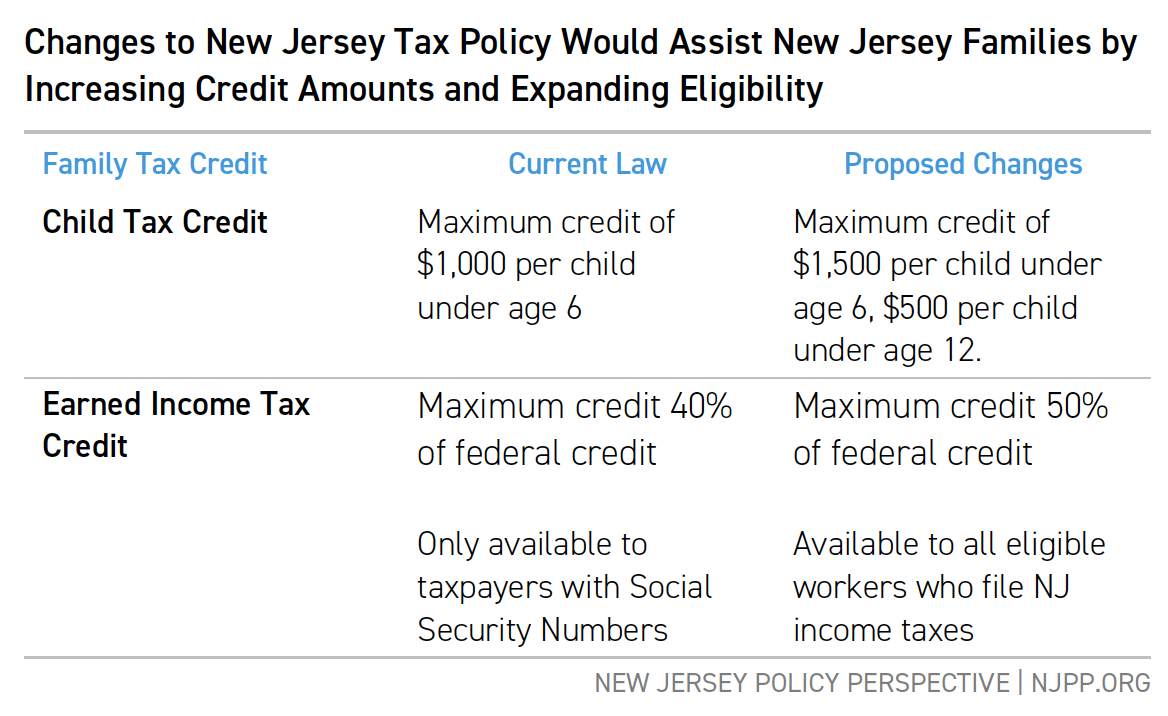
Thousands more New Jersey families could afford child care, groceries, and rent if state lawmakers expand two proven tax credits: the Child Tax Credit and the Earned Income Tax Credit.

Governor Sherrill opened her governorship with a call to keep “the door to opportunity open” for New Jersey families. Expanding these credits would deliver on that promise by putting money directly in families’ hands to help cover the cost of raising children – which the governor recognized by placing Child Tax Credit and Earned Income Tax Credit expansion in her campaign platform.

The Child Tax Credit and Earned Income Tax Credit have already put thousands of dollars back into New Jersey family bank accounts, reducing poverty and helping cover the cost of raising children. But these programs still leave out many households, due to child age, tax filer citizenship, or other eligibility requirements.

New Jersey Policy Perspective (NJPP) proposes common-sense changes that would assist New Jersey families directly by putting cash in their pockets. If Governor Sherrill wants to address affordability, expanding these credits is one of the more effective ways to help families meet everyday costs.

Increasing these credits and expanding eligibility would ensure all families can access opportunity.

Changes to New Jersey Tax Policy Would Assist New Jersey Families by Increasing Credit Amounts and Expanding Eligibility

These programs would expand affordability, fight poverty, and stimulate local economies.

Lawmakers can expand family tax credits to help families afford basic needs through existing programs, without creating new bureaucracy. While some changes could phase in gradually — as the state did with earlier Earned Income Tax Credit expansions — these credits can deliver relief quickly.

Governor-Elect Sherrill Will Inherit Budget Full of Hidden Dangers

TRENTON, NJ – JANUARY 15, 2026 — Governor-elect Mikie Sherrill is set to inherit a state budget full of hidden time bombs that threaten to explode in Fiscal Year 2027, according to a new analysis released today by New Jersey Policy Perspective.

With historic cash reserves and an improved credit rating, New Jersey’s finances appear healthy. In reality, the state faces billions in rising costs and revenue shortfalls that will severely constrain the incoming administration’s options.

“The next budget will be one of the most challenging in years,” said Peter Chen, senior policy analyst at NJPP and author of the report. “All the one-time fixes and federal money that helped balance recent budgets are gone. Governor-elect Sherrill will need to raise new revenue or make deep cuts just to maintain current services—before she can pursue any new initiatives.”

Five major budget pressures:

  • Stay NJ costs jump $900 million as the full annual cost of the senior property tax credit comes due
  • $1.5 billion structural deficit already exists, forcing the state to spend down reserves
  • School funding costs rise beyond inflation due to security and mental health requirements
  • Federal pandemic funding expires at the end of 2026, with no state replacement
  • State health benefit costs surge by 20 percent or more, adding hundreds of millions in costs


Federal cuts to Medicaid and other programs create additional uncertainty, potentially creating a $3.3 billion funding hole for hospitals and public health.

The report notes that the Murphy administration made important strides in fully funding schools and pensions. But those gains could be eroded without new revenue sources.

NJPP recommends focusing new revenue on concentrated wealth in individuals and large corporations, reducing expensive tax credit programs that benefit the wealthiest households and large multinational corporations, and exploring new options such as a wealth proceeds tax on net investment income.

“These budget time bombs are ticking,” Chen said. “The choices the Sherrill administration and legislature make in the coming months will determine whether New Jersey can maintain essential services and invest in its future, or whether we’ll see harmful cuts that set the state back.”

The full report is available at njpp.org.

###

Five Budget Time Bombs Facing the Next Governor

Governor-elect Mikie Sherrill is going to inherit a budget full of hidden dangers. On the surface, the state’s finances appear healthy: historic cash reserves, an improved credit rating, and on-target revenues. But beneath these gains lie budget time bombs that threaten the state’s fiscal stability and any new spending proposals.[1]

At a time when low- and middle-income families face rising costs and housing shortages, each of these time bombs will limit the state’s options for addressing residents’ needs.[2] These risks come on top of economic uncertainty, including a potential recession, which would reduce revenues and increase state costs.[3]

1. Existing structural deficit

Responsible budgeting requires sufficient revenue to fund schools, health care, and other essential services. In Fiscal Year (FY) 2026, New Jersey will generate $1.5 billion less in revenue than it needs to cover expenses.[4] As a result, the state will have to spend down its cash reserves, which have fallen each year from $10 billion in FY 2024 to less than $7 billion projected for FY 2026.[5] This imbalance means Governor-elect Sherrill will need to raise revenues or cut services simply to keep the state from going deeper into deficit.

Several factors drive this shortfall. State spending on property tax relief programs has grown from less than $1 billion to more than $4 billion in FY 2026, with future increases in Stay NJ (see below).[6] Expansions to economic development tax credits also reduce revenues. These credits give state tax dollars to corporations such as film studios or AI data centers for operations in New Jersey and remove billions in expected revenues.[7] Other increases in funding are mandatory to meet the state’s obligations to its pension funds and schools.[8]

NJPP has long advocated for increased progressive revenues to help close this gap.[9]

2. Ballooning Stay NJ costs

Housing affordability is a concern for seniors on fixed incomes. But Stay NJ, a new homeowner tax credit, threatens to dramatically increase the FY 2027 budget without targeting those who need help most. Stay NJ provides credits to homeowning seniors over age 65 with incomes up to $500,000.[10] In FY 2026, Stay NJ required only $280 million in state appropriations, despite an annual estimated cost of $1.2 billion.[11]

The cost was artificially low for two reasons:

  • The state had saved $320 million from prior years; and
  • FY 2026 only covers one half of calendar year 2026, meaning only half a year’s worth of payments will go out.


In FY 2027 neither condition will exist. The full $1.2 billion cost of the program will come due with no additional funding source.[12]

Hidden Costs Will Balloon Stay NJ Payments by $900 Million in FY 2027. Expected costs to state budget in fiscal years 2026 and 2027.

NJPP has identified potential savings by capping income for Stay NJ recipients to limit the program to seniors in need, rather than wealthy households.[13] These changes would reduce the program cost by more than $500 million.

Without reform, the Sherrill administration and legislature will face more than $900 million in additional Stay NJ costs in FY 2027.

3. School funding costs beyond inflation

New state requirements on schools have increased per-pupil funding needed to meet “adequacy,” the state’s standard for a thorough and efficient education.[14] Beyond these existing changes, voices from across the political spectrum have called for updating the school funding formula to more accurately reflect the cost of state standards and educating students from low-income families and who are multilingual learners.[15]

School funding represents the largest single expenditure in the state budget, with formula payments totaling $12 billion.[16] Even small changes in funding per pupil can result in large cost increases for the state.

School safety and mental health requirements are driving costs higher. The state’s 2026 Education Adequacy Report outlines changes that will increase funding needs.[17] Rising school safety concerns and concerns about youth mental health have driven the need for $14,972 in per-pupil funding for elementary students, an increase of more than seven percent from FY 2025 and 20 percent from FY 2023.[18] These increases fund one security guard per elementary school and mental health support for students.[19] Although these costs were included in the FY 2026 school aid calculations, many districts hit the six percent cap on aid increases, pushing additional costs to FY 2027.[20]

4. Loss of remaining pandemic-era funding

The fiscal cliff of expiring federal pandemic-era funding is creating funding gaps that the state will need to cover. For example, the expiration of federal funding for New Jersey Transit led to an enormous projected deficit that required the creation of the Corporate Transit Fee.[21]

Programs ranging from infrastructure to child care will lose federal funds when funding expires at the end of 2026.[22] These expirations have real effects, as the state’s child care subsidy programs were temporarily closed to new enrollees due to lack of funding and only recently began accepting new applications.[23]

New Jersey has also exhausted the last of its Debt Defeasance and Prevention Fund, a $10 billion reserve created to refinance high-interest debt during the pandemic.[24] The state used the fund for debt retirement and new capital improvement projects. But the state budget also transferred $1.1 billion to patch the structural deficit.[25]

With the fund empty, that revenue will not be available in future years, limiting the
state’s options.

5. Increasingly expensive state health benefits

The State Health Benefits Program provides health insurance for state and local government employees, with costs shared by employees and employers.[26] State actuarial reports recommend premium increases that would raise costs by 20 percent or more.[27] Even if proposed savings materialize, the state budget will face employee health benefit cost increases above inflation.[28]

Health benefits for active state employees and higher education employees cost $2.0 billion annually. Even small percentage increases can have large budget effects: a 10 percent increase in FY 2026 raised costs by over $180 million.[29]

Local government health plans face even steeper increases, creating potential state liability.[30] Although local government costs are not the state’s direct responsibility, problems with the local government health plan have previously required a temporary state bailout.[31]

One big unknown: the impact of federal cuts

Federal cuts present the largest uncertainty to the state’s budget. Some costs will fall to the state, even if the exact amount is unknown. For example, the state will have to implement a work requirement program for Medicaid by January 2026, which will require substantial appropriations and infrastructure.[32]

The state will also pay an additional $90 million in administrative costs for SNAP, with $78 million of those costs covered by counties, which administer SNAP in New Jersey.[33]

The Department of Human Services estimates that reductions in federal funding and federal restrictions on state health care revenues will result in $360 million in annual lost funding.[34] These policies will also force more residents to lose health care coverage. The result: a $3.3 billion annual cut in funding to hospitals and public health, which the state may have to backfill through charity care or other means.[35]

Beyond the tax and budget bill, the state faces decisions about whether to backfill federal cuts in other priorities. Keeping New Jersey at the forefront of scientific research may require state investment in cancelled federal biomedical research projects.[36] Delays in funding the Gateway tunnel project may lead to cost overruns and harm New Jersey’s economic growth.[37]

Conclusion

Governor Sherrill will inherit a budget full of time bombs. Despite steps by the Murphy administration to correct for the fiscal shortsightedness of past administrations by fully funding schools and pensions, the FY 2027 budget will face serious revenue shortfalls absent new revenues or drastic cuts. Depleting the state’s limited cash reserves will only deepen the crisis in future years.

There are solutions. NJPP has identified key revenue raisers that focus on concentrated wealth in individuals and large corporations.[38] Expensive tax credit programs that overwhelmingly benefit the already-wealthy can be reduced to increase revenue. New revenue, such as a wealth proceeds tax on net investment income, would also generate funds from wealthy individuals.[39]

Without new revenues, these budget time bombs will make maintaining current funding difficult, let alone any new initiatives the next governor may propose.


End Notes

[1] Ambrose, A. et al. New Jersey Policy Perspective. Sleepwalking Into Catastrophe. July 8, 2025.

[2] O’Dea, Colleen. NJ Spotlight News. NJ’s housing costs are skyrocketing. What will the next governor do? Oct. 20, 2025.

[3] Foster, S. Bankrate. The U.S. economy is slowing — and the nation’s top economists don’t expect it to improve much over the next year. Oct. 23, 2025.

[4] New Jersey Legislature. FY 2026 Appropriations Act Scoresheet. July 2, 2025.

[5] Total opening balance was $10.282 billion in FY 2024. New Jersey Legislature. FY 2024 Appropriations Act Scoresheet. July 19, 2023. Closing unreserved balance in FY 2026 is projected for $6.7 billion. New Jersey Legislature. FY 2026 Appropriations Act Scoresheet. July 2, 2025.

[6] Murphy, P., The State of New Jersey Budget in Brief, Summary of Budget Recommendations Fiscal Year 2026, Feb. 2025, pp. 12-13.

[7] State of New Jersey. Tax Expenditure Report, Fiscal Year 2026. 2025. pp. 10-11.

[8] The pension fund actuarial determined contribution has continued to increase. See New Jersey Legislature Office of Legislative Services. Analysis of the New Jersey Budget Interdepartmental Accounts Fiscal Year 2025-2026. May 2025. P. 6. School funding payments are adjusted by inflation and the Education Adequacy Report discussed below.

[9] Chen, P. New Jersey Policy Perspective. Fair and Square: Changing New Jersey’s Tax Code to Promote Equity and Fiscal Responsibility. Nov. 14, 2024.

[10] Pub. L. 2024, c. 88.

[11] S. 2026 (2025) pp. 280-282. Murphy, P. The State of New Jersey Budget in Brief, Summary of Budget Recommendations Fiscal Year 2026. Feb. 2025. pp. 12-13.

[12] Sobko, K. NorthJersey.com. Could federal budget chaos upend StayNJ property tax program for NJ seniors? (“Treasury officials confirmed there is no “buildup plan” for fiscal year 2027, estimated to cost $1.2 billion annually.”)

[13] Chen, P. New Jersey Policy Perspective. Course Correction: Preserving Senior Housing Affordability While Cutting Costs. Jun. 17, 2025.

[14] N.J. Stat. 18A:7F-46 (2025).

[15] Weber, M. New Jersey Policy Perspective. Resetting School Funding for New Jersey’s Next Decade. Oct. 24, 2025; Kudisch, B. NJ.com. Give N.J. schools more money to teach undocumented immigrants, county says. Feb. 16, 2025.

[16] Murphy, P. The State of New Jersey Budget in Brief, Summary of Budget Recommendations Fiscal Year 2026. Feb. 2025. pp. 15.

[17] New Jersey Dep’t of Education. FY2026 Education Adequacy Report. 2025.

[18] New Jersey Dep’t of Education. FY2026 Education Adequacy Report. 2025. pp. 4-5.

[19] New Jersey Dep’t of Education. FY2026 Education Adequacy Report. 2025. pp. 4-5.

[20] Kausch, K. & Kudisch, B. NJ.com. N.J. is pouring $12B into schools this year. See if your district is a winner — or facing cuts. Sep. 3, 2025.

[21] Reitmeyer, J. NJ Spotlight News. NJ Transit strike halted but financial questions remain. May 20, 2025.

[22] For a full list of spending, see New Jersey Recovery Plan, State and Local Fiscal Recovery Funds, 2025 Report.

[23] New Jersey Dep’t of Human Services, Division of Family Development. Child Care Assistance Program – Important Update. July 2025.

[24] Reitmeyer, J. NJ Spotlight News. Special reserve fund, set up to ease NJ’s bonded debt, runs dry. Aug. 11, 2025.

[25] Reitmeyer, J. NJ Spotlight News. Special reserve fund, set up to ease NJ’s bonded debt, runs dry. Aug. 11, 2025.

[26] New Jersey Division of Pensions and Benefits. Summary Program Description Guidebook For the State Health Benefits Program (SHBP) and the School Employees’ Health Benefits Program (SEHBP). Sept. 2025.

[27] New Jersey Dep’t of the Treasury. Press Release: AON Releases Recommended Rate Increases for State Health Benefits Plans for Plan Year 2026. Jul. 9, 2025.

[28] See Memorandum of Agreement between the Unions and the State of New Jersey. Sept. 4, 2025.

[29] New Jersey Legislature, Office of Legislative Services. Analysis of the New Jersey Budget: Interdepartmental Accounts. May 2025. pp. 25-27.

[30] New Jersey Dep’t of the Treasury. Structural and Financial Challenges in the State Health Benefits Program for Local Government. May 2025.

[31] P.L. 2024, c. 86.

[32] Hinton, E., Diana, A., and Rudowitz, R. KFF. A Closer Look at the Work Requirement Provisions in the 2025 Federal Budget Reconciliation Law. July 30, 2025.

[33] Department of Human Services, Division of Family Development. 2025 House Budget Bill Implications for the New Jersey Supplemental Nutrition Assistance Program (NJ SNAP). June 2025. P. 6.

[34] New Jersey Dep’t of Human Services, Statement from Human Services Commissioner Sarah Adelman on Impact of Medicaid and SNAP Cuts on NJ. July 3, 2025.

[35] New Jersey Dep’t of Human Services, Statement from Human Services Commissioner Sarah Adelman on Impact of Medicaid and SNAP Cuts on NJ. July 3, 2025.

[36] Stainton, L. NJ Spotlight News. Fears of Devastation Across NJ Health, Scientific Research if Trump Cuts Proceed. Feb. 12, 2025.

[37] Biryukov, N. New Jersey Monitor. Trump administration delays massive Hudson River rail project. Oct. 1, 2025.

[38] Chen, P. New Jersey Policy Perspective. Fair and Square: Changing New Jersey’s Tax Code to Promote Equity and Fiscal Responsibility. Nov. 14, 2024.

[39] Austin, S. and Davis, C. Institute on Taxation and Economic Policy. The Wealth Proceeds Tax: A Simple Way for States to Tax the Wealthy. Oct. 30, 2025.

NJPP Statement on Final Day of Legislative Action

On January 12, the New Jersey Legislature voted on more than 100 bills to close out the 2024-25 legislative session. Several bills will help protect New Jersey residents, while others weaken fiscal accountability and create challenges for the next legislature and administration.

In response to these bills, NJPP issues the following statements:

On paid family leave job protection expansion (A3451/S2950):

“No New Jersey worker should ever have to choose between bonding with their new child and keeping their job,” said NJPP Senior Policy Analyst Peter Chen. “This bill protects hundreds of thousands of workers from being fired or demoted for taking family leave. The next legislature should finish the job by closing remaining loopholes and extending these protections to everyone.”

On higher rates on heavy users of electricity (A5462/S4307):

“As New Jerseyans are already dealing with sky-high utility bills, this bill makes sure energy-intensive businesses, like data centers, pay for the costs they’re passing on to families. ” said Alex Ambrose, Policy Analyst at New Jersey Policy Perspective. “With PJM adding more data centers to the grid, New Jersey needs to protect residents from footing the bill. Governor Murphy must sign this to hold heavy electricity users accountable and keep costs down for families.”

On bills loosening and expanding corporate subsidy programs (A6298/S5025 and A6306/S5031):

“The state is staring down a deficit of more than $1 billion and working-class families are struggling to afford basics,” said Peter Chen, New Jersey Policy Perspective Senior Policy Analyst. “Now is not the time for more giveaways to politically connected corporations. A $300 million tax credit to the Prudential Center and loosened accountability rules chip away at the reformed 2020 corporate subsidy law. Governor Murphy should reject these bills and protect his legacy of reining in billionaire giveaways.”