
Based on Estimating the Costs of an Adequate Education in New Jersey[1] by Dr. Bruce D. Baker, University of Miami.
Key Findings
|
Every New Jersey student deserves access to quality education, no matter their income, race, gender, or disability. But a Black high school student, enrolled in a high-poverty district and in crisis, will have less access to a mental health professional than students in more affluent districts.[2] And a first-grader who speaks Spanish at home may have larger class sizes than students in nearby wealthier towns, preventing her from learning English as fast as she could.[3]
To deliver on the promise of a quality education, schools need enough funding to help students meet the state’s academic standards.[4] However, many New Jersey school districts, especially those in high-poverty communities, lack the resources they need to provide all students with an education that meets the state’s new, higher standards.[5] The state can fix this problem by increasing funding for school districts so they have the resources they need to educate their students properly.
This summary highlights key findings from Estimating the Costs of an Adequate Education in New Jersey by Dr. Bruce D. Baker.
A new report shows how New Jersey’s current school funding system falls short and outlines steps to fix it. The report provides a road map to guide the state toward properly funding its schools, as required by the New Jersey Constitution.
The report shows:
- New Jersey ranks among the top states on national tests when looking at average student performance. This success stems largely from the state’s strong commitment to funding many of its schools adequately. Unfortunately, a large gap remains between test scores of students from low-income families and their wealthier peers.
- Schools serving more students in poverty or English Language Learners (ELL) are not getting enough funding to close this opportunity gap.
- This funding shortfall comes from problems with the state’s school funding formula. The current formula uses outdated assumptions to determine how much extra funding a district receives for each student who qualifies for free or reduced-price lunch, a measure of economic need.
- Under the current school funding system, most Black and Latinx/Hispanic students attend schools that lack the resources they need, seriously harming their educational opportunities.
- Fixing the formula to properly fund schools serving students from low-income families would cost about $3.5 billion; this would only be a nine percent increase in the total budgeted spending of New Jersey school districts for 2025-26.[6] This investment would bring total school spending close to what New Jersey spent before the 2008 recession, measured as a share of the state’s economy.[7]
High Test Scores for New Jersey Students, But an Opportunity Gap Remains
New Jersey ranks among the top states for school funding, spending a larger share of its economy on education than most states (see table below). However, like the rest of the nation, New Jersey’s funding dropped over recent years, with a temporary increase during the pandemic.[8] This pattern shows that the state can afford to increase school funding, climbing back to the funding levels it had before the 2008 recession.

New Jersey’s Strong Funding Yields High Test Scores
New Jersey’s strong school funding has resulted in higher test scores compared to other states, even after the nationwide drop in test scores following the Covid pandemic. For example, math scores in Grade 8 remain among the highest in the nation, even after the drop following the pandemic.
While this success should be celebrated, we must remember that these test scores are averages: many students score higher than average, but many score below. Students in poverty continue to fall behind their peers. For example: while average Grade 8 math scores in New Jersey are high, the scores for economically disadvantaged students have consistently been below those of their more affluent peers.
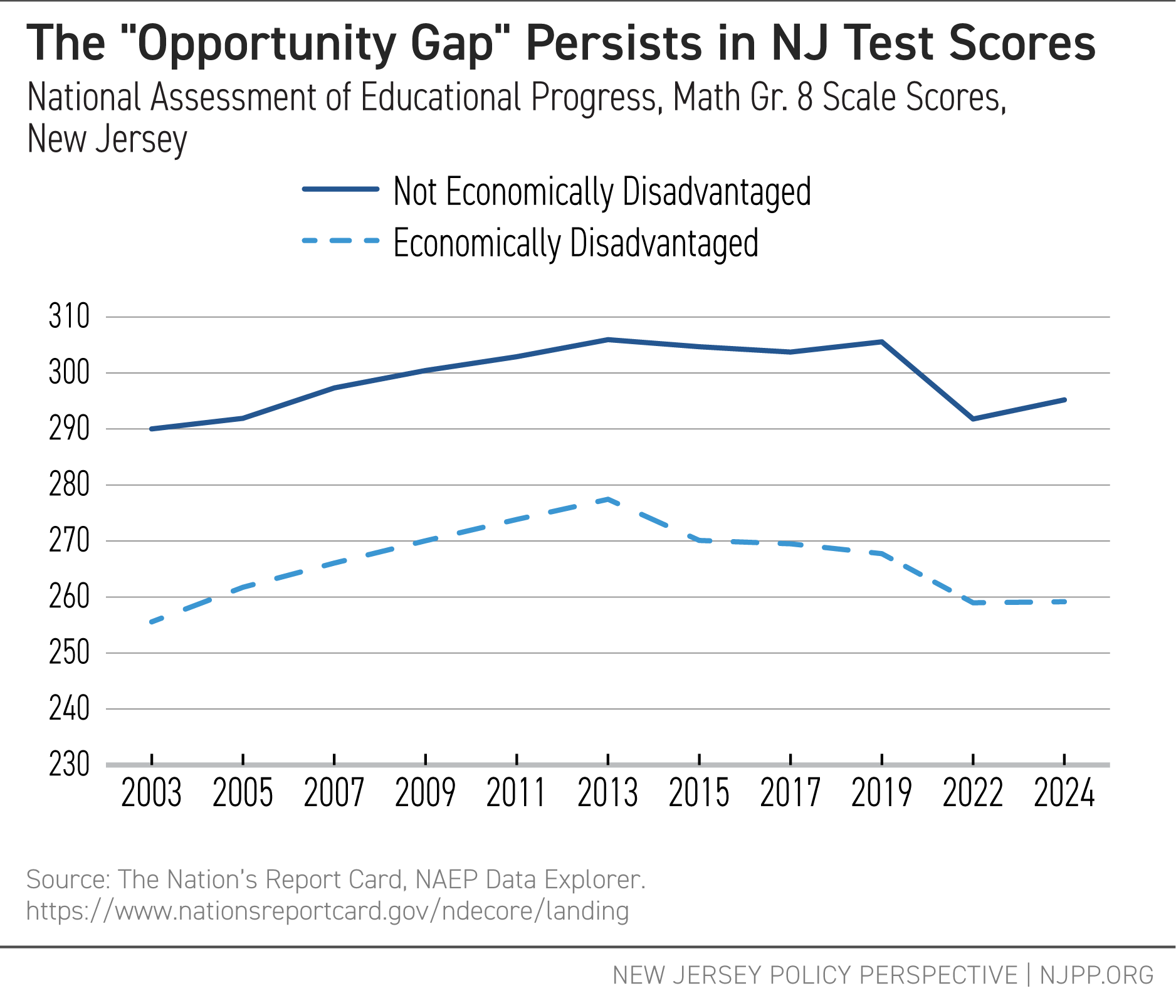
These persistent gaps exist because schools serving students from low-income families lack the resources they need. Closing the opportunity gap between more and less affluent students should be a key goal of the state. That can happen only when all schools are funded properly.
Schools Serving Students Facing Economic Challenges Aren’t Getting Enough Funding
Why Additional Funding Matters
Students from low-income families need additional support to succeed in school. Smaller class sizes, trained education specialists, targeted programs, classroom supports, and extra services all require additional funding. Without these resources, students from low-income families will not have educational opportunities that equal their classmates from higher-income families.[9]
How the Formula Should Work
New Jersey’s school funding formula is based on providing additional funding for students if they qualify for free or reduced-price lunch (a measure of poverty), or if they speak English as a second language at home.[10]
In theory, the school funding formula should provide significantly more money to schools serving more students in poverty. The formula includes extra funding for students who qualify for free or reduced-price lunch (FRPL), providing an additional 47 to 57 percent more funding per pupil. English Language Learners also receive an extra 50 percent more funding.
How the Formula Actually Works
In reality, the funding difference between high- and low-poverty schools is far too small. For every 10-percentage point increase in students qualifying for free and reduced-price lunch, schools spend only about $300 more per pupil on average. The same increase in English Language Learners results in about $400 more spending per pupil on average.[11]
Currently, for each student who qualifies for free or reduced-price lunch, schools receive only 21 percent more funding than they receive for a student who doesn’t qualify. This is far less than the 47 to 57 percent the formula intends. It’s also less than what the data says is needed to achieve rigorous outcomes.[12]
Changing the Funding Formula to Get More Money Where It Is Needed
The report uses actual data on school spending, student characteristics, and test outcomes to calculate what funding is needed for all students to achieve strong results on state tests. The report calculates how much funding would raise the statewide test scores by an amount equal to the current gap between students from the wealthiest and poorest families.[13]

To meet this goal, schools should receive much more funding for each student from a low-income family.[14] Currently, New Jersey schools spend an average of $2,960 more per student who qualifies for free or reduced-price lunch. To reach higher standards for all students, this amount should increase by $5,290 to a total of $8,880 per student.[15]
What Proper Funding Would Provide
The additional $5,290 per student from a low-income family would allow schools to:
- Reduce class sizes so teachers can give each student more attention
- Hire reading specialists and math coaches to help struggling students
- Provide after-school tutoring and summer programs to prevent learning loss
- Offer counselors and social workers to address barriers to learning that happen outside the classroom
- Update textbooks, technology, and facilities to create better learning environments
Many of these resources are standard in schools serving wealthier students but often missing in schools serving low-income communities.
Students of Color Are More Likely to Be in Schools Without Enough Funding
New Jersey’s current school funding system severely disadvantages students of color. The majority of Black and Latinx/Hispanic students attend schools that lack adequate funding.[16] As a result, outcomes for these students suffer: Black and Latinx/Hispanic students have less access to advanced courses, experienced teachers, updated technology, and support services. These resource gaps directly limit their educational opportunities and future economic prospects. This racial and ethnic imbalance must be addressed by reforming the state’s school funding formula.

Put another way: a Black or Latinx/Hispanic student in New Jersey has about a four in five chance of attending an underfunded school, while a white student has about a one in two chance. This difference reflects decades of policy decisions that have systematically underinvested in communities of color.[17]
Closing the Gap Costs $3.5 Billion, But NJ Can Afford It
Funding schools serving students in poverty properly requires tripling the additional funding these schools currently receive for each student from a low-income family who is enrolled.[18] With approximately 586,000 students who qualify for free or reduced-price lunch, the total investment would be about $3.5 billion each year.[19] To put this into perspective, New Jersey’s total state budget for fiscal year 2025 is about $59 billion.
This improvement represents about four-tenths of a percentage point of the state’s total economy.[20] Total K-12 spending would remain in line with levels before the Great Recession of 2008.[21]
More analysis will help figure out the exact formula changes needed. Until then, New Jersey policymakers must move urgently to take the following steps:
- Change the current formula to increase the additional per-student funding for students from low-income families. Currently, each low-income student enrolled in a district raises per pupil spending $2,960; this amount should be increased to $8,880. This amount can be adjusted after conducting additional research.
- Keep this higher funding level over the long term.
- Remove the sliding scale that provides different amounts based on district poverty concentration.
The path forward is clear: New Jersey must return to previous levels of funding to fulfill its constitutional mandate to provide all students with an education that prepares them to succeed.
End Notes
[1] Baker, B.D. Estimating the Costs of an Adequate Education in New Jersey. Trenton, NJ: New Jersey Policy Perspective. 2025.
[2] Weber, M. A. New Jersey’s Black Students Suffer a Decline in Access to School Mental Health Staff. New Jersey Policy Perspective.
[3] Weber, M.A. The Consequences of School Underfunding. New Jersey Policy Perspective.
[4] Baker, B. D., & Knight, D. Does money matter in education? Washington, DC: Albert Shanker Institute. 2025.
[5] Baker, B.D., & Weber, M.A. New Jersey School Funding: The Higher the Goals, the Higher the Costs. Trenton, NJ: New Jersey Policy Perspective. 2022.
[6] Total expenditures for 2025-26 based on “Expenditures Net of Transfers” from the NJDOE’s User Friendly Budgets. https://www.nj.gov/education/budget/ufb/
[7] Baker, B.D. Estimating the Costs of an Adequate Education in New Jersey. Trenton, NJ: New Jersey Policy Perspective. 2025. p. 3.
[8] Baker, B.D., Di Carlo, M, & Weber, M.A. The Adequacy and Fairness of State School Finance Systems (7th edition), p. 8-11. Washington, D.C.: The Shanker Institute. 2025.
[9] Baker, B. D., & Knight, D. Does money matter in education? Washington, DC: Albert Shanker Institute. 2025.
[10] For an in-depth discussion of the School Funding Reform Act’s (SFRA) funding formula, see: Baker, B.D., & Weber, M.A. Unlocking Academic Success: Revitalizing New Jersey’s School Funding Formula for Student Achievement. 2023.
[11] Baker, B.D. Estimating the Costs of an Adequate Education in New Jersey. Trenton, NJ: New Jersey Policy Perspective. 2025. p. 26. Table 3, “spend_2” shows the model estimate for increases in spending; the figures are divided by 10 to show the increase in spending given a 10-percentage point increase in either FRPL or ELL students.
[12] Regarding the difference between the implicit FRPL weight and the School Funding Reform Act (SFRA) formula weight: Many affluent districts spend well above the adequacy target set in the SFRA formula. The implicit weight is based on the actual differences in spending between districts: if districts with fewer FRPL students spend more than their adequacy target, the implicit FRPL weight will decrease to a level below the weight used in the SFRA formula. Put simply: the implicit weight is lower than the formula weight because low-FRPL districts spend more than their SFRA adequacy amount. It is also possible some high-FRPL districts are not spending what the formula says they should, possibly because they aren’t receiving all the local or state revenue the formula says they should receive. Further research is needed to determine the exact causes of this discrepancy.
[13] Baker, B.D. Estimating the Costs of an Adequate Education in New Jersey. Trenton, NJ: New Jersey Policy Perspective. 2025. p. 28. Formally, the report’s desired outcome is to raise the average state test score 1.0 standard deviations (1.0 SD). Several studies have found the achievement gap between 90th percentile household income students and 10th percentile household income students is on the order of 1.0 SD. (Reardon, S.F. The Economic Achievement Gap in the US, 1960-2020:Reconciling Recent Empirical Findings. CEPA Working Paper No. 21.09. 2021. Retrieved from Stanford Center for Education Policy Analysis) The increase in funding would be due to raising the free and reduced-price lunch weight; consequently, the additional funding would be concentrated in higher-poverty districts, as would be the ensuing increase in test scores. Raising the average state test score by 1.0 SD would, therefore, be closing the opportunity gap.
[14] The School Funding Reform Act (SFRA) formula weights FRPL students between 0.47 and 0.57 based on the concentration of economic disadvantage in their school district: more concentrated disadvantage leads to a higher weight. The report’s analysis suggests this sliding scale should be replaced with a single, higher weight for all FRPL students.
[15] Baker, B.D. Estimating the Costs of an Adequate Education in New Jersey. Trenton, NJ: New Jersey Policy Perspective. 2025. Table 3, p. 26 (spending model “spend_2”). The calculation here takes the ratio of the estimated weight to the implicit weight (0.63 / 0.21 = 3.0) and multiplies that by the “actual” spending found in the model estimate.
[16] Baker, B.D. Estimating the Costs of an Adequate Education in New Jersey, Trenton, NJ: New Jersey Policy Perspective. 2025. pp. 29-30.
[17] Baker, B.D. & Weber, M.A. Separate and Unequal: Racial and Ethnic Segregation and the Case for School Funding Reparations in New Jersey. 2021.
[18] “Tripling” the weight means tripling the actual extra amount spent on a student in economic disadvantage over what is currently spent. The amount the weight would need to be changed in the SFRA formula to achieve this result would likely be different.
[19] NJDOE Fall Enrollment Reports, 2024-25.
[20] Bureau of Economic Analysis, “GDP by State.”
[21] As the table above shows, spending on K-12 education was 4.6% in 2020, 4.2% in 2021, and 5.0% in 2022 (the latest figure available). The wide swings in the latest years are due to effects from the pandemic; it is likely the effort figure will drop in 2023. Yet even if it doesn’t, a 0.4 percentage point increase still puts the effort figure near where it was before the Great Recession.