A Wealth of Revenue: How Taxing Wealth Proceeds Can Help Balance New Jersey’s Budget

Adopting a wealth proceeds tax based on federal law could raise more than $1.1 billion to help balance New Jersey’s state budget, while affecting only a small share of the state’s wealthiest households. New Jersey policymakers could direct those funds toward education, health care, and other investments families need.

A core problem facing states is the limited ability to tax wealth, as opposed to income:

  • Income is the money paid to a household, such as wages or salary, interest, or business profits.
  • Wealth is the total value of all a household’s assets minus its debts, including the value of real estate, stocks, investments, and trusts, while subtracting debt such as mortgages or student loans.

 
Traditional tax systems tax income or sales transactions but have a difficult time taxing the wealth increases of households with high incomes. Put another way, Jeff Bezos’s wealth doesn’t come from his annual salary, but from the increasing value of his stake in Amazon and other companies. These types of increases in wealth are often taxed at preferential rates, when they are taxed at all.

New Jersey can take one step to solve this problem by adopting a wealth proceeds tax, based on the federal tax code. Rather than a direct tax on wealth, the federal government currently applies a 3.8 percent “net investment income tax” to the passive income generated by interest, dividends, and capital gains — the “proceeds” of wealth.

Without requiring burdensome new regulations, New Jersey could adopt the federal definition and incorporate it into its tax filing process. Minnesota already set a precedent in 2023 by doing so with a 223-word bill that codified this new revenue source. This would improve on New Jersey’s existing tax system, which treats capital gains such as stock sales as regular income.

Adopting a 4 percent tax on wealth proceeds based on the federal definition could raise more than $1.1 billion — a much-needed source of revenue at a moment when the state faces more than $1 billion in structural deficits heading into Fiscal Year 2027.

Only about 6.5 percent of New Jersey households would be affected by this change, with two-thirds of those households bringing in more than $1 million annually. More than 93 percent of New Jersey households would see no change at all.

As New Jersey policymakers consider revenue options, a wealth proceeds tax is a useful tool to raise revenue that focuses on the wealthiest individuals, rather than working-class and middle-class families.

Families Still Pay Millions to Stay Connected to Loved Ones in Prison

A phone call home can mean everything for the thousands of people incarcerated in New Jersey’s prisons and jails. Staying connected improves mental health, strengthens family ties, and helps people prepare for a successful return to their communities. But for many, these calls come at a high and unjust price. In 2024, NJPP released a report detailing these costs and who they harm most.

Historically, private companies ViaPath and JPay held monopoly contracts with New Jersey prisons and jails, charging families millions of dollars each year just to stay in touch with their loved ones. The scale of the problem is immense: in 2023 alone, these two companies generated over $7 million from phone calls, electronic messages, and video calls in state prisons.[1] Phone calls alone made up nearly three-quarters of that revenue, with ViaPath collecting almost $5.3 million from incarcerated New Jerseyans.[2]

The New Jersey Department of Corrections (NJDOC) has since renegotiated its contract, ending its relationship with JPay and securing new, lower rates with ViaPath.[3]

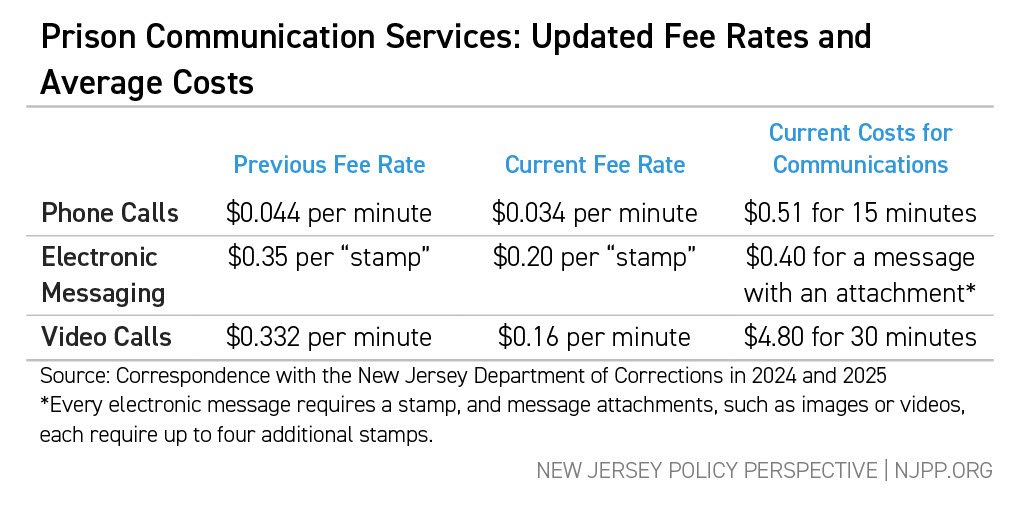
A table showing updated fees and average costs of prison communication services

Despite the new rates, families across New Jersey are still projected to pay an astonishing $6.6 million annually just to stay connected to their loved ones.[4]

That is roughly 65 percent of the total wages paid to incarcerated people in 2022, who typically earn just $1.60 to $7.50 a day.[5] For the many people in prison who earn the lowest daily pay rate, making a phone call home or sending an email costs a significant portion of their earnings. As a result, most of these costs fall on loved ones.

The financial burden is heaviest for women of color, specifically Black women, who are disproportionately the ones paying these costs.[6] Nationally, one in three families with an incarcerated loved one goes into debt trying to afford prison phone calls and messages.[7] In New Jersey, where the Black-white incarceration disparity is the highest in the nation, this is not just an economic issue but a racial justice one.[8]

Other states and cities have recognized that charging families for prison communication is both cruel and counterproductive. In recent years, New York, Massachusetts, Minnesota, and several other states have eliminated fees entirely.[9] New Jersey should not lag behind. At a cost of less than half a percent of the state’s $1.1 billion corrections budget, New Jersey could cover communication costs for every person incarcerated in a state prison and end these predatory practices.[10]

Keeping families connected is about more than fairness — it is about building safer, stronger communities. Regular communication reduces recidivism, supports children of incarcerated parents, and helps ensure that people return home ready to succeed.[11] No one should be forced to choose between debt and family ties.

New Jersey should make prison phone calls, emails, and video calls free of charge. Families have carried this cost for too long.


End Notes

[1] Ubel, M. Prison Profiteers: How Private Companies Profit From Prison Phone Calls and Harm New Jersey Residents. New Jersey Policy Perspective. (2024). Number has been adjusted for inflation.

[2] Ubel, M. Prison Profiteers: How Private Companies Profit From Prison Phone Calls and Harm New Jersey Residents. New Jersey Policy Perspective. (2024). Number has been adjusted for inflation.

[3] New Jersey Department of Corrections response to FY26 budget hearing questions. 2025. Pg. 27.

[4] Based on fiscal analysis done by Worth Rises using average DOC and jail population data and 2024 usage data provided by DOC including taxes and deposit fees paid by families. This figure only includes the costs associated with prisons ($6.6 million). The cost to families with loved ones in county jails would be an additional $6.5 million. Methodology is on file with author.

[5] Total wages in 2022 have been adjusted for inflation. New Jersey Department of Corrections response to FY24 budget hearing questions. 2023. Pg. 21; New Jersey Department of Corrections response to FY26 budget hearing questions. 2025. Pgs. 22-23.

[6] deVuono-powell, Saneta, et al. Who Pays? The True Cost of Incarceration on Families. Ella Baker Center, Forward Together, Research Action Design. Sep. 15, 2015. Pg. 9.

[7] deVuono-powell, Saneta, et al. Who Pays? The True Cost of Incarceration on Families. Ella Baker Center, Forward Together, Research Action Design. Sep. 15, 2015. Pg. 9.

[8] Nellis, A. The Color of Justice: Racial and Ethnic Disparity in State Prisons. The Sentencing Project. Oct. 2021. Pg. 10.

[9] Watford, A. New York Becomes Latest State To Offer Free Phone Calls In Prisons. Stateline. Aug. 1, 2025.

[10] Based on fiscal analysis done by Worth Rises which estimates it would cost the state as little as $1.5 million to provide fully free communications across New Jersey state prisons. Methodology on file with author. Fiscal Year 2025-2026 Analysis of The New Jersey Budget: Department of Corrections And State Parole Board. New Jersey Office of Legislative Services. Apr. 2025. Pg. 2.

[11] Wang, L. Research Roundup: The Positive Impacts of Family Contact For Incarcerated People And Their Families. Prison Policy Initiative. Dec. 21, 2021; Worth Rises. The Prison Industry: How It Started, How It Works, and How It Harms. Dec. 2020. Pg. 52.

Who Pays for a Per-Employee Medicaid Fee?

A fee tied to individual employees’ health coverage will encourage employers to find loopholes and harm workers.

That’s the core problem with Governor Mikie Sherrill’s proposal to charge large employers based on how many of their workers are enrolled in NJ FamilyCare, the state’s Medicaid program. In her first state budget address, Gov. Sherrill proposed collecting fees from employers who have 50 or more workers with Medicaid coverage. The fee would reportedly charge $325 to $725 per employee, depending on the number of employees.

In the wake of deep federal cuts to Medicaid, states — including New Jersey — are scrambling to protect their investments in affordable health care. Those revenue-raising proposals should focus on ensuring that wealthy individuals and corporations pay for health care, while protecting residents enrolled in Medicaid.

Support for Health Care Programs Must Avoid Punishing Covered Workers

While an assessment on employers to pay for employees’ Medicaid coverage might sound like an attractive way to tax big businesses to support health care, the problems with a fee structured as a charge per employee raise serious concerns. A fee designed around individual employees’ coverage in NJ FamilyCare could:

  • Discourage employers from hiring workers who have or might enroll in NJ FamilyCare. Workers who need health coverage most would face the greatest barriers to employment. Employers could screen out job applicants they perceive as likely to need Medicaid, creating discrimination against workers from low-income backgrounds.
  • Cause workers and their families to hesitate to enroll in NJ FamilyCare, even when they are eligible. Similar to immigrant residents’ fears about public charge rules — rules that can deny visas and green cards based on expected enrollment in certain government programs — this unfairly puts the burden on residents to take unnecessary risks in order to avoid even the potential of punishment.
  • Create and worsen stigma around NJ FamilyCare and other state-run health care programs. This could push residents toward employer-based health coverage, despite its drawbacks like its varying quality and inability to transfer with job changes. This concern affects workers in low-wage jobs and temporary positions most.

 
This fee structure treats workers with NJ FamilyCare as a problem to solve rather than residents seeking quality coverage. It pressures workers to accept potentially lower-quality coverage options through their employer. Workers might also feel stuck, tied to any job they have coverage for, even if they are enduring poor working conditions and are eligible for Medicaid. Ultimately, the fee does nothing to expand coverage options to help the 727,000 uninsured New Jerseyans, nor does it improve the affordability of coverage for workers.

Existing State Tools Can Build Broad-Based Support for NJ FamilyCare

At a time when costs are rising and families across the state are struggling with affordability, state leaders should focus on ensuring corporations and wealthy residents are paying their fair share for public goods. This includes building broader, more sustainable funding support for NJ FamilyCare and expanding coverage options for all residents. Long-term support for residents’ health care would eliminate funding loopholes and make it easier, rather than more difficult, for New Jerseyans to enroll in coverage and remain covered, even when life circumstances change.

New Jersey already has the tools to more sustainably fund NJ FamilyCare in the long term. Using these tools to build a broader base of support for programs would be more efficient and effective in ensuring long-term fiscal stability. In particular, policymakers should increase revenue from the Corporation Business Tax by closing loopholes, eliminate unnecessary tax credits for big businesses, and discourage and punish tax avoidance strategies. These efforts could raise similar amounts of revenue to fund Medicaid and improve the state’s fiscal stability through an uncertain future.

Opening the Door to Opportunity with Family Tax Credits

Thousands more New Jersey families could afford child care, groceries, and rent if state lawmakers expand two proven tax credits: the Child Tax Credit and the Earned Income Tax Credit.

Governor Sherrill opened her governorship with a call to keep “the door to opportunity open” for New Jersey families. Expanding these credits would deliver on that promise by putting money directly in families’ hands to help cover the cost of raising children – which the governor recognized by placing Child Tax Credit and Earned Income Tax Credit expansion in her campaign platform.

The Child Tax Credit and Earned Income Tax Credit have already put thousands of dollars back into New Jersey family bank accounts, reducing poverty and helping cover the cost of raising children. But these programs still leave out many households, due to child age, tax filer citizenship, or other eligibility requirements.

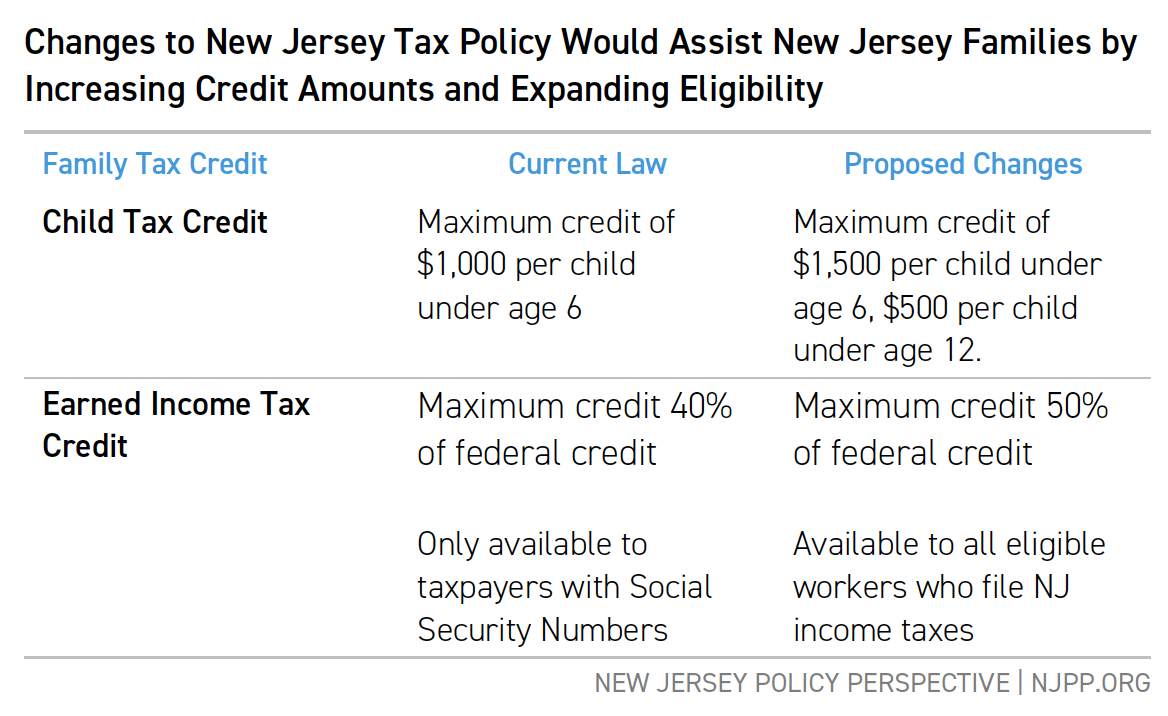
New Jersey Policy Perspective (NJPP) proposes common-sense changes that would assist New Jersey families directly by putting cash in their pockets. If Governor Sherrill wants to address affordability, expanding these credits is one of the more effective ways to help families meet everyday costs.

Increasing these credits and expanding eligibility would ensure all families can access opportunity.

Changes to New Jersey Tax Policy Would Assist New Jersey Families by Increasing Credit Amounts and Expanding Eligibility

These programs would expand affordability, fight poverty, and stimulate local economies.

Lawmakers can expand family tax credits to help families afford basic needs through existing programs, without creating new bureaucracy. While some changes could phase in gradually — as the state did with earlier Earned Income Tax Credit expansions — these credits can deliver relief quickly.

Census 2024: Economic Gains Bypass Many New Jersey Communities

While the state saw modest improvements in poverty and income levels, the data reveals persistent differences and growing concerns. Under-resourced communities continue to be disproportionately harmed by economic obstacles. In a state as wealthy as New Jersey, economic mobility is not a privilege — it’s a right everyone deserves.

Gender and Racial Disparities Persisted in 2024

Last month, the U.S. Census Bureau released new data offering insights into New Jersey residents’ economic security, confirming what many already know: poverty is not experienced equally. Women and communities of color continue to face high rates of poverty, highlighting the range of economic outcomes across the state.

According to the 2024 American Community Survey (ACS), New Jersey’s poverty rate stood at 9.2 percent in 2024.[i] It remains higher than the pre-recession level of 8.7 percent in 2008.[ii] Although lower than the national poverty rate of 12.1 percent and the prior year’s rate (9.7 percent), nearly 860,000 New Jersey residents lived below the Federal Poverty Level (FPL), the federal government’s official poverty measure.[iii] In 2024, the FPL was $25,820 for a family of three.[iv]

This threshold, however, does not adequately measure economic realities in high-cost states like New Jersey. Legal Services of New Jersey’s NJ True Poverty Tracker Report finds that a family of three needs an income closer to 300 percent of the FPL to afford basic necessities and live with dignity without making trade-offs between essentials.[v]

These topline figures fail to reflect the depth of economic disparity. Gender and racial differences persisted in 2024. Women experienced a poverty rate of 10.1 percent, compared to 8.2 percent for men.[vi] Black, American Indian and Alaska Native, and Latinx/Hispanic residents were nearly two to three times more likely to live in poverty than white (5.7 percent) and Asian (6.2 percent) residents.[vii]

Too Little Progress in Child Poverty Reduction

In 2024, 11.4 percent of children in New Jersey lived below the poverty level, a slight improvement from the previous year, yet still higher than the state’s overall poverty rate.[viii] This means children were disproportionately affected by economic insecurity. Because children rely on the financial stability of their caregivers, household poverty directly becomes child poverty. This effect intensifies in families with multiple dependents or single parents. When families struggle to afford housing, food, healthcare, and childcare, children often bear the brunt of those trade-offs.

More than 230,000 children lived in poverty.[ix] This number, a reflection of real lives, is unacceptable. Research shows that childhood poverty has long-term consequences, linked to harmful effects on educational attainment, health outcomes, and lifetime earnings.[x] Tracking child poverty is essential not only to understand the scope of economic inequality, but to ensure that policy prioritizes the well-being of the next generation. Every child deserves the opportunity to grow up with security, dignity, and access to opportunity.

These patterns in child poverty are deeply intertwined with broader patterns of household income. Families struggling to meet basic needs often do so on limited earnings, and income inequality across racial and ethnic lines continues to shape which children are most affected. While overall median household income rose to $104,294, not all New Jerseyans benefited from these gains equally.[xi]

Black, Latinx/Hispanic, and American Indian and Alaska Native families are still earning less than white and Asian families. These persistent income gaps help explain why child poverty remains disproportionately high in communities of color, despite the state’s economic growth.

 New Jerseyans Share Outlooks on Economic Conditions

In the most recent U.S. Census Bureau Household Pulse Survey (HPS), which includes data collected between August 20 and September 16, 2024, one-third of respondents reported difficulty paying for usual household expenses and nearly four in five reported rising prices for goods and services.[xii]

The 2024 HPS estimates demonstrate that despite overall improvements in general economic indicators, many New Jerseyans were left behind or continue to face financial strain. Data collected also reveals a wide range of experiences across the state, further suggesting that economic conditions had not improved uniformly and many struggled to keep up with the burden of inflation and high cost of living.

Action Needed to Build an Economy for the Many

The latest Census data highlights the urgent need to strengthen New Jersey’s safety net for families facing economic insecurity. In 2024, the state raised its minimum wage to $15.13 per hour, and recipients of the NJ Child Tax Credit received larger refunds.[xiii] These measures offered meaningful relief and marked progress, but the gains remain modest and uneven. Working-class communities, in particular, continued to face disproportionate hardship.

To build an economy that works for everyone, New Jersey should strengthen policies that put cash directly into people’s hands. Building up existing supports, expanding proven programs, and exploring bold approaches (such as guaranteed income) can buffer families against future shocks.[xiv] With a potential recession on the horizon and federal rollbacks threatening core assistance programs, it’s more critical than ever to ensure New Jerseyans have the resources they need to thrive.


End Notes

[i] NJPP Analysis of Census Bureau – American Community Survey. Table S1701 ACS 1-Year Estimates 2024.

[ii] U.S. Census Bureau. American Community Survey, 2007 and 2008; and Puerto Rico Community Survey, 2007 and 2008.

[iii] NJPP Analysis of Census Bureau – American Community Survey. Table S1701, ACS 1-Year Estimates 2024 (United States); NJPP Analysis of Census Bureau – American Community Survey. Table S1701, ACS 1-Year Estimates 2023 (New Jersey); NJPP Analysis of Census Bureau – American Community Survey. Table S1701, ACS 1-Year Estimates 2024 (New Jersey).

[iv] U.S. Department of Health and Human Services, Office of the Assistant Secretary for Planning and Evaluation. 2024 Poverty Guidelines.

[v] Legal Services of New Jersey, Poverty Research Institute. New Jersey True Poverty Tracker: A Report on Populations Experiencing Deprivation in New Jersey. 2022.

[vi] NJPP Analysis of Census Bureau – American Community Survey. Table S1701, ACS 1-Year Estimates 2024.

[vii] Note that the margins of error for smaller populations, such as American Indian and Alaska Native, are higher and therefore, there is a larger possible variation. NJPP Analysis of Census Bureau – American Community Survey. Table S1701, ACS 1-Year Estimates 2024.

[viii] NJPP Analysis of Census Bureau – American Community Survey. Table S1701, ACS 1-Year Estimates 2024.

[ix] NJPP Analysis of Census Bureau – American Community Survey. Table S1701, ACS 1-Year Estimates 2024.

[x] New Jersey State Policy Lab at Rutgers University. Prevalence of Child Poverty in New Jersey. 2022.

[xi] Note that the margins of error for smaller populations, such as American Indian and Alaska Native, are higher and therefore, there is a larger possible variation. NJPP Analysis of Census Bureau – American Community Survey. Table S1903, ACS 1-Year Estimates 2024.

[xii] NJPP Analysis of Census Bureau – Household Pulse Survey Interactive Tool, “Difficulty Paying for Usual Household Expenses.” August 20th – September 16th, 2024; NJPP Analysis of Census Bureau – Household Pulse Survey Interactive Tool. “Price Increases for Goods and Services.” August 20th – September 16th, 2024.

[xiii] New Jersey Department of Labor & Workforce Development. New Jersey’s Minimum Wage Chart. 2020; New Jersey Treasury, Division of Taxation. Child Tax Credit. 2025.

[xiv] Chen, P. Freedom from Want: An Economic Guarantee for New Jersey’s Kids. New Jersey Policy Perspective. September 2025.

A LI“HEAP” of Trouble: Slashing Federal Utility Assistance Will Hurt New Jersey Seniors, Families, and Working-Class Households

With double-digit energy cost increases expected to hit electric bills this summer, utility affordability is front of mind for many New Jersey families and lawmakers. For hundreds of thousands of New Jerseyans, a federal program called the Low Income Home Energy Assistance Program (LIHEAP) has helped reduce energy costs by hundreds of dollars each year, especially for those who spend a high percentage of their income on utilities.

Now, LIHEAP faces multiple threats. On April 1, the Trump administration laid off all federal Department of Health and Human Services staff administering the program, leaving billions in funds unable to be sent to states. A leaked draft budget for the department proposes eliminating the entire program’s funding.

Here is what’s at stake for New Jersey. LIHEAP helps over 240,000 households pay their energy bills, including:

  • 56,000 households with a person with a disability
  • 114,000 households with a senior member
  • 36,000 households with a child under age 6


For perspective, this is approximately the same number of households as all of Ocean County (241,000 households).

LIHEAP distributes $212 million to help New Jersey families with their energy bills and to buy more energy-efficient heaters or air conditioners to save them money.

Federal LIHEAP funds go to the New Jersey Department of Community Affairs, which works with local community groups to help eligible people apply for the program. But this process relies on payment processing and reimbursement from the federal government, which staff reductions would threaten.

At a time when utility bills are already rising and the weather in New Jersey is getting more extreme due to climate change, now is the time to protect and expand LIHEAP to get it in the hands of even more eligible families, not cut funding at the federal level and make energy less affordable.

Dismantling U.S. Dept. of Ed. is Costly and Inefficient for New Jersey

A strong education system is fundamental to opportunity, economic mobility, and the long-term success of our communities. The Trump Administration’s efforts to weaken or dismantle the U.S. Department of Education (USED) raise both legal and policy concerns. Only an act of Congress can dissolve the Department; until then, the President has an obligation to keep it staffed and fully functioning. Furthermore, even if Congress were to choose to eliminate USED, much of its work would have to be offloaded to other departments or agencies, undermining efforts to improve efficiency and reduce spending.

Title I grants, for example, must still be distributed according to federal law.[1] These Congressionally-mandated grants specifically support schools serving large numbers of students from low-income backgrounds; they cannot be halted by any administration, even if the Department is dissolved. Over many years, USED staff have developed expertise in data collection and grant administration, ensuring that complex Title I funding formulas are accurately implemented and that schools receive critically important resources.[2] Eliminating that institutional expertise  — only to have to rebuild it elsewhere — would be an inefficient use of both time and taxpayer money.

In 2022, about 7 percent of the revenues for New Jersey’s school districts came from federal sources.[3] Districts with higher concentrations of poverty, however, are more reliant on federal aid; in Camden, for example, nearly 15 percent of revenues came from federal sources. Slashing this funding would have devastating effects on the school districts serving our most economically disadvantaged children.

New Jersey’s colleges also rely heavily on USED and the federal funding it distributes. In 2024, New Jersey’s postsecondary students received nearly $1 billion in federal grants and an additional $1.6 billion in federal direct student loans.[4] Until recently, the Department has also played a significant role in protecting students’ civil rights on college campuses. Weakening or eliminating the Department would put the rights of students, faculty, and staff in jeopardy at New Jersey’s universities and colleges.

Dismantling USED would have far-reaching and long-term disastrous effects both nationwide and for communities across New Jersey. As the state grapples with a structural budget deficit, lawmakers must prioritize defending the critical programs, policies, and federal spending that support New Jersey students and schools.


End Notes

[1] https://crsreports.congress.gov/product/pdf/R/R47702

[2] https://nces.ed.gov/pubs2019/2019016.pdf

[3] Author’s calculation from data published by the US Census: https://www.census.gov/data/tables/2022/econ/school-finances/secondary-education-finance.html

[4]
https://www.ed.gov/about/ed-overview/annual-performance-reports/budget/us-department-of-education-budget-history

Medicaid Cuts and Red Tape Jeopardize Health Care for Over 750,000 New Jerseyans

Every New Jerseyan deserves access to affordable health insurance and care. Medicaid coverage ensures that people can see a doctor for routine checkups and essential care, improving overall health and reducing medical debt for enrollees. However, recent federal proposals to slash Medicaid funding for states threaten gains in coverage for adults and children across New Jersey. Federal Medicaid dollars support New Jersey FamilyCare, which provides health insurance for low- and moderate-income households — making it a critical lifeline for families statewide.

Under the recently passed House budget resolution, one harmful proposal would impose work requirements for Medicaid. If Congress passes these onerous work requirements, about 765,000 New Jersey adults could lose health insurance 44 percent of all adult Medicaid enrollees. Other estimates, including from the New Jersey Department of Human Services, which administers Medicaid in New Jersey, conclude similarly, showing that hundreds of thousands of people risk losing health insurance with work requirements under these rules.

Overall, these counterproductive requirements would add burdensome and unnecessary red tape to insurance applications while threatening basic health insurance for nearly half of all enrollees. Most adult Medicaid enrollees already work, while those who are not are most often caring for family members, dealing with illness or disabilities, or pursuing education. Evidence from states with work requirements for health insurance demonstrate that these policies fail to increase employment, while access to affordable health insurance actually improves a person’s ability to get and keep a job.

Cuts that remove people from Medicaid shift costs onto working- and middle-class families who rely on it. These families already face rising housing, food, and health care expenses. If a New Jersey family in the lowest 20 percent of earners lost coverage, they would lose, on average, $11,909 annually.

New Jersey must protect NJ FamilyCare by rejecting Medicaid cuts that would undermine affordability, strain the state’s budget, and put hundreds of thousands of New Jerseyans at risk of losing lifesaving health insurance.

From Health Care to Highways: How Federal Funding Shapes New Jersey

Federal funds play a crucial role in supporting state government services that protect and provide for New Jerseyans. Because of this funding, New Jersey can ensure clean water flows from the tap, children receive healthy meals at schools, state departments can repair roads and rail lines, and residents can access routine medical checkups. In fact, nearly one-third of New Jersey’s budget expenditures depend on federal funds, meaning that federal budget cuts would inevitably lead to reductions in state agency funding and essential services that families rely on.

New Jersey’s State Departments Depend on Federal Funding

New Jersey’s state departments administer essential programs, acting as the clearinghouse for billions in federal funding.

The three state departments most reliant on federal dollars (by percentage of their budget) are:

  • Department of Agriculture,
  • Department of Labor and Workforce Development, and
  • Department of Environmental Protection.


Specifically, these departments administer critical programs, including:


Feeding families and children, helping people get jobs, and keeping the air clean are essential services that federal cuts could put at risk. If Congress slashes federal funding, these departments may be forced to lay off workers and scale back operations, directly harming New Jersey residents.

Top Federal Programs in New Jersey

New Jersey’s state budget also relies on several multi-billion dollar federal grants earmarked for specific programs that fund key services supporting state residents.

  • Department of Human Services: Administers Medicaid/CHIP and TANF, helping families with low to no income access health care and cash assistance.
  • Department of Transportation: Receives nearly $2 billion in federal funding to build and maintain state and local roads, improving accessibility and safety for people with disabilities, pedestrians, and cyclists.


These programs receive some of the largest federal grants, playing a crucial role in improving the quality of life for New Jerseyans.

With the state budget already facing a structural deficit, New Jersey must push back against federal funding cuts that could weaken its ability to deliver essential services to residents.

Federal Funding Cuts Threaten New Jersey’s Residents

Federal funding is the backbone of many essential public services in New Jersey, supporting health care, food assistance, child care, and education. However, recent federal proposals from D.C. include deep cuts to these programs — primarily to finance tax breaks for corporations and the ultra-wealthy.

These cuts would have devastating consequences for the state’s most vulnerable residents — including immigrant communities, people with disabilities, low-income families with young children, and older adults on fixed incomes. 

New Jersey’s schools, hospitals, and bridges depend on federal funding

New Jersey receives nearly $30.8 billion in federal funds, many of which support critical programs for families and the state’s economy, according to recent data from the Center on Budget and Policy Priorities.

Many of these funds are passed through the state budget to individuals and programs, so even small disruptions in federal funding may lead to child care providers and soup kitchens closing their doors permanently or families being cut off from food or heating assistance.

Millions of New Jersey households count on federally funded programs

Whether programs and services are administered by federal, state, or local governments, federal grants flow to millions of households and families across New Jersey. This aid translates into health insurance and health care, preschool and child care, school meals and special education funding, and affordable housing — foundational supports to help every family succeed.

At a time when families are struggling to afford necessities like housing, food, and healthcare, any cut to these and other federal programs will directly harm hundreds of thousands of people. With the state budget facing its own structural deficit of more than $2.1 billion, federal cuts now would further hamper the state government’s ability to assist New Jerseyans. To safeguard the stability of New Jersey and support affordability for families who need it most, policymakers must prioritize protecting and expanding federal investments in public services and maintain an ample surplus to ensure the state can protect its families from harm.