Immigrant Small Business Ownership is a Cornerstone of New Jersey’s Economy

To read a PDF version of this report, click here. 


On any given day and in every corner of the state, immigrants – both documented and undocumented – wake up and set out to work at small, local businesses that they themselves own and operate. This follows a nationwide trend, as immigrants are almost twice as likely to start new businesses than their native-born peers. And while immigrants are more likely to open any kind of business — including large corporations like Tesla, Google, and Pfizer — they are much more likely to own a “Main Street” business than native-born residents.[1] These small businesses, like grocery stores, hair salons and restaurants, generate approximately $1 billion in economic activity every year and are critical to downtowns and local economies across New Jersey with its 565 unique municipalities.

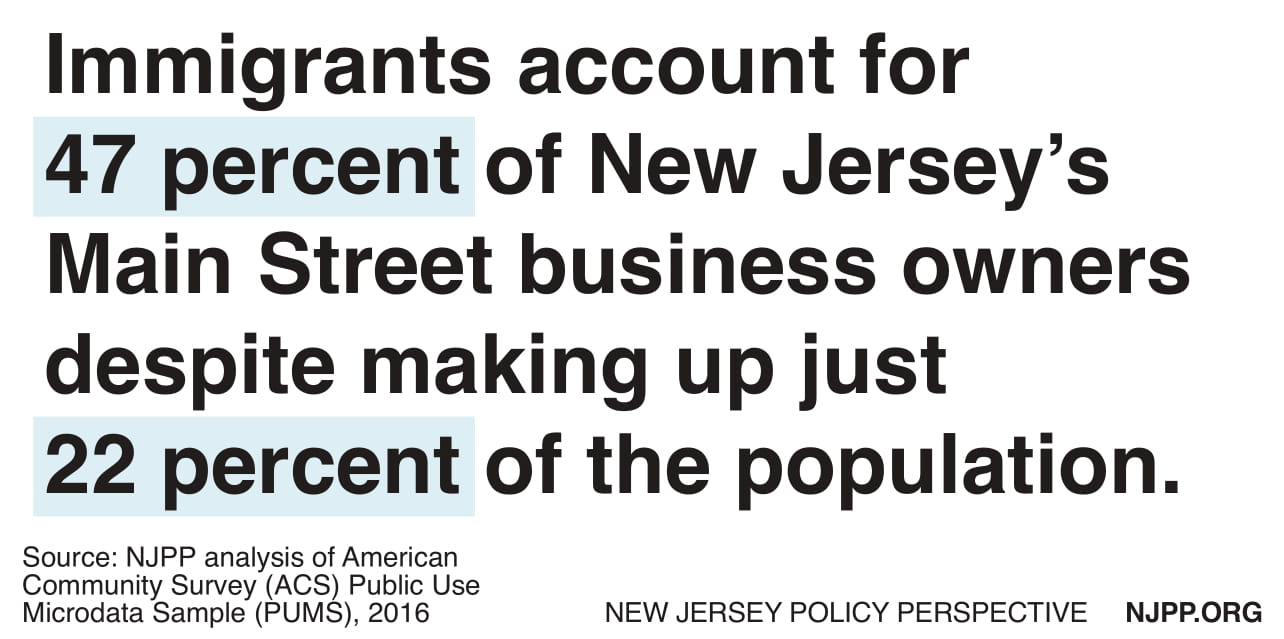
Immigrants own a higher share of Main Street businesses in New Jersey than in any other state not named California.[2] In fact, immigrants account for 47 percent of the Garden State’s Main Street business owners despite making up just 22 percent of the total population.[3] Given the state’s many small towns and its diversity of immigrants — New Jersey has the third highest share of immigrants and arguably the most ethnically diverse immigrant population and workforce in the nation — this is perhaps not surprising, but it is nonetheless important to the state’s economy.
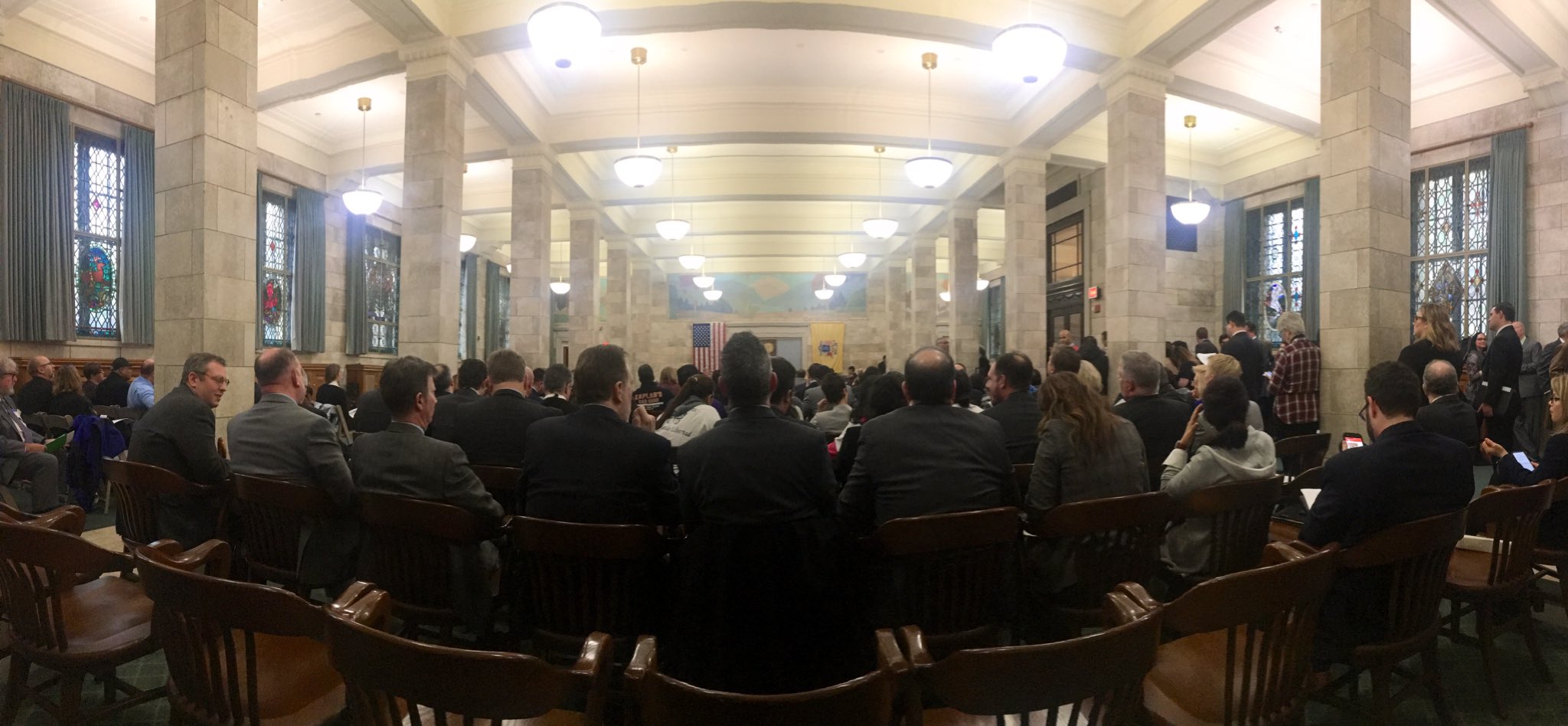
Proactive immigration policies are inextricably linked to the success of immigrant-owned businesses, yet decisions on these issues are often made without input from immigrant business communities. For example, a proposal to expand access to driver’s licenses to all residents, regardless of immigration status, will allow customers of immigrant-owned businesses to have more purchasing power. This policy would also allow employees of immigrant-owned businesses to leave work on their own terms — not just when the last bus or train departs — and become more financially secure and independent.[4]

New Jersey’s Immigrant Entrepreneurs Are Diverse and Own a Variety of Businesses

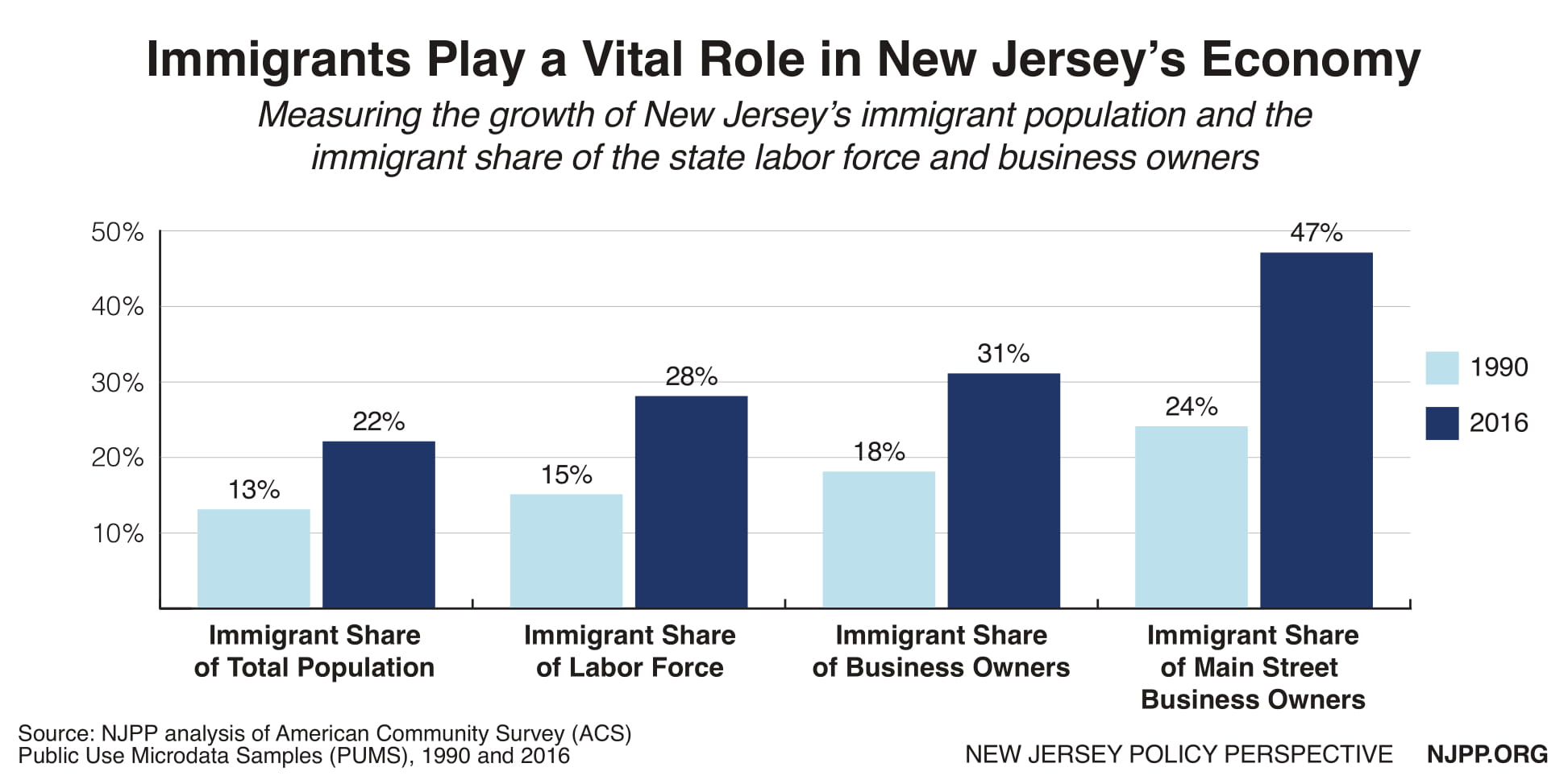
New Jersey’s immigrant population has doubled since 1990, and the shares of immigrants in the labor force and immigrant business owners have grown along with it. In 2016, immigrants made up 31 percent of New Jersey’s business owners and 28 percent of the labor force, up from 18 percent and 15 percent, respectively, in 1990.

The immigrant share of Main Street business owners has also grown tremendously, doubling over the same time — to 47 percent in 2016 from 24 percent in 1990.
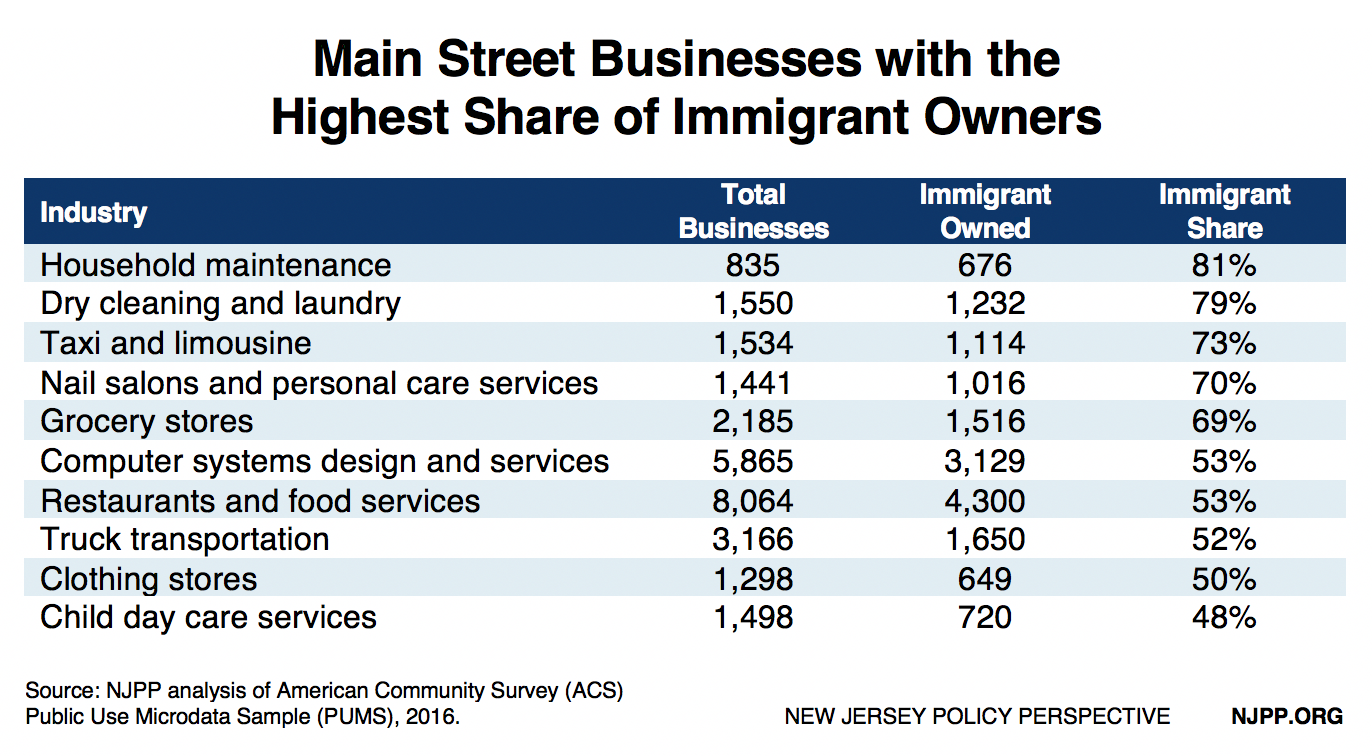
And while a majority (53 percent) of New Jersey’s Main Street businesses are owned by individuals born in the US, 8 out of 10 dry cleaners and 7 out of 10 grocery stores and bodegas are owned by immigrants. Further, immigrant entrepreneurs own 50 percent or more of the state’s household maintenance businesses, transportation services, nail salons, computer service centers, restaurants, and clothing stores.[5]
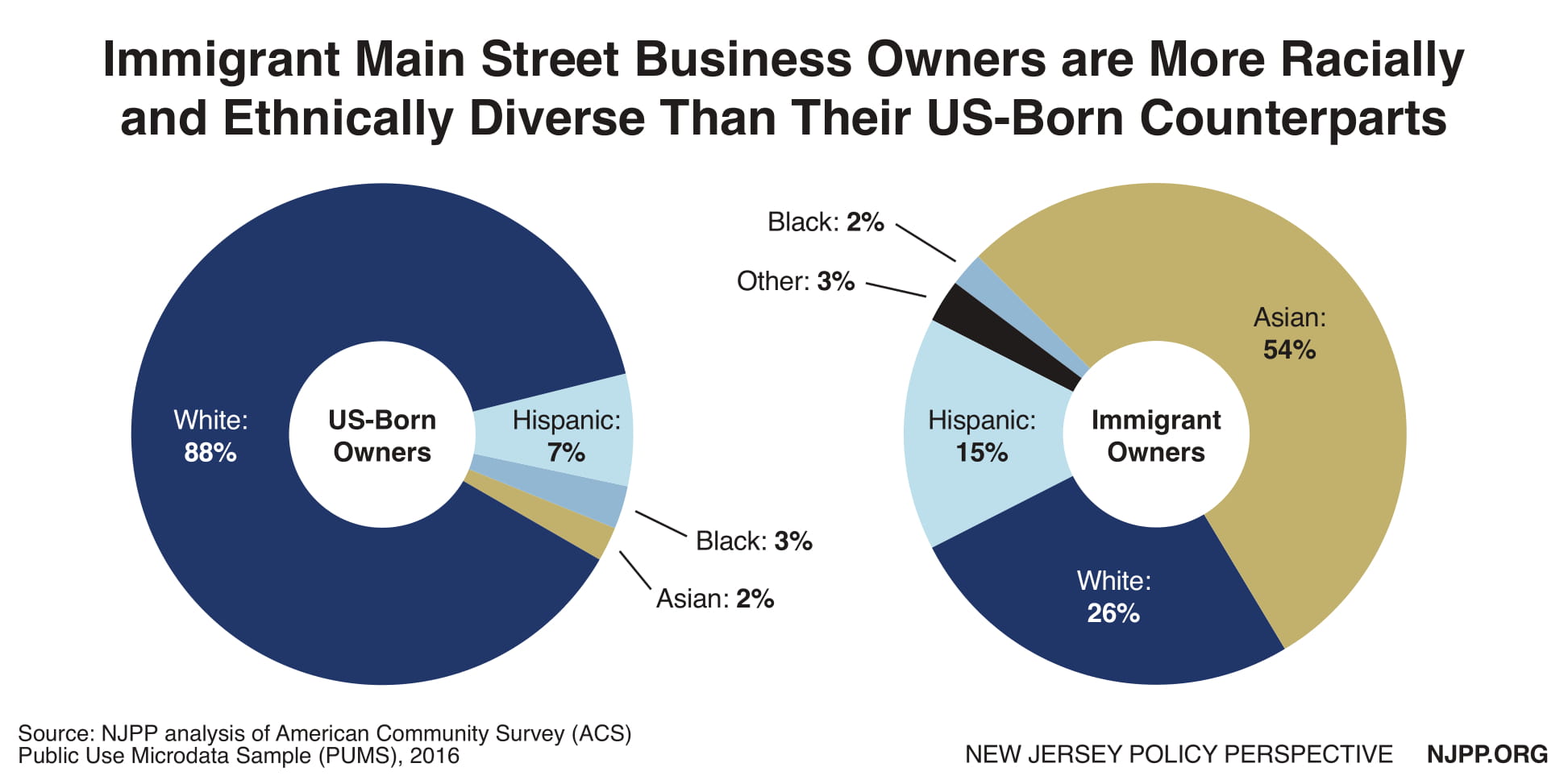
New Jersey’s immigrant entrepreneurs are diverse in the types of businesses they own and in regard to their race and ethnicity. A majority (54 percent) of Main Street immigrant business owners are Asian, while fifteen percent are Hispanic.[6] Asian and Hispanic immigrants are much more likely than their US-born peers to own Main Street businesses. However, Black immigrants only account for two percent of immigrant owned Main Street businesses.
What Makes Immigrants More Likely to be Business Owners

Mounting evidence suggests that immigrants are more likely to start and own small businesses because they face discrimination in the job market due to limited English proficiency and, sometimes, their citizenship status.[7] In addition, immigrants who earned advanced degrees in their home country have trouble continuing their careers in the US as foreign qualifications and academic achievements may not be recognized.

Ray Lamboy, Executive Director of the Latin American Economic Development Association (LAEDA), a nonprofit dedicated to helping immigrants and ethnic minorities start their own businesses, reinforces these findings:

“First generation immigrants do not typically have the access or the time to develop strong networks of support in the business community. This makes it difficult for immigrants to acquire full-time, professional positions in the workforce. Within immigrant communities, connections and networks are more easily established, making it easier for immigrants to find support in starting their own business.

“An example of a strong immigrant entrepreneur network can be found in South Jersey, where a large share of small businesses are owned by immigrants from the Puebla region of Mexico. These immigrants own a majority of the Latino owned businesses in Camden and the Vineland–Millville–Bridgeton metro-region. A majority of these businesses are supported with resources from other immigrant entrepreneurs from the same part of Mexico.”[8]

Immigrant-owned businesses are often a source of first jobs for other immigrants in the community for two reasons: the stepladder experience and block mobility.[9]

The stepladder experience is the idea that immigrant businesses function as a training platform for other immigrants to gain knowledge on how business is done in the United States, obtain work experience, and build social capital.[10] Some immigrants start their business in the informal market (businesses that are not incorporated or legally recognized) and then incorporate it once they gain experience, capital, and knowledge of the market and regulatory landscape. For instance, Felix Sanchez of Passaic, New Jersey started his businesses selling tortillas in the informal market, going door-to-door. As his community’s Latino population grew, so did his business, in spite of him not speaking English and dropping out of school after sixth grade. His company, Puebla Foods, is now a multi-million-dollar business.[11]

Block mobility explains that immigrants seek to be business owners resulting from the disadvantages and discriminations they often suffer in the labor market due to a lack of English proficiency and trouble transferring their foreign-earned degrees.

Economic Impact and Disparities in Earnings Between Native-Born and Immigrant Small Business Owners

Owning a Main Street business comes with increased social capital, as these establishments are an important part of the fabric of their respective local communities. However, owning a Main Street business does not guarantee a higher salary.

The average annual earnings for an immigrant Main Street business owner in New Jersey are $45,117. This is less than the average earnings for their US-born counterparts, who make $53,998 per year. When counting all businesses, the average annual earnings for an immigrant entrepreneur are $55,998. For US-born businesses owners, the average annual earnings are $75,062. For context, the average New Jersey immigrant earns $45,037 per year while US-born New Jerseyans earn an average salary of $58,000.[12]
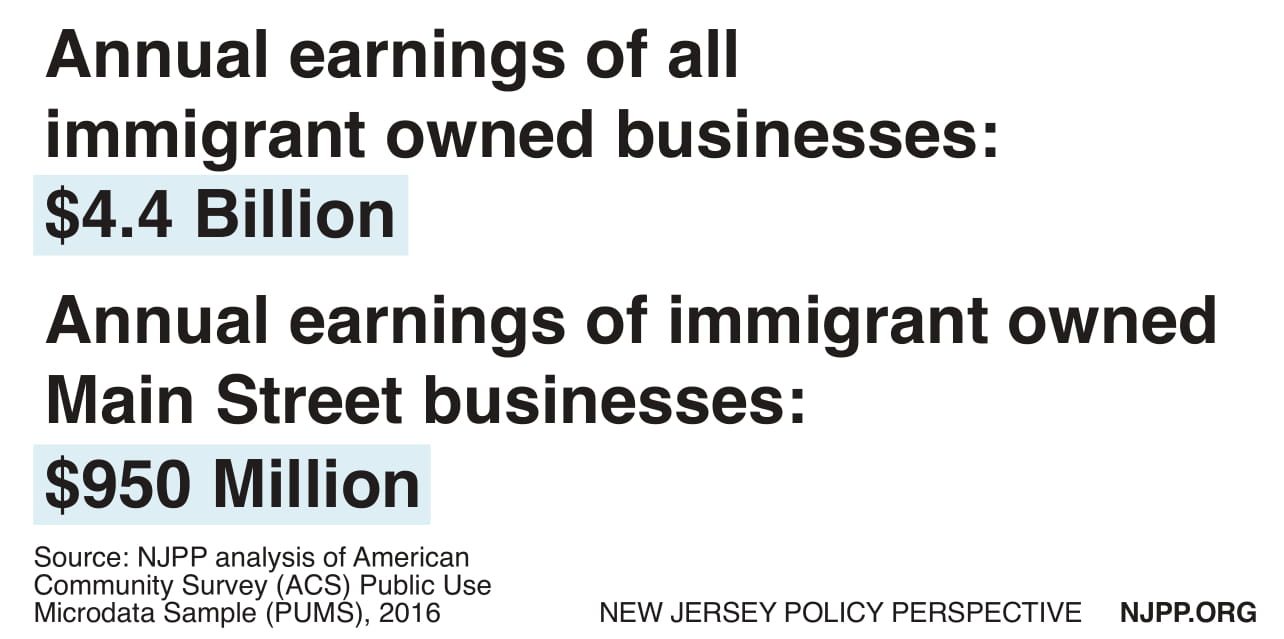
Nevertheless, New Jersey’s immigrant business owners are a critical part of the state’s economy. In total, New Jersey’s immigrant-owned businesses earn $4.4 billion dollars per year, including $950 million per year from Main Street businesses.[13] These earnings inject money into local economies, employ thousands of New Jersey workers, and in some cases, act as a lifeline for neighborhoods that have experienced decades of disinvestment and population decline.

Education and Gender Disparities

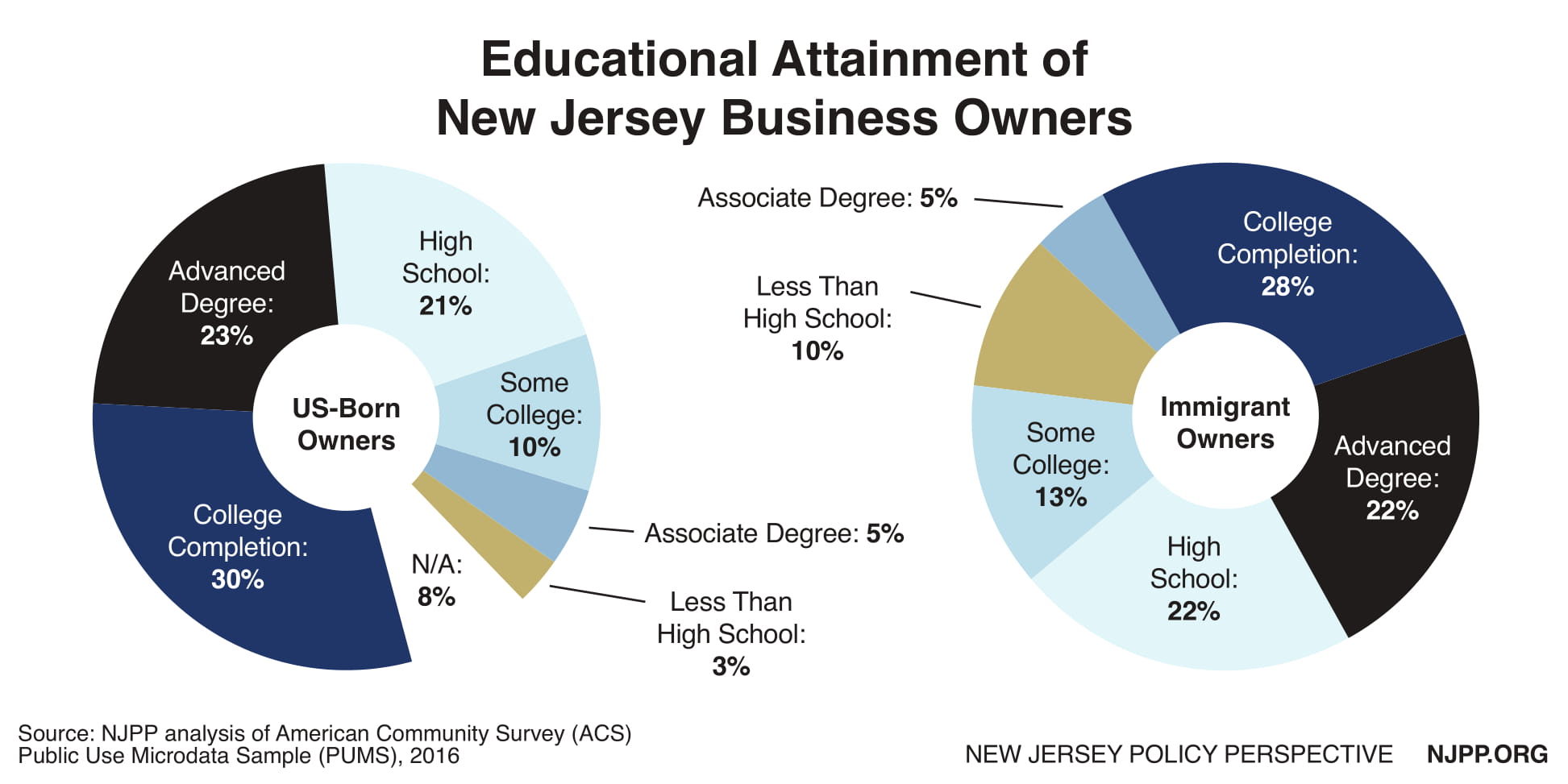
Higher-education is strongly correlated with owning a business. This is true for both immigrants and US-born business owners. Half of immigrant business owners — 50 percent — have either completed college or have an advanced degree. US-born business owners mirror these levels of education, as 53 percent have completed college or have an advanced degree.

Education, however, is not as strong a predictor of immigrant business ownership as it is for US-born entrepreneurs. Almost a third of immigrant business owners — 32 percent — have a high school degree or less. This is eight percentage points higher than US-born business owners, as only 24 percent have a high degree or less. This exemplifies the impact of the stepladder effect, which explains how many immigrants gain the necessary experience within the immigrant business sector to open their own business.
In regard to the gender breakdown of business ownership, men own a greater share of businesses than women. Men own 74 percent of total businesses and 67 percent of Main Street businesses. Immigrant women are slightly more likely to own a business than US-born women.

Immigrant Owned Small Businesses Are a Critical Part of New Jersey’s Economy

Small businesses are the backbone of local economies and communities across the state.[14] Small businesses, specifically those on Main Street, help neighborhoods stay economically active and, in some cases, revitalize cities experiencing population decline. Small businesses also help increase the local tax base and stimulate consumer spending in local economies.[15]

New Jerseyans born outside of the US are an asset not only to the state’s culture but also to its broader economy. Policymakers and the public alike should recognize the contributions of immigrants and the vital role they play on Main Streets in every corner of the state. It is in everyone’s best interest to have proactive policies that allow immigrants to prosper and feel safe and secure here in the Garden State. When immigrants do better, we all do better.


Endnotes

[1] Dyssegaard K.David, Bringing Vitality to Main Street: How Immigrant Small Businesses Help Local Economies Grow. Fiscal Policy Institute. 2015.

[2] Main Street businesses are defined by this report as small businesses focused on neighborhood services, accommodation and food services, and retail. This definition is consistent with that used by David K. Dyssegaard, cited above.

[3] NJPP analysis of American Community Survey (ACS) 2016, Public Use Microdata Sample (PUMS), 5-Year. Data obtained from Fiscal Policy Institute.

[4] Amuedo-Dorantes, C., Arenas-Arroyo, E., & Sevilla, A. (2018). Labor Market Impacts of States Issuing of Driving Licenses to Undocumented Immigrants (No. 12049). Institute for the Study of Labor (IZA). http://ftp.iza.org/dp12049.pdf.

[5] Private Households subsector include private households that engage in employing workers on or about the premises in activities primarily concerned with the operation of the household. These private households may employ individuals, such as cooks, maids, butlers, and outside workers, such as gardeners, caretakers, and other maintenance workers. Source: https://www.bls.gov/iag/tgs/iag814.html

[6] Ibid 3.

[7] Zhou, M. (2004). Revisiting Ethnic Entrepreneurship: Convergences, Controversies, and Conceptual Advancements. The International Migration Review,38(3), 1040-1074. Retrieved from http://www.jstor.org/stable/27645425

[8] NJPP interview conducted with Ray Lamboy, Executive Director of Latin American Economic Development Association, January 2019. http://www.laeda.com/

[9] Ibid 1.

[10] Ibid 7.

[11] Semple, Kirk. Moving to U.S. and Amassing a Fortune, No English Needed. New York Times. 2011. https://www.nytimes.com/2011/11/09/nyregion/immigrant-entrepreneurs-succeed-without-english.html?smid=tw-share&_r=0

[12] Ibid 3.

[13] Ibid 3.

[14] Nava, Erika (2017). New Jersey Immigrants are a Huge Economic Driver. https://www.njpp.org/blog/new-jerseys-immigrants-are-a-huge-economic-driver

[15] Ibid 1.
In Brief: New Jersey’s School Funding Reform Act at 10 Years

In this report, Dr. Bruce D. Baker of Rutgers University analyzes the impact of New Jersey’s School Funding Reform Act (SFRA) over the last decade and recommends policies that would strengthen the law and improve the state’s school funding system.

To read a PDF version of the full report click here.

To read a PDF version of the report summary, click here.


New Jersey’s School Funding Reform Act (SFRA) of 2008 was never a perfect law; in many ways, however, it remains a model state school finance policy:

  • SFRA directs more funding toward the students who need it the most. Under SFRA, New Jersey distributes state aid more progressively across local public school districts with respect to students’ needs.
  • SFRA directs more funding toward the school districts that can’t raise enough revenue locally. Because of SFRA, New Jersey distributes state aid progressively with respect to local income and property wealth, which serve as measures of local capacity to adequately fund schools.

Unfortunately, SFRA has been undermined by several factors through the years during and following the economic recession of 2008, including:

  • Cuts and freezes to state aid. These cuts have led to larger and large shares of children attending districts falling well short of their adequacy budget targets.
  • Failure to enforce a minimum local fair share. The failure to make sure each district raises its “fair share” of school funding through local taxes leaves some districts with even larger gaps between current spending and adequacy targets.
  • Local property tax increase caps. These caps prohibit districts that are levying less than their required local effort – and spending less than adequacy targets – from raising their local property taxes so as to adequately fund their schools.

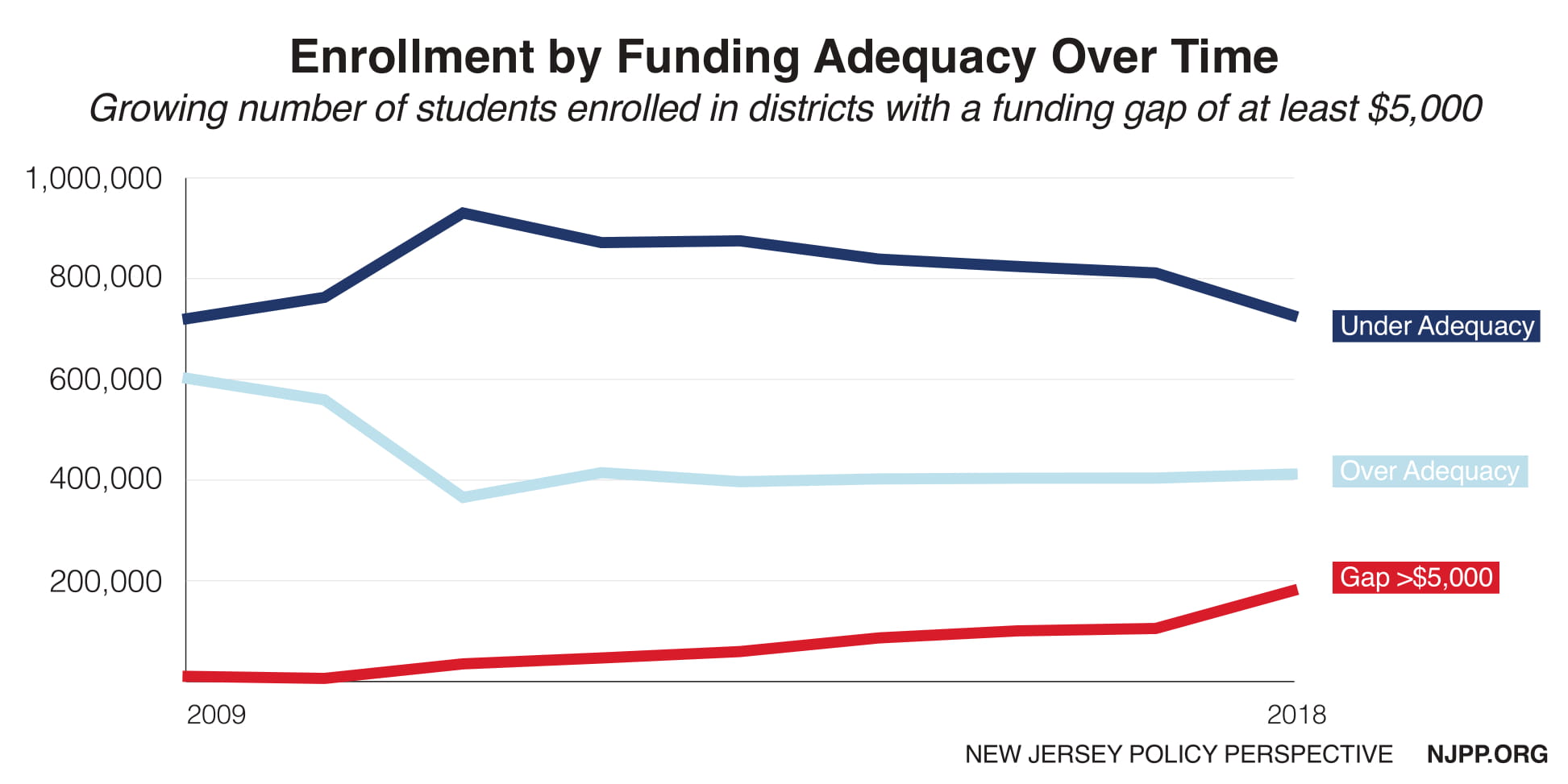
Figure 1: Total Student Enrollment by School District Adequacy (2008-2018)

Figure 1 shows the numbers of children attending districts that are below adequacy and more than $5,000 per pupil below adequacy.[1] About 800,000 children attend districts below adequacy and nearly 200,000 children attend districts with adequacy gaps greater than $5,000 per pupil. These gaps alone require a minimum of $1 billion to close.

Rise and Fall of Progressive School Funding in New Jersey

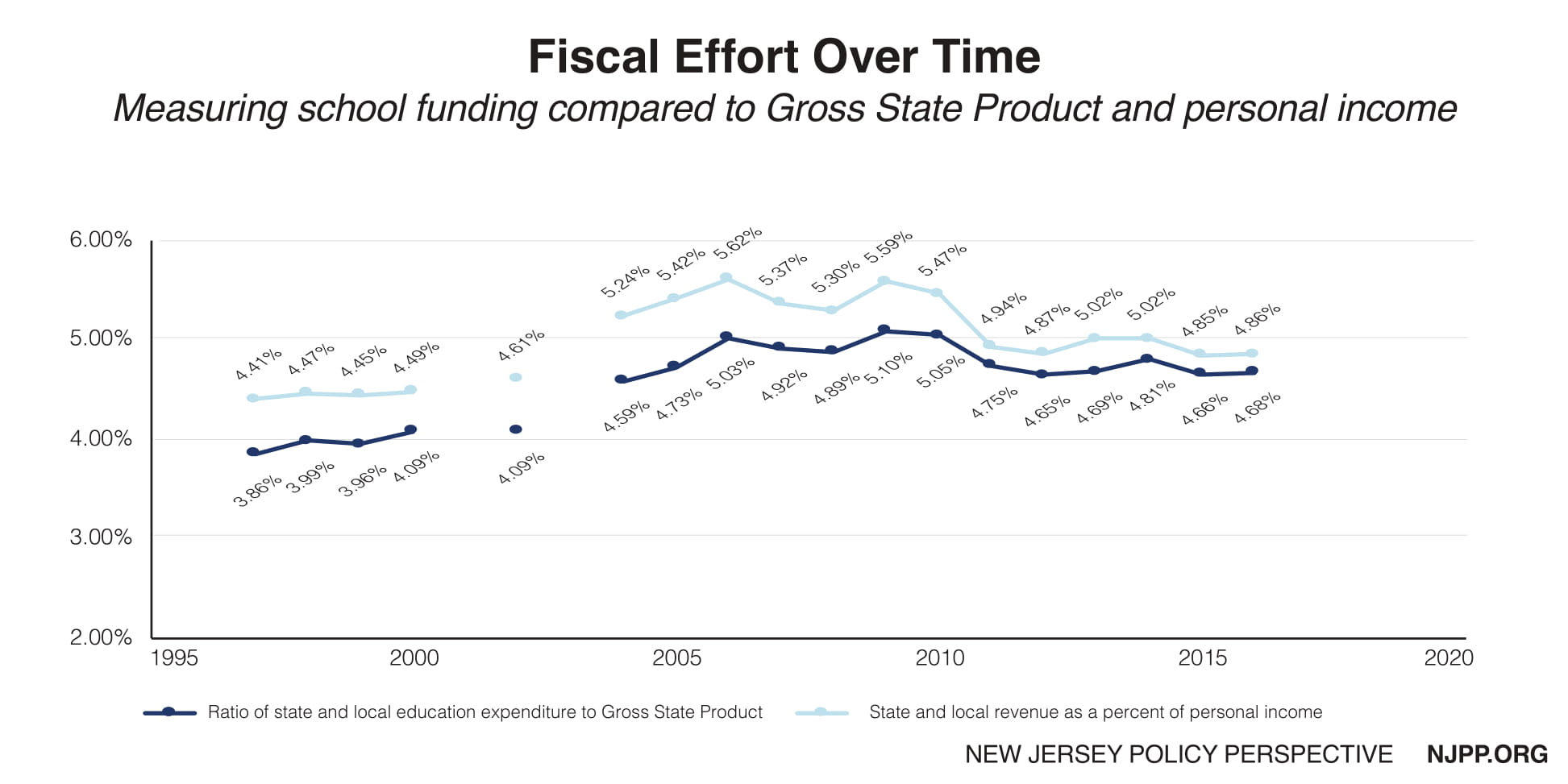
New Jersey reached its highest school funding effort level around 2009 with respect to GDP/State and 2006 with respect to personal income. Since that time, effort has declined, including a sharp decline from 2010 to 2012. Current effort levels are back to early 2000s levels, about halfway between their peak and pre-1998 levels. In 2015, New Jersey ranked 5th in the share of aggregate personal income spent on elementary and secondary education.

Figure 2: NJ School Funding Effort Levels (1996-2016)

How School Funding Affects Student Achievement

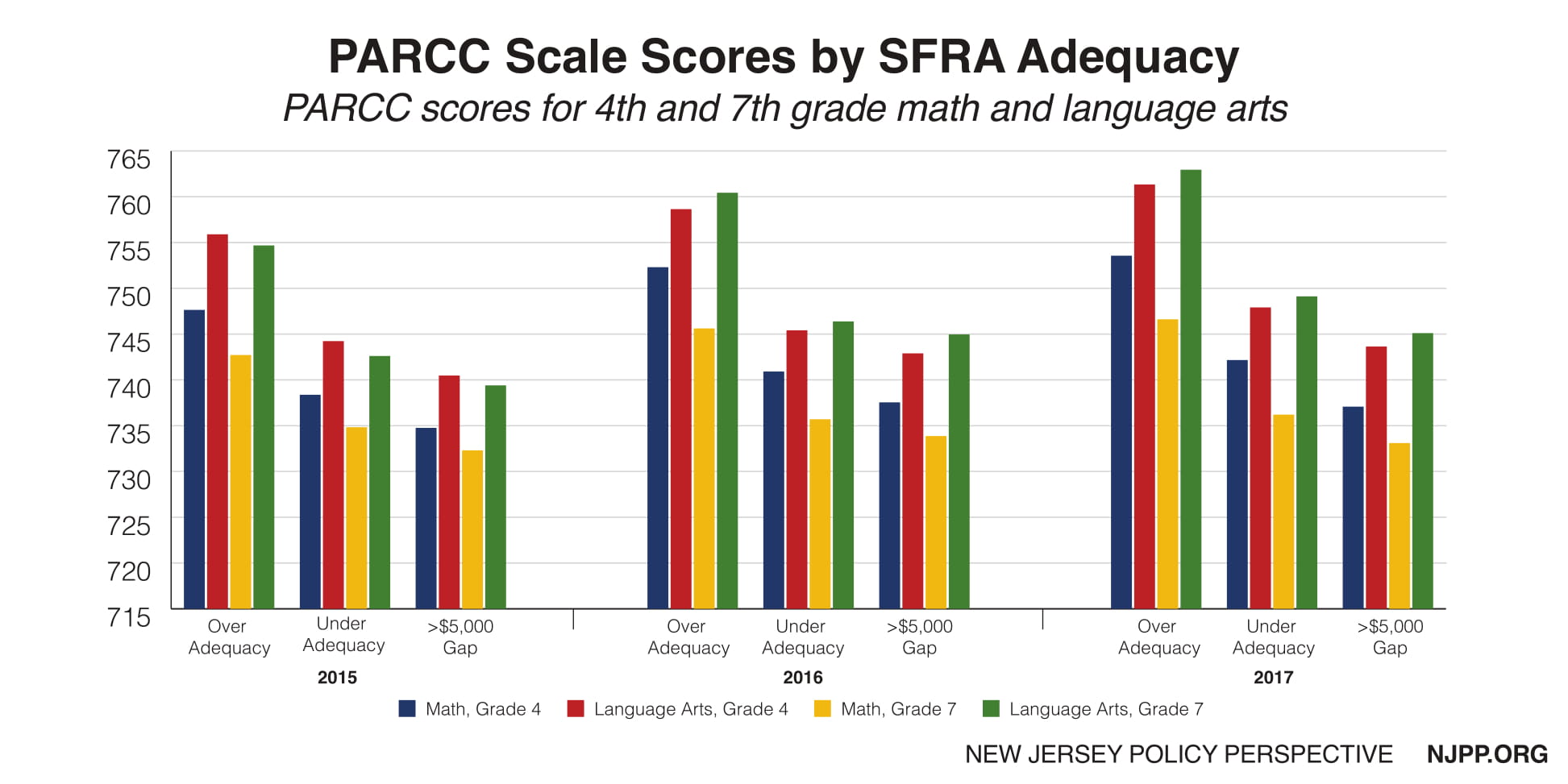
Figure 3: Average PARCC Scores by SFRA Adequacy Group (2015-2017)

Figure 3 summarizes average PARCC scores for the past three years, showing lower average scores in schools in districts with larger adequacy gaps. Admittedly, this relationship is, to an extent, circular: districts serving higher-need populations tend to have lower scores, and also tend to have larger adequacy gaps. But therein lies the point. The goal of a progressive school finance formula is to leverage additional resources in order to assist in closing the funding gaps – and therefore, the outcome gaps between high-need and low-need districts. National data shows SFRA has helped to shrink these gaps – but state data shows New Jersey’s school funding system is still falling short of what is needed to equalize educational opportunity.

School Funding: New Jersey vs. the Nation

The evidence is clear: school funding matters. The maps below show how spending and outcomes are related in the lowest-poverty and highest-poverty districts.

The map in Figure 4 is based on a statistical model, using national data, that calculates how much the lowest-poverty districts (bottom 20 percent in poverty) actually spend compared to how much they would need to spend to achieve average national test outcomes. Darker green indicates more spending. The map in Figure 5 shows test score outcomes; darker blue indicates higher outcomes.

New Jersey’s most affluent districts make large investments in their schools compared to similar districts in other states. As a consequence, New Jersey’s lowest-poverty districts have some of the highest test score outcomes in the nation. New Jersey’s wealthiest districts spend more on their schools and get exceptional outcomes in return.

Figure 4: Spending Gaps for Lowest Poverty School Districts

Figure 5: Test Score Outcomes for Lowest Poverty School Districts

What about the New Jersey districts with the highest levels of poverty (top 20 percent)? As the map in Figure 6 shows, these high-poverty districts still don’t spend enough to match the districts with the lowest levels of poverty (darker red indicates lessspending than what is needed to attain average test outcomes). Nonetheless, as the map in Figure 7 shows, these least affluent districts still come close to matching national average educational outcomes (as indicated by the tan color, which signifies average outcomes).

Figure 6: Spending Gaps for Highest Poverty School Districts

Figure 7: Test Score Outcomes for Highest Poverty School Districts

Overall, New Jersey is in a good position with respect to the rest of the nation: the state is able to shoot for much higher than prior year national average outcomes. But a sustained commitment to adequate and equitable funding is necessary for the state to provide allof its students with equal educational opportunity.

Solutions to Improve SFRA

Short Term:

  1. Fully funding the SFRA formula to meet its adequacy targets.
  2. Requiring districts to fully fund their local fair share if they fall below adequacy targets.
  3. Using a competitive wage growth index instead of a consumer price index. New Jersey can only maintain a high-quality teacher workforce if it offers competitive wages. Keeping those wages competitive requires tying them to the wage increases of other college-educated professionals.

Medium Term:

  1. Replacing the current Geographic Cost Adjustment (GCA) factor (which is applied at the county level) with a similarly determined adjustment (Taylor’s ECWI) applied at the labor market level, to remove distortions along county lines within the same labor market.
  2. Returning special education funding to a system based on tiers of student need, with appropriately differentiated funding based on actual distributions of children with disabilities. This change should be combined with providing 100% of special education funding through the equalization formula.

Long Term:

  1. Recalibrating funding targets and cost adjustments tied to current outcome goals. Using current data and applying more rigorous cost analysis methods, New Jersey should reexamine the levels of resources needed for schools and districts to efficiently achieve its current educational goals.
  2. Reconsidering the role of charter schools and how they affect public school funding. The state should direct funding to charter schools based on costs and needs while simultaneously assessing their fiscal impact on the efficiency of the entiresystem of public schools.
  3. Integrating pre-K funding into the SFRA model.
  4. Considering a statewide, SFRA-like formula for financing the state’s community college system. This would enable the provision of free, equitable and adequate two-year public college programs for all who wish to attend.

2019 is the year to act – to create better schools and better lives for the children of New Jersey. This report provides a starting point for the Murphy administration and the Legislature to enact legislation that will lead to a better statewide school funding system and a better education for all of New Jersey’s students.


Endnotes

[1]As calculated in this report.

Why New Jersey Should Expand Access to Driver’s Licenses

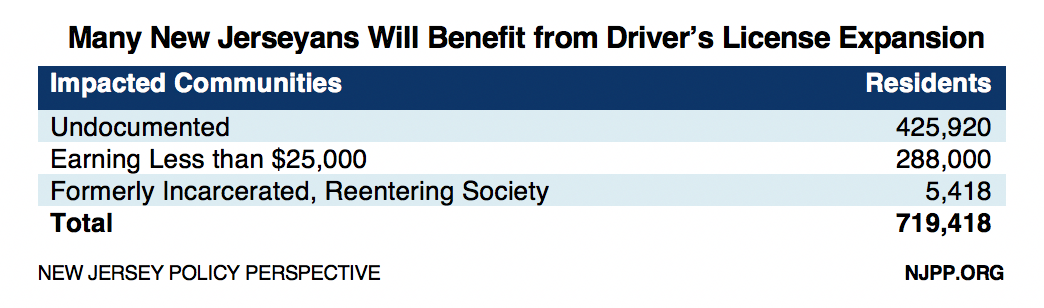
As New Jersey welcomes 2019 with the passage of a $15 minimum wage and paid family leave expansion, it’s time to shift focus to another policy issue that’s critical to the economic security of working families: making New Jersey the 13th state in the nation to allow all its residents to apply for driver’s licenses, regardless of their immigration status. There is a proposal in the Legislature — A4743 — that would lower the barriers to getting a driver’s license, impacting 719,000 New Jersey residents and benefitting not only undocumented immigrants, but those who earn less than $25,000 a year as well as those reentering society from the criminal justice system. This policy will increase public safety, empower workers and families in every corner of the state, boost the state’s economy, and contribute over $9 million in revenue to the state in the form of registration and licensing fees.

In New Jersey, having a car is essential to fully participating in the economy. No matter where you live in the Garden State — with very few exceptions — driving is necessary to get to work, pick kids up from school and take them to the doctor, shop for groceries and complete all the other errands that fill up the day. The ability to drive legally and safely is central to a vibrant New Jersey economy where everyone can work, get around and provide for themselves and their families.

Based on the experiences of other states that have implemented driver’s license expansion, NJPP estimates that 338,000 New Jersey residents will apply for a license during the first three years of implementation.

Restricting who is allowed to legally drive also has a chilling effect on the families and children of those who do not have the documents necessary to receive a driver’s license. In New Jersey, 168,000 children have undocumented parents who cannot drive them to and from school, their doctors appointments, sports games and practices, and other activities and errands parents make with their children. Instead, they are left relying on underfunded transit systems and spending money on taxis or Uber/Lyft drivers when that money could be going toward their children and spent in their local communities.

The proposed legislation, A4743, would create two categories of driver’s licenses and identification cards:

  • REAL-ID: a REAL ID Act-compliant driver’s license and identification card that residents can use to travel domestically on an airplane and enter federal buildings.
  • Standard License: a non-REAL ID basic license and identification card that would not be valid to board an airplane or to be used for certain official federal purposes. However, the non-REAL ID license would be valid for driving purposes and a form of identification.


What is REAL ID?

In 2005, the Congress passed and then-President George W. Bush signed the REAL-ID Act, legislation requiring driver’s licenses and identification cards to meet certain requirements set by the federal government to control who could board an airplane and hence make the country “more secure.” Specifically, the Real-ID Act calls for proof of legal presence in the United States and identity, a social security number, and state residency. The law also requires that applicants’ personal data and documents be entered into a state government database that is accessible to the federal government. These requirements are similar to the six-point system New Jersey currently has with the exception of the requirement to retain or scan documents into a DMV database. Despite there being no data that suggests the provisions in this law actually make driver’s licenses and identification cards more secure, the federal government is set to fully implement and enforce the REAL ID Act over the next two years.

States are not required to have their driver’s licenses and identification cards comply with the REAL ID Act, as there is no legal or financial punishment, but non-compliance will create a burden for residents of those states as they will need additional documentation, such as a passport, to fly domestically or enter federal buildings. The federal government will start enforcing the provisions of the REAL ID Act in New Jersey on October 10, 2020.  

Is New Jersey REAL ID Compliant?

No, New Jersey’s licenses and identification cards are not compliant with the REAL ID Act, but state officials have signaled that they hope to change that in 2019. As of February 2019, 38 states are compliant, as well as Washington DC, Puerto Rico, and Guam. New Jersey is one of twelve states that is not compliant, and all twelve have received enforcement extensions into 2019 and 2020.

Who will benefit from A4743?

If New Jersey becomes REAL ID compliant without creating a standard license as an alternative option, many residents will be impacted by this change. The federal REAL ID Act’s requirements will make driver’s licenses out of reach for many, including undocumented immigrants, individuals earning less than $25,000 a year, and people reentering society from prison.

To ensure these residents, who may not have the funds and necessary documentation for a REAL ID, are able to legally drive and fully participate in society, New Jersey must create an alternative license. This is the only way to ensure that all New Jersey residents can continue to have access to a driver’s license and be able to protect their privacy.

Sponsored by Assemblywoman Annette Quijuano, A4737 would ensure New Jersey is compliant with the REAL ID Act while also creating an alternative standard license.

Creating an alternative standard license would benefit the following people:

  • Citizens who do not want their information stored in a federal data system
  • Those who do not need a license to travel domestically
  • Certain senior citizens
  • Survivors of domestic violence who are unable to retrieve all their documents
  • Formerly incarcerated individuals
  • Low-income individuals and families
  • Transgender people whose documents may not accurately match their gender identity
  • Immigrants, including undocumented immigrants
  • Both citizens and noncitizens who have lost essential documents and have not yet obtained replacements because of cost or administrative delay


New Jersey has an opportunity to be REAL ID compliant and allow other qualified New Jersey residents the opportunity to be trained, licensed, and insured. It is a common sense policy that would make the Garden State’s road safer, allow children to arrive safely to school, help local economies to prosper, and establish a modeled system for the nation to follow.


Methodology

  1. Estimating how many people who are undocumented would be impacted

To estimate the number of people who would get licenses if New jersey allows undocumented immigrants to apply, we start with the number of unauthorized immigrants who are 18 years and older. We use the experience of other states to predict the “take-up rate” for New Jersey—the share of unauthorized immigrants who would get licenses if the policy was changed.

The number of unauthorized immigrants is drawn from the Center for Migration Studies (CMS), PEW Hispanic Center, and Migration Policy Institute Estimates of the Unauthorized Population; we take the average of the three estimates which is 484,000 and multiply that by the percentage of undocumented population that is 18 years and older,88 percent to give us the estimated number of folks who would benefit, 425,920.

The share of age-eligible unauthorized immigrants who get a license within three years of implementation of the policy ranges from about a quarter (25 percent in Nevada) to about a half (47 percent in Illinois), according to the Fiscal Institute Policy. In New Jersey, we assume that the policy would be implemented well, and that the take-up rate would be at the top of this range. Our estimate is that (47 percent) of age-eligible unauthorized immigrants would get a license.

  1. Calculating how many people earn less than $25,000

According to the IPUMS American Community Survey 2017, 1-year sample, an estimated 2.4 million U.S. citizens adults including naturalized citizens in New Jersey reported earning less than $24,999 and based on a study at least 12 percent of voting-age American citizens earning less than $25,000 per year do not have a readily available U.S. passport, naturalization document, or birth certificate. Hence, we multiple 2.4 million times 12 percent.

  1. Calculating how many people reenter from the criminal justice system

According to the latest outcome report, “State of New Jersey Department of Corrections
State Parole Board Juvenile Justice Commission (2016), 10,835 inmates were released in 2011. Based on the Motor Vehicles Affordability and Fairness and Task Force Final Report (https://www.state.nj.us/mvc/pdf/about/AFTF_final_02.pdf) studies show that at least 50 percent of those released out prison do not have access to identification. Thus, we multiplied 10,835 times 50 percent.

  1. Calculating license revenue:

Under A4743, the cost of obtaining a “standard basic license” is $18 and an initial permit is $10 for a license, totaling $28. Under the first outcome, the three potential groups total is multiple by the 47 percent “take-up rate” (see number 1 for more). The second outcome only includes the undocumented population times the 47 percent “take-up rate” times the price of license plus permit. The recurring revenue calculates only the revenue for renewing the license.

Paid Family Leave Bill Passes Through The Legislature

Today, New Jersey passed legislation to make sweeping improvements to the state’s Paid Family Leave Insurance Program and the Temporary Disability Program. These changes will go a long way toward making the programs more accessible to working families, especially those struggling to balance work and family care-giving.

SHEILA REYNERTSON, SENIOR POLICY ANALYST, NJPP:
“New Jersey Policy Perspective has long supported critical improvements in the state’s Family Leave Insurance Program. As part of Time to Care Coalition, NJPP called for reforms in our 2017 report highlighting the design flaws that have undermined the intention and impact of the program. Far too many workers were not taking leave, even though they pay into the program, because they either didn’t know about it or couldn’t afford to use it. We applaud the legislature for quickly recognizing the need to make paid time off more accessible to working families, ensuring that New Jersey’s family leave program remains strong and competitive with other states.

“Improving New Jersey’s paid Family Leave Insurance program is a common-sense policy that ensures workers don’t have to make impossible choices between economic security and important family obligations. By improving wage replacement rates, more low-income workers can afford to take leave when they need it. And by expanding the length of leave from 6 weeks to 12 weeks, more new parents can take the necessary time to recover from birth and bond with a new child. This bill also crucially extends the benefit—and the economic security that comes along with it—to survivors of domestic violence and sexual assault.

“Disappointingly, the bill lacks important job protections, failing to protect 800,000 employees from losing their jobs if they choose to take leave because they work for a New Jersey business with fewer than 30 employees. The Time to Care Coalition will continue to advocate for universal job protection, because the size of a company should not determine whether a worker deserves economic security while grappling with difficult health and life altering events outside the workplace.”

$15 Minimum Wage Bill Through The Legislature

Today, legislation to increase New Jersey’s minimum wage to $15 by 2024 passed through the legislature and now awaits Governor Murphy’s signature. This is one of the most significant pieces of legislation in the state’s history and will benefit nearly one million workers and their families, strengthening our economy and benefiting businesses all across the Garden State.

BRANDON MCKOY, DIRECTOR OF GOVERNMENT AND PUBLIC AFFAIRS, NJPP:
“Raising the minimum wage to $15 an hour will improve the lives of millions of people across New Jersey as low-paid workers and their families will be able to more easily afford their basic day-to-day needs. The positive impact of this change will reverberate throughout the economy as workers will immediately have more purchasing power, spending their increased earnings in their local communities and benefiting businesses on Main Street.

“After several proposals that excluded teen workers from the full wage increase, we are very happy to see that they have not been marginalized in this bill—work is work and should be valued regardless of who does it or how old they are. While this legislation will have a tremendous and positive effect on the state, more work must be done to ensure that New Jersey’s agricultural and tipped workers are not left behind. Employees in these sectors face unique challenges that are left unaddressed by this legislation, and we will continue to fight for policies that fully recognize the dignity of their labor.

“We applaud the legislature for recognizing that millions of New Jerseyans suffer from poverty wages and making it a priority to urgently pass this bill onto the governor’s desk. This will be one of the most consequential and beneficial pieces of legislation in the state’s history, helping to reduce poverty, mitigate income inequality, and strengthen our economy.”

New Jersey’s $15 Minimum Wage Proposal


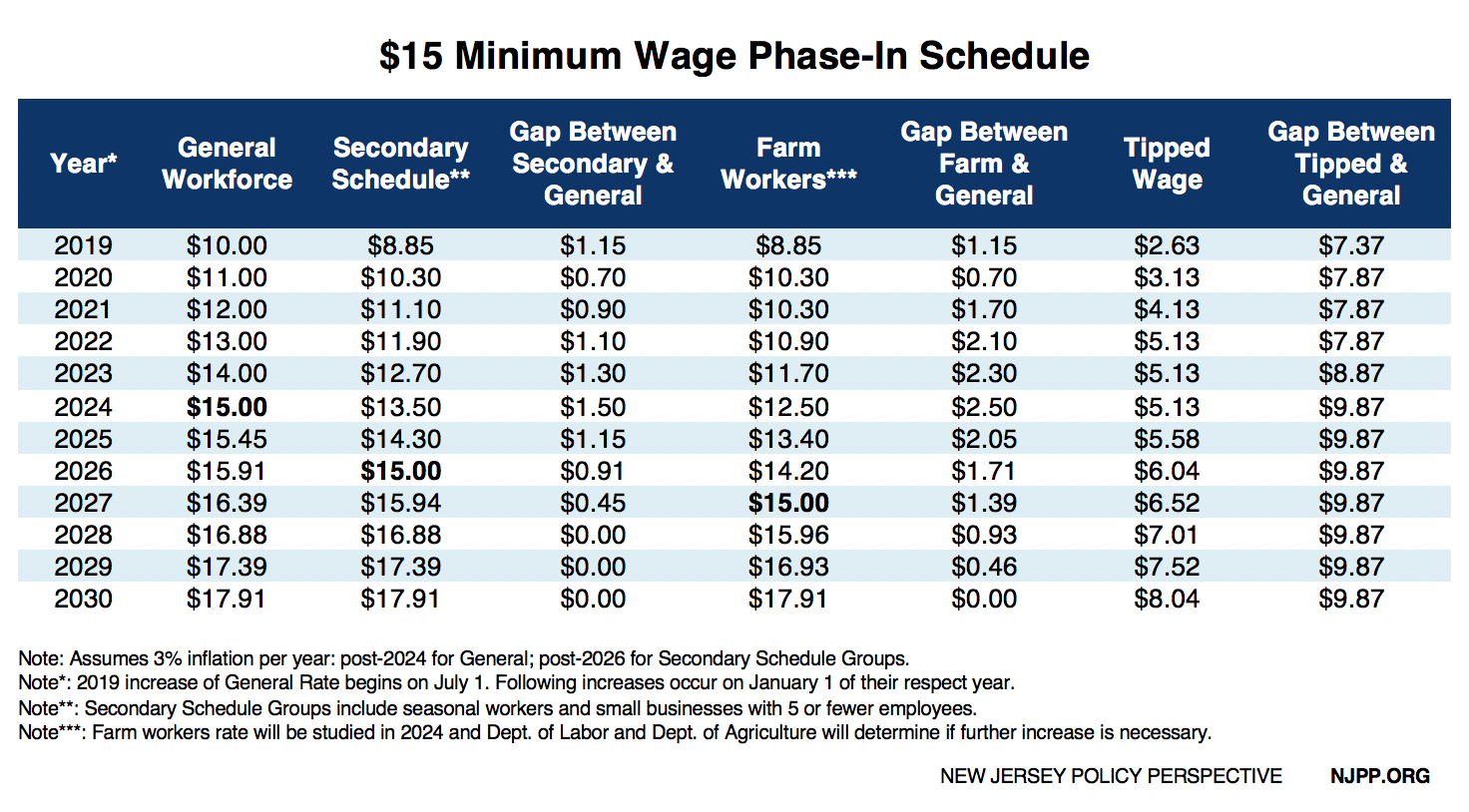
Earlier this month Governor Murphy and legislative leaders reached a deal to raise the state’s minimum wage to $15 by 2024, for most workers. Seasonal and small business employees will reach $15 by 2026, while farm workers will reach $15 by 2027, but only if the labor commissioner and secretary of agriculture sign off on it. The proposal is far from perfect — and unnecessarily complex as all work should be valued equally — but nonetheless it will have a tremendous positive impact for the Garden State’s low-paid workers and broader economy. Further, the minimum wage will remain indexed to inflation, and despite a slower phase-in for some, the legislation provides a pathway for all workers to reach the full minimum wage by 2030.   

The Basics

NJPP has long-advocated for a $15 minimum wage for all workers to combat poverty and ensure all New Jerseyans can better support themselves and their families. The current minimum wage of $8.85 fails to reflect the state’s high cost of living and helps explain why four in ten New Jerseyans qualify as working poor, according to the United Way ALICE report. Raising the minimum wage to $15 an hour will boost the take home pay of nearly one million workers and inject billions of dollars into the state economy as families have more disposable income to spend in their local communities.

Assembly bill A15 is the current proposal to raise the minimum wage to $15 and is the culmination of a year-long deliberation between Governor Murphy, Senate President Sweeney, and Assembly Speaker Coughlin. The bill passed the Assembly Labor Committee on Thursday, January 24, and is being fast-tracked through the Legislature — the bill could pass both chambers and be signed by Governor Murphy by the end of the month.

The proposal makes new distinctions in New Jersey’s wage and hour law,  so workers in certain sectors — in particular farmworkers, seasonal workers and employees at small businesses with five employees or less — will have to wait longer to reach a $15 minimum wage. Again, it is important to note that for these workers, the bill provides a pathway to parity, so all workers will have the same minimum wage from 2030 onward. This is critical because it prevents workers on the slower phase-in schedule from earning a sub-minimum wage in perpetuity. Instead, they will just be on a slower phase-in schedule but will eventually catch up to the full minimum wage and its yearly cost of living increases.

Unfortunately, this does not apply to tipped workers, as is detailed below, and further advocacy is necessary on behalf of both tipped and farm workers to ensure that the dignity of their work is fully valued and properly honored.

Phase-In Schedule (For Most Workers)

As specified in the bill, the current minimum wage of $8.85 will rise to $10.00 an hour on July 1, 2019, and to $11.00 an hour on January 1, 2020. From then on, the minimum wage will increase by $1.00 per hour every January 1st until it reaches $15.00 on January 1, 2024. Every year thereafter, the minimum wage will receive an inflationary bump, tied to the Consumer Price Index (CPI).

Secondary Schedule (Seasonal and Small Business Workers)

For seasonal workers, defined as “those who are employed by an employer that is a seasonal employer or non-profit or government entity, and not outside of the period of that year commencing on May 1 and ending September 30,” and employees at businesses of five workers or fewer, the minimum wage will rise at a slower rate and reach $15.00 an hour on January 1, 2026. The next two years will act as a catch up period, so that by January 1, 2028 these workers will earn the same minimum wage as everyone else, including cost of living increases. From 2028 onward, these workers will earn the full minimum wage and will be eligible for the same CPI increases as the general minimum wage.

Farm Workers

With regard to farm workers, the minimum wage for will increase to $12.50 an hour by January 1, 2024. At that juncture, a joint decision will be made by the state labor commissioner and secretary of agriculture on whether to recommend that the minimum wage for farm workers should continue to increase. If the two agree that the minimum wage should continue to increase, it will rise to $15.00 per hour by 2027, and will reach parity with all other workers by 2030 If the two parties cannot come to an agreement, a third member — as proposed by the governor and approved by the legislator — would break the tie and affirm the decision. If the state labor commissioner and secretary of agriculture make a recommendation to prevent further increases, the legislature would have to affirm that decision by passing a concurrent resolution.

While the different schedule for farm workers is less than ideal, it is important to note that absent both a recommendation not to continue on the specified path by the state labor commissioner and secretary of agriculture, and a concurrent resolution adopted by both houses of the legislature implementing the recommendation, the increases to $15 by 2027 remain in effect, as will further increases to catch up to the general minimum wage.

Tipped Workers

With regard to tipped workers, their minimum wage will increase to $5.13 per hour by 2022, where it will remain until 2024. Then, beginning in 2025, the wage will increase in concert with the general minimum wage, remaining $9.87 lower than the general minimum wage in perpetuity. NJPP has advocated for a full phase-out of the tipped wage as it improves the work experience for employees, guarantees a level of income that enables them to reliably budget for their lives, and very clearly makes a tip a tip again rather than being a critical portion of earnings that is necessary to afford the most basic of needs. We will continue to advocate for a full phase-out of the tipped wage, as is the law in seven other states, so that the labor of tipped workers is properly recognized and valued.

It’s Time for a $15 Minimum Wage

This testimony, on A15, was delivered to the Assembly Labor Committee on Thursday, January 24, 2019.

Good morning Mr. Chairman and members of the committee. Thank you for the opportunity to speak here today. My name is Brandon McKoy and I am the Director of Government and Public Affairs at New Jersey Policy Perspective.

NJPP has long been a strong supporter of raising the minimum wage to $15. The economic benefits for workers, their families, the business community and our state’s economy at large are significant and desperately needed. This proposal — bill A15 — will help approximately one million workers, almost one quarter of the state’s entire workforce, to better afford their needs and take care of the families.

Furthermore, these workers will now be able to more fully participate in our economy, meaning that the businesses of this state will benefit from a sizable increase in their customer base. When people can actually purchase their needs instead of putting them off due to poverty-level wages, businesses experience significant increases in revenue, helping grow and strengthen our economy.

It is no secret that New Jersey has been one of the slowest states to emerge from the Great Recession. When nearly a quarter of your workforce is earning poverty-level wages, it isn’t difficult to see why this is the case. This bill will help rectify this problem. It isn’t a silver bullet, and it won’t end poverty on its own, but it is a critical piece of the puzzle to tackling income inequality in this state.

That’s not to say there aren’t some shortfalls in this piece of legislation. The scenario for farm workers is far from certain as they may or may not see their wages rise to $15 by 2027. And the situation for tipped workers is not ideal either. While this bill increases their wages to $5.13 by 2022, it also increases the gap between the tipped wage and the general minimum wage by about 50 percent. New Jersey already has one of the largest gaps between the tipped and general minimum wage. To make it larger is not sound policy and invites increased instances of wage theft and workplace harassment for employees, especially women. As such, we also support bill A2903 which improves the state’s anti-wage theft laws in important ways, and we will continue to report on and advocate for improvements in these areas.

Poverty and income inequality tangibly harm millions of New Jerseyans. These two phenomena limit the freedom and liberty of our residents, weaken and destabilize our economy, and arrest our ability to deal with the many problems that we face as a state. Many people who testify today will try to convince you that this bill artificially inflates the minimum wage. They will say it goes too far too fast, and they will use terms like “wage mandates” to convince you that such a proposal is an encroachment on the freedoms of employers to determine what is best for them.

The fact of the matter is that had the federal minimum wage kept up with worker productivity over the past half century, it would be well above $20 by now – if anything, the minimum wage has been artificially deflated for decades. And when we look around and see so much poverty and struggle, and when we read analyses such as the ALICE report from the United Way of Northern New Jersey which shows us that 4 in 10 Garden State households are effectively working poor, we ought not be surprised at what we find.

This bill will be one of the most important, beneficial, and consequential pieces of legislation in this state’s history. It will help one million workers, make New Jersey a real competitor for workers in our region again, and inject nearly $4 billion into our economy – much of which will be spent in our local communities, helping to boost the fortunes of businesses on main street from Avondale to Waretown. This will be one of the best bills you could ever support in your career as a legislator.

As such, we urge you to support A15 and pass it through committee. Thank you for your time and consideration.

Deal Reached on $15 Minimum Wage

Earlier today Governor Murphy and legislative leaders reached a deal on legislation to raise New Jersey’s minimum wage to $15 an hour by 2024. The proposal includes a parity provision for seasonal and small business employees (who will not reach $15 an hour until 2026), ensuring all workers make the same wage by 2028.

BRANDON McKOY, DIRECTOR OF GOVERNMENT AND PUBLIC AFFAIRS, NJPP: 

“Raising New Jersey’s minimum wage to $15 an hour is one of the most consequential, pro-worker policies enacted in the state’s history. Phasing in to $15 over five years will boost the take home pay of almost one million New Jerseyans from all corners of the state. The positive impact of this increase will reverberate throughout the economy as workers will immediately have more disposable income to spend in their local communities. This will also benefit New Jersey’s vibrant business community, especially those on Main Street, by growing their customer base and helping more residents afford their goods and services.

“NJPP has long-advocated for a $15 minimum wage for all, as New Jersey’s high cost of living does not discriminate based on age or sector. The parity provision in this proposal is critical to ensuring seasonal and small business employees will not be left behind, even if their phase-in schedule is a few years longer. We applaud the inclusion of teen workers, who were at risk of being carved out of this legislation, as their work is just as valuable to the economy and their families as anyone else’s.

“For the state’s agricultural and tipped workers, there remains more work to be done. Employees in these sectors face unique challenges that this legislation leaves unaddressed. The dignity of all workers must be recognized and we will continue to report on and fight for policies that meet the needs of all New Jerseyans, including our tipped and farm workers.”

Slow Pace of Progress on Minimum Wage Limits Benefits

Stagnating wages are no secret—not to New Jersey’s low-paid workforce nor to state legislators who have long considered raising the minimum wage to a more-livable $15 an hour. But with every year of inaction, the value of $15 takes a hit, as do New Jersey’s working families who struggle to make ends meet on minimum wage salaries.

In August 2016, Governor Chris Christie vetoed a bill that would have increased the minimum wage to $15 by 2021. That veto proved to be a significant setback to the Fight for $15 campaign, delaying much needed relief for low-paid workers across New Jersey by several years. Now, increasing the minimum wage to $15 is back in the spotlight, but the current proposal is a shell of the legislation passed two years ago and fails to recognize how much ground has been lost over that time.

Introduced earlier this month by Assembly Speaker Craig Coughlin, A15 would increase the minimum wage to $15 by 2024 for most workers, and not until 2029 for “carved out” sectors of New Jersey’s low-paid workforce. The purchasing power of $15 already takes a hit by pushing back the minimum wage’s implementation to 2024, but extending the phase-in to 2029 fails to meaningfully tackle poverty or address ever-growing income inequality in a serious manner. As legislators negotiate the future of New Jersey’s minimum wage it is important to tease out just how much low-paid workers will be losing due to the slow pace of progress on this issue.

For a full-time worker who doesn’t miss any time whatsoever — meaning they never have to take time off for being sick, to take care of a loved one, or even for a short vacation — a $15 an hour wage translates to a $31,200 annual salary, and that’s before taxes. Assuming three percent inflation per year, a $15 minimum wage erodes in value to $13.69 an hour, or $28,475 per year, in 2024, and just $11.76 an hour, or $24,453 per year, in 2029.


There is a real cost associated with the slow pace of progress in raising New Jersey’s minimum wage. For a full-time worker, this will cost them between $2,725 and $6,747 in annual wages. In a state where the current living wage is upwards of $18 an hour for a single worker, a $15 minimum wage in 2024—while a significant improvement—isn’t meeting the need that many lawmakers are hoping to address with this piece of legislation.

If the goal is to truly provide workers with a living wage, legislators must recognize the need to make up for the time lost after Governor Christie’s veto in 2016. In practice, this means either shortening the phase-in period so the minimum wage reaches $15 by 2021, or keeping the same phase-in schedule but ending at a figure higher than $15. Why? Because if the bill from 2016 had been signed into law and the minimum wage reached $15 in 2021, it would have risen with inflationary bumps to $16.39 an hour in 2024 and $19.00 per hour in 2029. Fully acknowledging these facts would mean proposing and passing legislation that increases the wage to $16.39 — not just $15 — by 2024.


Since 2016, income inequality has only grown more dire and poverty remains higher than pre-Recession levels. In proposing a much-needed increase in the minimum wage, the Legislature should introduce legislation that recognizes just how much ground has been lost. The level of need for low-paid workers in New Jersey has not waned; if anything, it has grown in size and scope. The minimum wage bill that the legislature votes on must address these economic realities and the serious needs that low-paid workers have today. Passing a comprehensive bill that values work—and New Jersey’s high cost of living— will ensure the full benefit of the policy can be realized across the state and its economy.

Now is the Time for Driver’s License Expansion

New Jersey is among the most diverse states in the nation and has the third-largest share of immigrants, and its public policy should reflect this reality. Expanding access to driver’s licenses to all residents, regardless of immigration status, is fundamental to New Jersey’s immigrant communities fully participating in the state’s economy.

All New Jerseyans would benefit from drivers license expansion through safer roads and a stronger economy. And chances are we all have family members, friends, classmates, coworkers, and neighbors who are immigrants, and perhaps undocumented.Their success is very much tied to ours, and we all want members of our communities to thrive.

This policy has already been adopted in twelve states and Washington, DC, and is proven to make roads safer and immigrant communities more secure. Other vulnerable populations also benefit from this policy, like survivors of domestic violence who many not have all of the 6-point identification documents on-hand. There is simply no good reason not to advance this common-sense legislation.

In 2006, legislation was introduced to allow all New Jerseyans to be trained, tested, licensed and insured. This proposal ultimately failed as legislative leadership felt it was “not the right time.” Now, more than a decade has passed and immigration advocates are left wondering: when is the right time? Why not now?

Yes, New Jersey has taken important steps over the last year to make the state fairer and more welcoming to immigrant communities, namely through the passage of universal access to financial aid for higher education, but critical work remains undone.

The Senate President has publicly stated he supports expanding access to driver’s licenses. The Assembly Speaker similarly pledged his support to the Let’s Drive campaign. The governor has also signaled that he will sign such a policy if it lands on his desk. So what is holding up the legislation from advancing?

It is not lost on the Let’s Drive campaign that every member of the Assembly is up for reelection in 2019, but politics should not get in the way of sound public policy, especially when that policy would benefit so many New Jerseyans. Now is the time. Let’s drive.