
Proposed Medicaid Work Rule Puts Coverage for the Medically Frail at Risk

Dear Administrator Oz:

New Jersey Policy Perspective (NJPP) appreciates the opportunity to comment on the Centers for Medicare & Medicaid Services’ (CMS) Interim Final Rule implementing Medicaid community engagement requirements under H.R. 1.

Specifically, NJPP urges CMS to broaden its definition of medical frailty and preserve states’ ability to rely on self-attestation when verifying it.

NJPP is a nonpartisan, nonprofit organization that drives policy change to advance economic, social, and racial justice for New Jersey residents. Through independent research, analysis, and advocacy, NJPP works to ensure that state and federal policies expand opportunity and promote the well-being of all New Jerseyans.

NJ FamilyCare, New Jersey’s Medicaid program, is the foundation of the state’s health care safety net and provides health coverage to more than 1.8 million New Jersey residents, including 305,000 enrolled in NJ FamilyCare’s Aged, Blind, Disabled (ABD) program.[1] For these residents, Medicaid is more than health insurance, it pays for the daily services and supports they need to live safely and with dignity, whether in their own homes, community-based settings, or nursing facilities.

Although Congress exempted medically frail individuals from community engagement requirements, the interim final rule goes beyond the scope of H.R. 1 by adopting policies that make those exemptions more difficult to access and administer. New Jersey’s experience during Medicaid unwinding demonstrated that increased paperwork and verification requirements can cause eligible people to lose coverage. The interim final rule risks repeating those mistakes by adopting an overly restrictive approach to medical frailty and limiting states’ ability to rely on self-attestation. As CMS implements H.R. 1, we urge the agency to prioritize policies that preserve coverage for individuals who remain eligible for Medicaid while minimizing unnecessary administrative burden on beneficiaries, providers, and state Medicaid agencies.

CMS Should Adopt a Broader and More Practical Definition of Medical Frailty

The interim final rule requires states to determine not only that an individual has a qualifying medical condition, but also that the condition significantly impairs the person’s ability to participate in community engagement activities. While New Jersey intended to rely primarily on existing administrative and claims data to identify individuals who qualify for the medical frailty exemption, this additional requirement will instead require many beneficiaries to obtain medical documentation from their health care providers to demonstrate the extent of their functional limitations.

Obtaining this documentation will be difficult for many New Jersey residents living with cancer, serious mental illness or substance use disorder, or other chronic conditions. At the same time, physicians and other clinicians, who are already facing workforce shortages and considerable administrative demands, will be asked to complete forms and certify functional impairment, diverting time away from patient care.

CMS should eliminate the requirement that medically frail individuals demonstrate significant impairment and allow states to rely on available administrative data, supplemented by clinical information when needed, to identify individuals who qualify for the medical frailty exemption. This approach would better protect eligible beneficiaries and reduce unnecessary burdens on providers. It would also let states implement the exemption in a way that reflects the realities of people living with complex medical conditions.

States Should Retain Flexibility to Use Self-Attestation

NJPP is also concerned that the interim final rule unnecessarily limits the use of self-attestation when determining medical frailty.

Medicaid has always worked to balance program integrity with administrative efficiency by allowing states to accept self-attested information when electronic verification is unavailable or impracticable. Restricting self-attestation shifts unnecessary administrative burden onto beneficiaries with serious health conditions, many of whom face obstacles to obtaining repeated medical documentation.

These requirements also increase administrative costs for states and providers without improving oversight or accuracy. New Jersey has invested significantly in streamlining eligibility processes and maximizing automated verification. CMS should allow states to continually accept self-attestation for medical frailty exemptions, particularly when reliable administrative data or other verification sources are unavailable, so that individuals with serious health needs are not disenrolled from Medicaid simply because they are unable to navigate burdensome documentation requirements.

Conclusion

Administrative complexity should not become a barrier to health coverage for people who remain eligible for Medicaid. The interim final rule should support efficient administration while protecting medically frail individuals from unnecessary coverage loss.

NJPP respectfully urges CMS to:

  • Adopt a broader and more workable definition of medical frailty.
  • Preserve state flexibility to use self-attestation when electronic verification is unavailable.
  • Reduce unnecessary documentation requirements that increase administrative burden without improving program integrity.


Thank you for the opportunity to submit these comments. We appreciate CMS’s consideration and urge the agency to revise the interim final rule to ensure that implementation protects access to health coverage, minimizes unnecessary administrative burden, and allows states like New Jersey to administer Medicaid efficiently while preserving coverage for eligible residents.

End Notes

[1] New Jersey Department of Human Services. Division of Medical Assistance and Health Services June 2026 Enrollment Report. June 2026. Note that participants enrolled in Medicaid through the ABD program are not subject to work requirements.
Proposed Medicaid Per-Employee Fee Puts Workers at Risk

Good evening, Chair Pintor Marin/Sarlo and members of the Committee. Thank you for this opportunity to provide my testimony in opposition to A5324/S4533. My name is Jennifer Spiegel, and I am a policy analyst at New Jersey Policy Perspective (NJPP). NJPP is a non-partisan, non-profit research institution that focuses on policies that can improve the lives of low- and middle-income people, strengthen our state’s economy, and enhance the quality of life in New Jersey.

New Jersey Policy Perspective strongly supports raising additional revenue to protect NJ FamilyCare and preserve access to health care for New Jersey families. The state must find sustainable revenue to maintain coverage, especially as federal Medicaid funding faces new threats.

NJPP opposes this particular approach and urges the committee to reconsider the structure of any fee designed to support Medicaid — one that raises revenue without creating new risks for the workers the program is meant to serve.
The goal of raising revenue is right. The structure of this proposal is not.

By assessing employers based on the number of workers enrolled in NJ FamilyCare, the legislation creates incentives that could harm the very residents the Medicaid program is intended to help. A fee tied to individual workers’ health coverage status risks discouraging employers from hiring workers who have or may need Medicaid coverage. Employers may start screening out applicants they perceive as likely to enroll in NJ FamilyCare, creating new barriers for low-income workers and families seeking employment.

The proposal may also discourage eligible residents from enrolling in health coverage. If workers believe their enrollment could create costs for their employer or jeopardize employment opportunities, they may hesitate to sign up for benefits for which they are legally eligible. This is especially true as the federal government is cutting access to Medicaid with new work requirements. Public policy should be making it easier for residents to enroll, not harder.

Additionally, by applying the assessment to workers’ dependents who are enrolled in Medicaid, this proposal undermines the tremendous progress New Jersey has made through the Cover All Kids initiative in expanding health coverage for children regardless of their family’s circumstances. For many working families, employer-sponsored insurance is simply not affordable because dependent premiums and cost-sharing far exceed what their household budgets can absorb. Medicaid often provides the only affordable, comprehensive coverage option for children even when a parent is employed. New Jersey should not be penalizing families who are prioritizing health care coverage for their children.

The proposal also fails to recognize the unique challenges facing nonprofit employers. Many nonprofit organizations operate on thin margins and already struggle to offer affordable health insurance because of limited funding and rising health care costs. This legislation should take into consideration the variety of types of employers that are going to be impacted and make sure that organizations like nonprofits providing essential services in communities across New Jersey are not going to be harmed.

The assessment reinforces harmful stigma around Medicaid by treating workers enrolled in NJ FamilyCare as a problem to be solved rather than residents accessing an essential public program. NJ FamilyCare provides critical coverage for working families across the state, and workers who rely on Medicaid should not be viewed as a financial liability.
This proposal does not expand coverage or improve affordability for the residents who still lack it — and New Jersey has no shortage of those residents.

The state already has more effective tools available to generate comparable revenue — and examples to learn from. Massachusetts uses broader-based health care financing that spreads responsibility across the workforce rather than targeting workers enrolled in public health programs. Closing Corporation Business Tax loopholes, reducing ineffective business tax subsidies, and strengthening enforcement against corporate tax avoidance would provide a broader and more sustainable revenue base — without putting workers at risk.

New Jersey has the resources to protect NJ FamilyCare and ensure that all residents have access to quality, affordable health care. Achieving that goal will require asking profitable corporations to contribute more through broad-based, sustainable revenue sources — not through a per-employee Medicaid assessment that would harm the workers it is intended to help.

Thank you for your time and consideration.

Closing Loophole on Alternative Business Losses for High-Income Individuals Will Save NJ $120 Million Annually

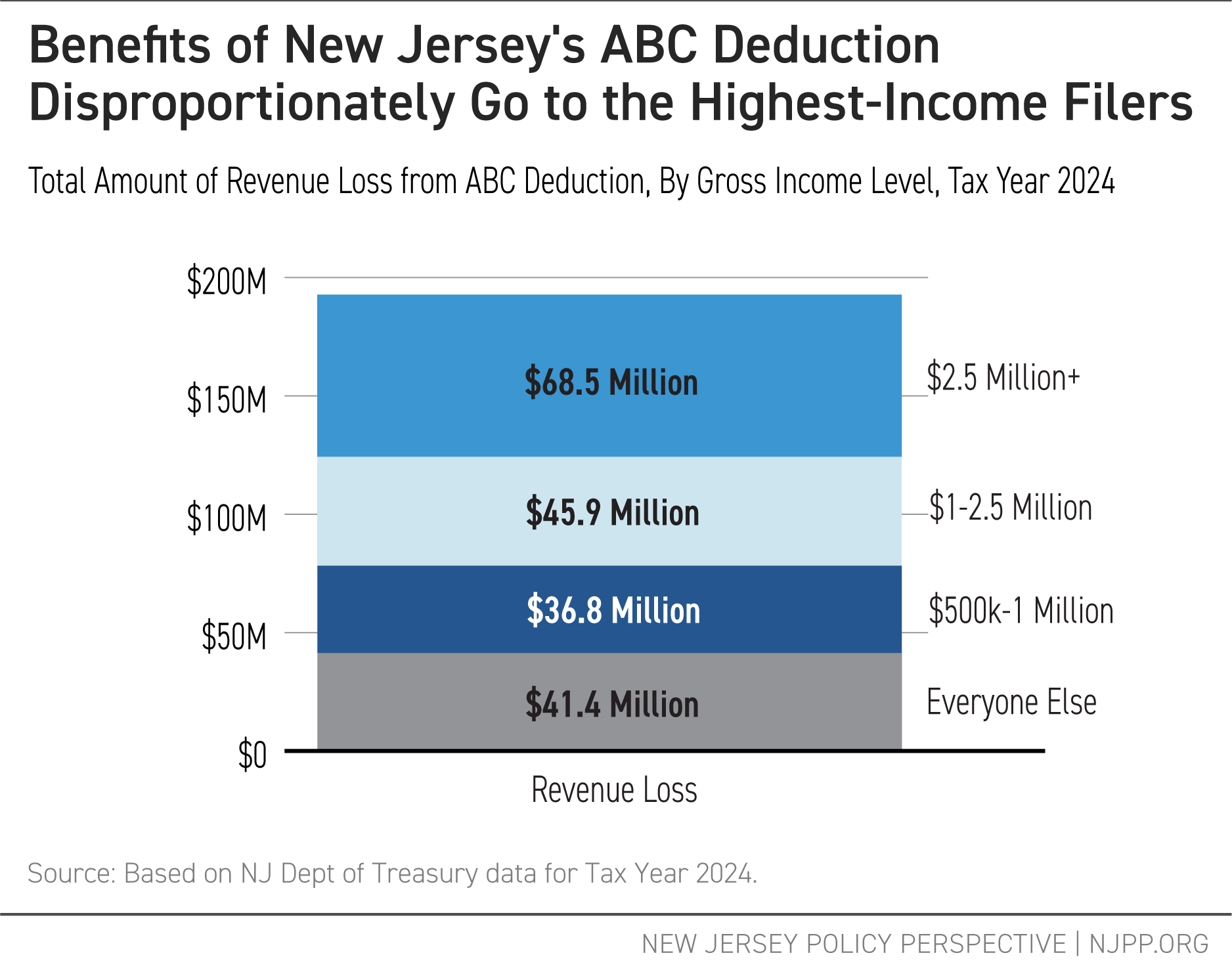
The Alternative Business Calculation (ABC) deduction has drifted from its original purpose of closing a gap in the tax code into a fast-growing benefit for very high-income individuals. The bill today takes a key step towards ending this benefit for high-income households with over $1 million in annual income.FY

  • Since 2016, the ABC deduction has more than doubled in size, outpacing all other personal income tax deductions combined.
  • And that growth has been concentrated in very wealthy households. Sixty percent of the benefits go to roughly 0.6 percent of New Jersey tax filers, all with more than $1 million in income.
  • Reforming the deduction for the highest-income households raises more than $120 million in much-needed revenue while affecting less than 1 percent of New Jersey tax returns.

Benefits of New Jersey's ABC Deduction Disproportionately Go to the Highest-Income Filers

I urge the committee to pass a bill that aligns with the governor’s original proposal and to oppose and eliminate any carveouts or exemptions. As the original ABC deduction compromise made clear, opening any additional loopholes will result in likely exploitation and enrichment for the already-wealthy.

Temporary Closure of Corporate “Net Operating Loss” Tax Loophole Will Save State Hundreds of Millions

Although reasonable in theory, the net-operating-loss deduction has become a substantial tax benefit for large, profitable corporations, which have ballooned the value of net-operating-losses for the top 1 percent of corporations. Offsetting profits with prior losses can help smooth the volatile profit patterns of corporations year over year. But tax planning has allowed some of the world’s largest businesses to accumulate losses on paper year after year, despite growing profits for shareholders.

New Jersey’s program is no different, with roughly $1.2 billion in lost revenue in tax year 2023. That is roughly a quarter of the $4 billion in total corporate business tax collected in fiscal year 2025, when those returns were primarily processed. These lost revenues occurred despite record corporate profits each year.

Many corporations stack these net-operating-losses with other credits and deductions to eliminate their tax liability entirely. Of corporate filers claiming more than $1 million in net-operating-loss tax deductions, almost two-thirds reduced their taxable income to $0. Profitable businesses should not be able to avoid taxation by accumulating paper losses while declaring record profits to their investors. 

NJPP seeks amendments to further cap NOL claims in the privilege period starting July 1, 2030. As written, this bill sets a ticking time bomb of revenue loss for a future fiscal year. Deferring these lost revenues does not fix the fundamental issue of difficult-to-audit paper losses.

Instead, the legislature should consider more permanent changes to rein in net-operating-loss growth beyond the next few years. The broad pattern of net-operating-loss accumulation by large corporations with sophisticated tax planning departments should concern the state as it looks to shore up revenue in years to come. Specifically, the legislature should consider:

  • Reducing the carryforward window from 20 years to a shorter time frame,
  • Reducing the percentage of losses a company can claim to 40 percent of taxable income
  • Capping the overall amount of claimable loss at $1 million permanently.


Additional corporate tax reforms including permanent net-operating-loss reform will be necessary to prevent more tax base erosion.

Expanded Child Tax Credit Will Help Hundreds of Thousands of Families Afford Cost of Raising Kids in NJ

Putting money back in family pockets is one of the most effective ways to improve affordability for New Jerseyans and help them meet the high cost of raising a child. Expanding the Child Tax Credit by 25 percent will help families with young children stretch their budgets a little farther, lifting more families out of poverty and into economic security.

Since it began, the Child Tax Credit has helped hundreds of thousands of New Jersey children, with an average benefit of about $950 for recipients. Although this money does not erase the costs of raising children, it does ease the burden on families. As the federal expanded Child Tax Credit during 2021 demonstrated, this credit can be a tool in slashing child poverty dramatically, if more resources are directed to fund it.

The proposed changes will increase the amount distributed to families to roughly $260 million. But this amount is still roughly the size of the Film and Digital Media Tax Credit, which subsidizes film studio productions, and roughly one-third the size of the proposed Stay NJ compromise.

Lawmakers with an interest in improving affordability for New Jersey families can continue to build on this tax credit by expanding the age range upwards and increasing the credit amount to help families adjust to rising costs.

There is only one amendment NJPP is seeking – extending the three-year window or instead making this change permanent. Costs will not be lower for New Jersey families in three years and the cost of this change is substantially lower than many permanent tax expenditures.

NJPP urges the committee to vote yes on this critical piece of legislation and help hundreds of thousands of children and their families afford to grow and thrive in New Jersey.

Governor Sherrill’s First Budget Takes Real Steps Towards Closing Deficit While Helping New Jerseyans Meet Costs

NJPP has long asserted that fiscal responsibility and strong investments in families and communities can go hand in hand. This budget takes critical steps to make that a reality by expanding revenues by closing tax loopholes that benefit wealthy corporations and individuals, and by continuing to put more money back into family pockets and into infrastructure, such as New Jersey Transit. For those reasons, NJPP supports this bill and encourages the committee to vote in favor.

But the budget bill must signal a broader shift away from austerity and towards a state that uses its wealth to support all its residents, while appropriately taxing the billion-dollar corporations and wealthy individuals who profit off of it.

There remain serious challenges that require solutions:

  • The state’s revenues are not keeping pace with expenditures, threatening key programs such as health care funding, school and municipal budgets, and basic supports for working families. Closing the structural deficit will require a closer look at big spending items such as corporate tax credits and property tax credits, while increasing revenues.
  • Wealthy individuals and large corporations have continued growing wealth at a record pace, including tax cuts at the federal level, while their contributions to New Jersey revenues have stagnated. A more effective strategy for addressing high-wealth tax avoidance will be necessary to ensure the state has the resources it needs.
  • Short-term thinking continues to shortchange long-term investments, including raids in the Clean Energy Fund and Regional Greenhouse Gas Initiative to pay for transit operations and utility assistance, as well as failing to increase Work First New Jersey benefits for very-low-income New Jerseyans trying to keep pace with high costs.

At its core, this budget heads in the right direction, raising revenues and reducing costs. But the next steps towards a responsible budget will likely be more challenging. Making New Jersey affordable for all will require bold decisions on the part of policymakers and elected officials.

The state has enough resources to help ensure no child goes hungry and no family is forced to choose between rent and health care. This budget bill takes the state one step closer, with many more steps to go.

Cutting Off Data Center Subsidies Is the Right Move for New Jersey

New Jersey should never have been in the business of subsidizing data centers, which have increased utility rates and imposed costs on communities up and down the state. NJPP thanks the bill sponsors and legislative leadership for the proposal in A5165 to end the brief, costly Next New Jersey AI tax credit.

But this change comes too late for the $250 million already lost to this program, sending taxpayer dollars to subsidize the industry causing cost increases and straining state infrastructure. As NJPP laid out in its March 2026 report, Fool’s Gold: The Hidden Costs of AI Data Centers for New Jersey, data centers accounted for 70 percent of the growth in electricity demand. And this loss of revenue comes at a time when state government is in need of new revenues simply to meet current program costs for the schools, health care, and transit funding the state’s residents depend on.

The Next New Jersey AI tax credit should serve as a cautionary tale for lawmakers. The bill authorizing the creation of the credit was overwhelmingly passed by both houses, including unanimous passage in the Senate, despite few guardrails on the program and a substantial sticker price of $500 million.

As corporate tax credits come up for creation, extension, or expansion, whether for the film industry or real estate developers or the next hot industry, NJPP urges the legislature to apply a proper degree of skepticism to the promises of corporations to demand a tighter set of regulations before issuing these credits. Otherwise, it will be the public on the hook once more for the cost of these corporate subsidies, without receiving the promised benefits.

New Jersey Should Reject Unjustified Giveaways to Sports Teams and Big Business

The continued expansion of corporate tax credits to induce economic development has yet to fully deliver on its promise. And yet, this bill proposes to send good money after bad, authorizing billions of state tax dollars to go towards private businesses and billionaires.

To be clear, the word “tax credit” is simply another word for subsidy – state tax dollars will go to pay for the development of real estate projects that benefit primarily private corporations and individuals, with the goal of creating long-term economic growth. Independent economic analysis from right, left and center have routinely cast doubt on the effectiveness of these credits.

Expanding the overall cap on credits by $3 billion has no justification.
The bill as written would expand the maximum total value of credits to $14.3 billion from the current cap of $11.5 billion. Basic questions remain unanswered such as why this increase is needed, given that credits remain unused in many years, and why such a dramatic increase does not include any additional safeguards on expenditures. Additionally, it’s unclear how this funding would all be used in the years remaining on the initial nine-year authorization.

There is no clear need for the sports and entertainment project described in the bill.
The renovation of a sports arena in a first-class city operating for 15 years with a seating capacity of 15,000 individuals applies only to one facility – the Prudential Center in Newark. The arena itself is less than 20 years old, and its entire initial cost was $375 million. Why less than two decades later it requires more than half as much to renovate as it did to build from scratch is a mystery.

In addition, sports stadiums and arenas remain among the worst possible investments for cities and states looking to increase economic activity. In state after state, and study after study, arenas produce pennies on the dollar, while saddling communities with white elephant buildings at the mercy of billionaire sports owners.

Although the requirements in the proposed bill admirably attempt to extract community benefits, at core these projects should not be the recipient of state tax dollars, given their woeful history.

As the state faces a shaky fiscal future, now is not the time to hand out more subsidies to billionaires and big corporations.

State Tax Credits Should Benefit the State, Not Just Private Businesses

The justification for economic development tax credits is that although they do subsidize billionaire businesses and developers, they should eventually have net benefits for the state – that the economic activity generated will offset the loss in revenues. Yet what this bill proposes to do is exempt megaprojects that cost the state hundreds of millions of dollars from this analysis, solely on the basis of their location in government-restricted municipalities.

The net-benefits test in the Economic Recovery Act of 2020 was a key accountability feature. Without it, a project could move forward without justifying that it would benefit the state and its residents overall, whose tax dollars are functionally subsidizing the project. In particular, the project has to actually have a positive revenue impact, not just generalized economic activity. If state tax dollars are subsidizing for-profit corporations, the standard for returns to the state must be set high.

Eliminating this net-benefits test for any project undermines the basic function of the EDA to evaluate projects for their benefit to the state. If these projects are indeed so transformational and critical, it should be easy to demonstrate their economic benefits to the state. If they cannot meet that standard, then they should not qualify for tax subsidies.

One final note: the upcoming budget already anticipates a roughly $1.5 billion structural deficit, with increasing costs and uncertain revenues. If anything, this should be a time for the state to be tightening accountability to ensure that these projects truly benefit the state’s budget, not loosening the purse strings simply because certain developers have not met current requirements.

At the very least, this committee should vote to hold this bill and await the budget projections for FY2027, before potentially losing more revenue to projects with limited fiscal benefit.

Protecting Confidential Data Sent to Government and Health Care Providers Keeps All New Jerseyans Safer

When New Jerseyans share personal identifiable information with any state or government agency, they do so with the trust that their information will be kept confidential.

Yet under current law, public entities routinely sell information to data aggregators, with limited protections on confidentiality. As NJPP Senior Policy Analyst Marleina Ubel has detailed in the November 2024 report Combating Surveillance and Protecting Privacy: Why New Jersey Needs the Immigrant Trust Act, federal immigration enforcement uses a dragnet of personal information that includes motor vehicle records such as scanned driver’s license photos and the license plate and vehicle data of nearly 3 in 4 adults.

When combined with available data sources such as credit records and geolocation data from phone providers, federal law enforcement can identify and track the locations of almost all Americans with a shocking degree of accuracy, without needing a warrant and in secret.

Current loopholes in state privacy laws make it far too easy for federal immigration enforcement to access sensitive data from schools, libraries, doctors’ offices, and government agencies. And with the new frontier of license plate readers, facial recognition, and extensive surveillance provided by cameras operated by government agencies or third-parties on their behalf, the amount of data that can be used to enact a vast dragnet has only increased.

As federal agencies have shredded existing privacy laws to hand over sensitive tax and Medicaid enrollment data to immigration enforcement, now is the time for states to step up to protect the sensitive data that residents share with the state.

New Jersey’s governments, health care providers, and schools should not be unwitting accomplices to vast data collection to supercharge federal immigration enforcement. Passing A6309 is an important step to keeping all New Jerseyans’ data safe and secure.