From Health Care to Highways: How Federal Funding Shapes New Jersey

Federal funds play a crucial role in supporting state government services that protect and provide for New Jerseyans. Because of this funding, New Jersey can ensure clean water flows from the tap, children receive healthy meals at schools, state departments can repair roads and rail lines, and residents can access routine medical checkups. In fact, nearly one-third of New Jersey’s budget expenditures depend on federal funds, meaning that federal budget cuts would inevitably lead to reductions in state agency funding and essential services that families rely on.

New Jersey’s State Departments Depend on Federal Funding

New Jersey’s state departments administer essential programs, acting as the clearinghouse for billions in federal funding.

The three state departments most reliant on federal dollars (by percentage of their budget) are:

  • Department of Agriculture,
  • Department of Labor and Workforce Development, and
  • Department of Environmental Protection.


Specifically, these departments administer critical programs, including:


Feeding families and children, helping people get jobs, and keeping the air clean are essential services that federal cuts could put at risk. If Congress slashes federal funding, these departments may be forced to lay off workers and scale back operations, directly harming New Jersey residents.

Top Federal Programs in New Jersey

New Jersey’s state budget also relies on several multi-billion dollar federal grants earmarked for specific programs that fund key services supporting state residents.

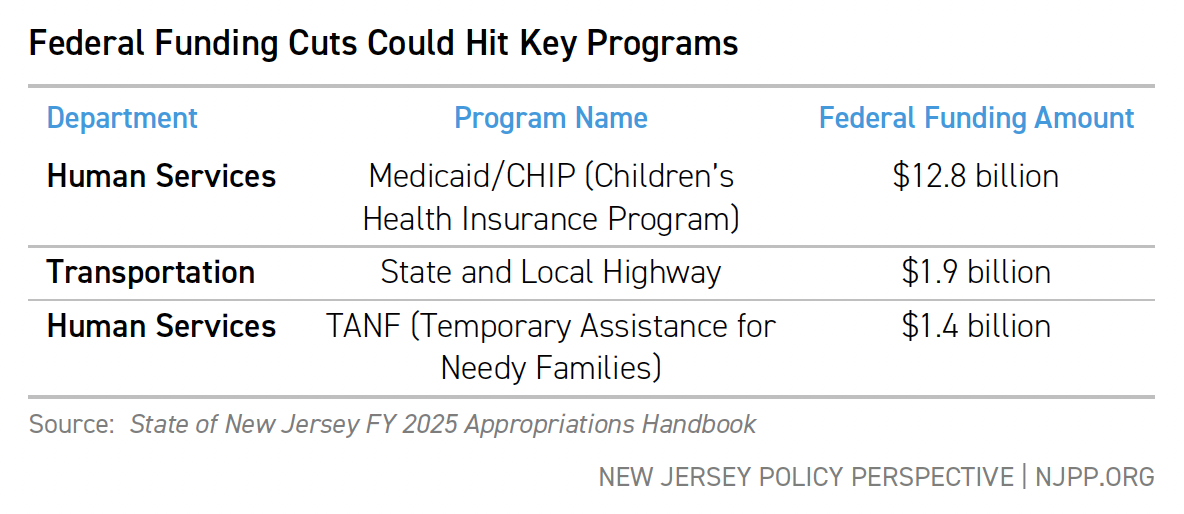
  • Department of Human Services: Administers Medicaid/CHIP and TANF, helping families with low to no income access health care and cash assistance.
  • Department of Transportation: Receives nearly $2 billion in federal funding to build and maintain state and local roads, improving accessibility and safety for people with disabilities, pedestrians, and cyclists.


These programs receive some of the largest federal grants, playing a crucial role in improving the quality of life for New Jerseyans.

With the state budget already facing a structural deficit, New Jersey must push back against federal funding cuts that could weaken its ability to deliver essential services to residents.

Federal Funding Cuts Threaten New Jersey’s Residents

Federal funding is the backbone of many essential public services in New Jersey, supporting health care, food assistance, child care, and education. However, recent federal proposals from D.C. include deep cuts to these programs — primarily to finance tax breaks for corporations and the ultra-wealthy.

These cuts would have devastating consequences for the state’s most vulnerable residents — including immigrant communities, people with disabilities, low-income families with young children, and older adults on fixed incomes. 

New Jersey’s schools, hospitals, and bridges depend on federal funding

New Jersey receives nearly $30.8 billion in federal funds, many of which support critical programs for families and the state’s economy, according to recent data from the Center on Budget and Policy Priorities.

Many of these funds are passed through the state budget to individuals and programs, so even small disruptions in federal funding may lead to child care providers and soup kitchens closing their doors permanently or families being cut off from food or heating assistance.

Millions of New Jersey households count on federally funded programs

Whether programs and services are administered by federal, state, or local governments, federal grants flow to millions of households and families across New Jersey. This aid translates into health insurance and health care, preschool and child care, school meals and special education funding, and affordable housing — foundational supports to help every family succeed.

At a time when families are struggling to afford necessities like housing, food, and healthcare, any cut to these and other federal programs will directly harm hundreds of thousands of people. With the state budget facing its own structural deficit of more than $2.1 billion, federal cuts now would further hamper the state government’s ability to assist New Jerseyans. To safeguard the stability of New Jersey and support affordability for families who need it most, policymakers must prioritize protecting and expanding federal investments in public services and maintain an ample surplus to ensure the state can protect its families from harm.

Boost Family Tax Credits to Boost Affordability

All children in a state as wealthy as New Jersey deserve to grow up without fear of homelessness or hunger. Yet many families with children struggle with affordability due to the state’s high cost of living, especially for housing and transportation. More than 1 in 4 New Jersey children live in a low-income household — less than $62,000 for a family of four. To make the state the best place to raise a child, New Jersey’s state budget must prioritize programs that help working families meet the cost of raising children.

New Jersey already has two programs that help families meet those rising costs:


However, these tax credits do not reach all families with children who need assistance, due to the children’s age, the tax filer’s citizenship, or other eligibility requirements. Also, the credit amounts should increase to keep up with the rising child-related costs like food and child care.

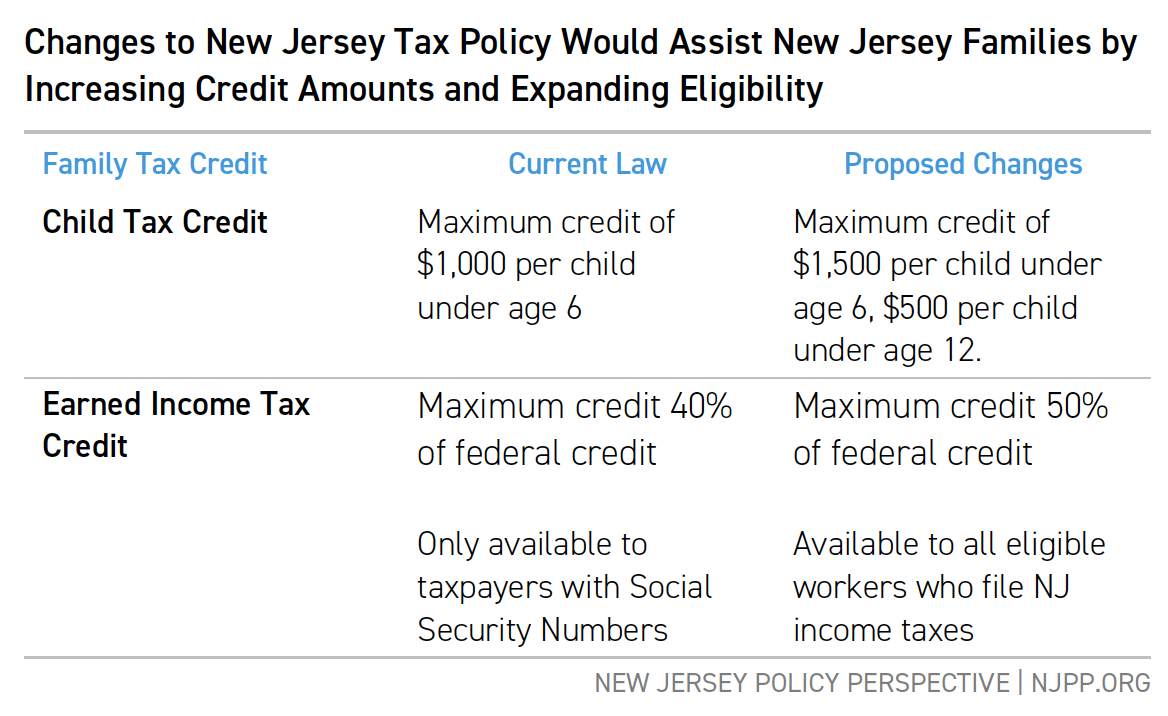
As a recent NJPP report lays out, New Jersey should expand its Child Tax Credit to children beyond age 5 through 11 and increase the maximum benefit from $1,000 to $1,500 for children under age 6. In addition, expanding the Earned Income Tax Credit by another 25 percent and increasing eligibility for all workers who file taxes.

These changes would put hundreds of dollars back into families’ pockets, helping make New Jersey the best place to raise a family by providing an estimated $432 million to low- and moderate-income households. By amplifying the antipoverty effects of these critical lifelines, the state can help more households meet basic needs and raise the standard of living for working families.

Changes to New Jersey Tax Policy Would Assist New Jersey Families by Increasing Credit Amounts and Expanding Eligibility

These tax credits can help address the affordability crisis for families in the most straightforward way – by giving them cash to help pay critical costs. Working family tax credits have a long track record of reducing poverty and helping families meet basic needs. New Jersey’s budget for fiscal year 2026 should include expanded funding for working family tax credits to put money back in families’ pockets and make good on the state’s promise to its children.

Extending Trump Tax Cuts Would Benefit the Wealthiest New Jerseyans

Fair tax policy depends on prioritizing the well-being of all households, not just the wealthiest. New Jersey, and the nation as a whole, cannot afford to hand special tax breaks to the most affluent residents by slashing essential services such as health insurance for working families. New analysis of the Trump administration’s plan to make tax breaks from the 2017 tax law permanent shows that the proposal would do just that. It would make the wealthiest New Jerseyans even richer while cutting programs and support for families who need help affording basic necessities like food and health care.

This proposal means that the average tax break for the top 1 percent will be nearly 200 times the benefit of the lowest-earning 20 percent of the state’s households. And those differences add up: nearly half the benefits would go only to the top 5 percent of income earners.

Extending these tax breaks perpetuates regressive tax policy – sending enormous benefits to the richest 5 percent while doing little or nothing to help residents struggling to make ends meet.

For more on this analysis and its methodology and other state-by-state analyses, check out the Institute on Taxation and Economic Policy’s issue brief here.

New Jersey can and should make its own tax code fairer by raising rates on the wealthiest individuals and corporations, not giving them even more tax breaks.

Corporate Transit Fee Should Only Go to NJ Transit

Every day, hundreds of thousands of New Jersey residents rely on NJ Transit to get to work, school, medical appointments, family visits, shop, and dine. But this essential service is under threat as the agency’s operating budget faces a nearly $1 billion budget deficit for FY 2026 — a shortfall that constitutes nearly one-third of its budget. In response, lawmakers stepped up, and Governor Murphy established the Corporate Transit Fee (CTF), marking the first dedicated funding source in NJ Transit in history. To preserve this progress, the FY 2026 budget must ensure that revenue generated through the CTF is used exclusively to fund NJ Transit — its original intent.

Years of chronic underfunding have eroded NJ Transit’s reliability and affordability, culminating in record delays and a 15 percent fare increase in 2024, exacerbating rider dissatisfaction. Worst still, transit riders are more likely to be low-income and not own cars, leaving them particularly vulnerable to service disruptions and fare increases.

As lawmakers deliberate on the FY 2026 state budget, they will inevitably seek additional revenue sources. It will be tempting to raid the CTF for purposes unrelated to transit — a pattern all too familiar in New Jersey. Similar diversions include lawmakers consistently using the Clean Energy Fund and the agency’s own capital fund to plug budget gaps in NJ Transit operations. Yet, the CTF was created precisely to address NJ Transit’s $1 billion funding deficit. Allowing the practice of diversions to continue would undermine NJ Transit’s ability to serve the millions of riders who depend on it.

Historically, lawmakers have filled NJ Transit budget gaps through fare hikes and service cuts, which risks destabilizing the transit agency with a “transit death spiral” — a vicious cycle where reduced ridership leads to less revenue, prompting further cuts and fare increases. Public transit is essential for our state’s economic growth, traffic congestion relief, and meeting our climate goals. Undermining NJ Transit threatens progress on these critical priorities.

This risk can be averted; the CTF offers a solution. Its revenue is more than enough to cover the agency’s shortfall and could reverse the additional 3 percent annual fare hike scheduled for July 2025.

Importantly, the CTF only applies to corporations with net profits exceeding $10 million, representing less than 1 percent of all corporate taxpayers in New Jersey. Moreover, because the tax applies to profits made in New Jersey and not just companies located in the state, more than 4 out of 5 corporations that pay the fee are out-of-state and multinational companies.

The Corporate Transit Fee was created to fund NJ Transit operations and must be used exclusively for that purpose. Dedicated CTF revenue will ensure that NJ Transit can continue to serve as a lifeline for residents and support economic growth. By safeguarding this funding source, lawmakers can secure a more equitable and prosperous future for all New Jerseyans.

Expand Anti-Poverty Programs to Help Families in Crisis

All New Jersey families, regardless of income, race, size, or family structure, deserve to feel supported and have the opportunity to build a bright future here in the Garden State. Yet, hundreds of thousands of residents continue to face economic challenges and are looking for relief.

Federal threats to funding loom over all safety net programs including Temporary Assistance for Needy Families (TANF), which provides cash assistance to families with the lowest incomes. In response, New Jersey leaders must protect and improve anti-poverty programs to demonstrate a commitment to helping families in need, rather than subject them to further cuts.

NJPP’s previous research showed that the lack of action to update and fund the Work First New Jersey programs (TANF, General Assistance, and Emergency Assistance) has resulted in a gradual decline and failure of these anti-poverty programs to adequately support families during modern economic times.

As noted in NJPP’s prior reports, the state’s stagnant TANF amount has even less purchasing power than it did in 1998, losing approximately 30 percent of its value since then. As a result, the assistance that a family receives each month now barely covers the average cost of the month’s groceries.

New Jersey's TANF Benefits Have Lost 30 Percent of Their Value Since 1998

In addition to declining benefit amounts that do not adequately support residents’ needs, the TANF system suffers from outdated rules that fail to represent current understandings of poverty, as well as underfunded and understaffed offices to support people in poverty. This perpetuates racial inequities, keeps residents — including thousands of children — in poverty, and worsens long-term health, social, and economic outcomes for families throughout the state.

With many residents struggling to meet the high cost of living in the state, now is the time for New Jersey to demonstrate leadership in fighting poverty by increasing monthly grant amounts, updating program rules, and improving customer service with better funding. Increasing TANF grant amounts in next year’s budget will demonstrate commitment to New Jersey’s residents with low incomes – to help them reach their full potential and build a brighter future for the Garden State.

End Predatory Prison Communication Fees

Human connection is a fundamental need. Whether it’s parents expressing love to their children or spouses checking in on each other, maintaining relationships sustains us all. This need for connection is no different for individuals incarcerated in New Jersey’s prisons. For them, a simple phone call can be a vital lifeline —  fostering hope, encouraging positive behavior, and supporting rehabilitation. Regular contact with loved ones has also been shown to reduce recidivism. Yet, despite the importance of connection with the outside world, communication is increasingly out of reach for individuals incarcerated in New Jersey due to the exorbitant fees collected by private, for-profit telecommunication companies that hold monopoly contracts with corrections agencies.

It does not have to be this way. New Jersey can join the growing number of state and local governments recognizing the importance of family connections by eliminating barriers to communication. Making phone calls free for incarcerated people and their loved ones would ensure all have access to this basic need.

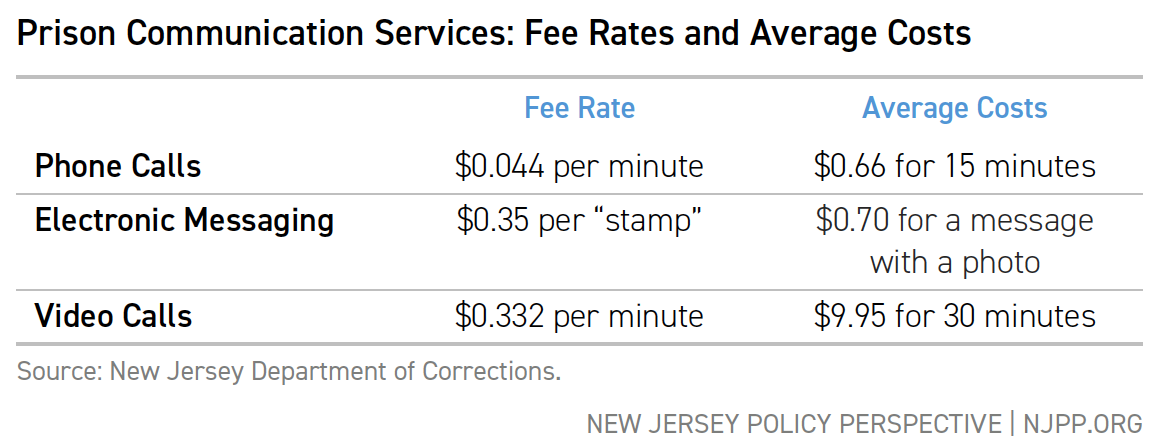
Currently, New Jersey contracts with private companies to provide communication services in prisons. These companies generate millions of dollars in revenue by charging families exorbitant fees for phone calls, video calls, and messages. As a result, incarcerated individuals and their families pay a staggering $15 million annually to stay in touch.

Prison Communication Services: Fee Rates and Average Costs

The burden of these costs disproportionately falls on families, as prison wages are abysmally low — with most workers earning up to $3.00 per day. Nationally, one in three families with an incarcerated loved one falls into debt trying to cover the costs of communication. Among those bearing these costs, 83 percent are women, with women of color hit hardest due to racial disparities in the criminal legal system.

Accessible and affordable prison communications are vital for family connections, supporting human dignity, and ensuring successful reentry after incarceration. By eliminating predatory communication fees, New Jersey can keep families connected and put an end to unjust practices that cost families millions annually. It’s time for New Jersey to prioritize connection over profit.

Combating Surveillance and Protecting Privacy: Why New Jersey Needs the Immigrant Trust Act

Every parent should be able to trust that their child can interact with public programs and systems — like schools and health care providers — without fear of being detained and separated from their family. This trust, however, has been eroded, and for good reason.

New Reports of Mass Surveillance and Data Collection

New reporting has uncovered that federal Immigration and Customs Enforcement (ICE) is using a legal loophole to retrieve sensitive data from once-trusted institutions such as public schools and libraries, youth sports leagues, and doctor’s offices. This mass surveillance can result in family separation and is particularly harmful in states like New Jersey, where nearly half a million children live with at least one non-citizen parent.[1] The Immigrant Trust Act (S3672/A4987), which has yet to receive a committee hearing in the Legislature, would help protect these families from the threat of federal surveillance and intervention.

New Jersey is one of the most diverse states in the nation with 41 percent of children in the state living in a household with immigrant parents, according to a recent analysis of Census data by the Immigration Research Initiative.[2] Those most at risk for family separation, however, are the 22 percent of New Jersey children that live with at least one non-citizen parent.[3] These children should be able to attend school — as is their legal right — and see a doctor without having sensitive data collected and stored without the permission or knowledge of their parents or guardians.

ICE uses sensitive data that it collects from a variety of service providers, both public and private, to target, track, and separate families — which has resulted in a dragnet of data, impacting more than 70 percent of US adults. This data collection has resulted in detentions and deportations, destroying families and communities across the country. Mass surveillance also results in a broader “chilling effect,” where many immigrant and mixed-status families fear accessing public services and programs they are entitled to. This puts already vulnerable families at increased risk of poverty, food insecurity, and limited access to health care.

For example, the fear created by ICE surveillance deters participation in the Children’s Health Insurance Program (CHIP), and a lack of health insurance hinders child development and threatens a family’s financial stability. This chilling effect helps explain why U.S. citizen children with at least one immigrant parent are more likely to be uninsured than children with U.S. born parents.

Keeping Families and Communities Together with the Immigrant Trust Act

New Jersey can and must do more to protect the almost half a million children at risk of surveillance and family separation, which can have long-lasting and devastating effects on their mental health, academic performance, and overall well-being. The Immigrant Trust Act will help safeguard New Jersey families by providing equal access to vital services and privacy protections, regardless of immigration status. This act, which codifies and closes loopholes in the Attorney General’s existing Immigrant Trust Directive, would prohibit state and local entities from cooperating with federal immigration authorities and limit the information that can be shared with them, thereby protecting the rights and privacy of New Jersey children and families.

The Immigrant Trust Act would help ensure that all children and families in New Jersey have access to crucial public services and programs without fear of discrimination or deportation. By protecting the rights of immigrants and their families, the state can improve the health and well-being of all residents and uphold its commitment to justice and equity for all.


End Notes

[1] Children is defined as 17 years old and younger. American Community Survey data, 2021.

[2] Immigration Research Initiative analysis of American Community Survey data, 2021.

[3] Immigration Research Initiative analysis of American Community Survey data, 2021.

New Jersey’s Prescription Drug Price Council Must Act To Build on Federal Progress

No family should have to choose between life-saving medicine and buying groceries. Yet, prescription drug spending at pharmacies has nearly doubled over the last two decades, intensifying this struggle for many families.[i] Recent federal actions allowing prescription drug price negotiations in Medicare — a federal health insurance program for senior citizens and some people with disabilities or certain chronic conditions — are an important step forward for affordability that will benefit thousands of New Jersey families. However, millions who are not eligible for Medicare still need relief. Garden State leaders can build on the federal momentum by ensuring that, once the final appointments are made, the state’s Prescription Drug Affordability Council promptly holds its required public meetings to begin its critical work on data collection and legislative recommendations to improve affordability for all residents.

Recent Federal Actions Will Cut Prescription Drug Costs for Medicare Enrollees

Federal leaders have taken significant steps toward improved affordability by allowing negotiations of prescription drug prices for Medicare enrollees through the Inflation Reduction Act (IRA) of 2022. Previously, restrictions had prevented Medicare from pushing back on pharmaceutical companies’ price hikes.[ii] Other major steps in the IRA to address affordability in Medicare include capping out-of-pocket maximums for Part D (prescription drug) coverage and limiting the cost of insulin in the program to $35.[iii]

The first of the negotiated prices, announced in August 2024 and taking effect in January 2026, include 10 prescription drugs covered under Medicare, resulting in 38 to 79 percent in savings.[iv] Further, the IRA establishes a timeline for expanding these negotiations to cover even more drugs: 15 more drug prices from the prescription drug coverage in 2025, 15 from prescription drug and medical services coverage in 2026, and 20 more each year from 2027 onward. With each new list of drugs, the negotiated prices will become effective every other January — two years after for each new list, gradually increasing the number of drugs covered and providing increased cost relief for Medicare beneficiaries.[v]

Medicare Negotiated Rates Benefit a Majority of Senior Citizens, But Few Others

While these federal negotiations are promising, they only benefit Medicare enrollees — meaning that around 82 percent of New Jersey residents will not see cost reductions from the negotiated rates.[vi] Most Medicare enrollees in New Jersey are senior citizens, with 93 percent of residents who are 65 years old and older insured through the program.[vii] In contrast, only around 3 percent of working-age adults and 0.5 percent of children in the state are enrolled in Medicare.[viii] Consequently, the majority of children and working-age adults do not receive the affordability protections provided by these negotiated rates.

Although older adults are more likely to take multiple prescriptions and higher annual health care costs, younger residents with chronic diseases such as hypertension and diabetes also face significant financial strain from high drug prices. Across all age groups, many individuals are forced to alter how they manage their medications — such as cutting pills or forgoing prescriptions entirely — due to the unaffordable costs.[ix]

Empowering the New Jersey Prescription Drug Affordability Council Will Improve Affordability for All

To ensure affordability for all residents, New Jersey must fully activate its recently established Prescription Drug Affordability Council (PDAC). State leaders passed the prescription drug reforms, including PDAC, expecting them to “bring to light the inner workings and beneficiaries within the pharmaceutical industry and work to combat rising prices.”[x] However, leaders have been delayed in finalizing the last council members; in turn, this has prevented the scheduling of the council’s first meetings and collection of data.[xi]

State law directs the council to research the obstacles to affordability in the pharmaceuticals supply and demand chains, explore further state actions to improve affordability, and make recommendations regularly to the state legislature.[xii] Given the timeline needed to conduct this in-depth research, make the first policy recommendations, pass the policies in the legislature, and provide the departments time to establish new procedures and regulations, every day that delays the work means that relief remains out of reach for New Jersey families even longer.

Once the final members of the PDAC are appointed, they must move swiftly to hold public meetings and begin gathering the in-depth data needed for their work. By moving forward, state leaders will promote a more affordable future for all Garden State residents.


End Notes

[i] RAND Corporation, Prescription Drug Prices in the U.S. Are 2.78 Times Those in Other Countries, 2024. https://www.rand.org/news/press/2024/02/01.html. RAND estimates that retail prescription drug spending increased by 91 percent between 2000 and 2020.

[ii] Congressional Research Service, Negotiation of Drug Prices in Medicare Part D, 2022. https://crsreports.congress.gov/product/pdf/IF/IF11318

[iii] KFF, Explaining the Prescription Drug Provisions in the Inflation Reduction Act, 2023. https://www.kff.org/medicare/issue-brief/explaining-the-prescription-drug-provisions-in-the-inflation-reduction-act/

[iv] Centers for Medicare & Medicaid Services, Medicare Drug Price Negotiation Program: Negotiated Prices for Initial Price Applicability Year 2026, https://www.cms.gov/files/document/fact-sheet-negotiated-prices-initial-price-applicability-year-2026.pdf; KFF, FAQs about the Inflation Reduction Act’s Medicare Drug Price Negotiation Program, 2024. https://www.kff.org/medicare/issue-brief/faqs-about-the-inflation-reduction-acts-medicare-drug-price-negotiation-program/

[v] Centers for Medicare & Medicaid Services, Inflation Reduction Act: CMS Implementation Timeline, 2022. https://www.cms.gov/files/document/10522-inflation-reduction-act-timeline.pdf; KFF, FAQs about the Inflation Reduction Act’s Medicare Drug Price Negotiation Program, 2024. https://www.kff.org/medicare/issue-brief/faqs-about-the-inflation-reduction-acts-medicare-drug-price-negotiation-program/

[vi] NJPP Analysis of Census Bureau – American Community Survey,  Table S2704, ACS 1-Year Estimates 2023. https://data.census.gov/table/ACSST1Y2023.S2704?q=S2704&g=040XX00US34

[vii] NJPP Analysis of Census Bureau – American Community Survey,  Table S2704, ACS 1-Year Estimates 2023. https://data.census.gov/table/ACSST1Y2023.S2704?q=S2704&g=040XX00US34

[viii] NJPP Analysis of Census Bureau – American Community Survey,  Table S2704, ACS 1-Year Estimates 2023. https://data.census.gov/table/ACSST1Y2023.S2704?q=S2704&g=040XX00US34

[ix] For discussion of annual health care spending, see: Centers for Medicare & Medicaid Services, NHE Fact Sheet, 2022, https://www.cms.gov/data-research/statistics-trends-and-reports/national-health-expenditure-data/nhe-fact-sheet#. For discussion of prescription drug affordability across adult age groups, see: KFF, Public Opinion on Prescription Drugs and Their Prices, 2023, https://www.kff.org/health-costs/poll-finding/public-opinion-on-prescription-drugs-and-their-prices/. For discussion of behaviors associated with high prescription drug costs, see: Healthcare Value Hub, New Jersey Residents Worried about High Drug Costs; Support a Range of Government Solutions, 2023, https://www.healthcarevaluehub.org/advocate-resources/publications/new-jersey-residents-worried-about-high-drug-costs-support-range-government-solutions-1.

[x] Quote from Senator Vitale, Chair of the Senate Health Committee. Office of Governor Phil Murphy, Governor Murphy Signs Legislative Package to Make Prescription Drugs More Affordable for New Jerseyans, 2023, https://www.nj.gov/governor/news/news/562023/20230710a.shtml.

[xi] Politico Pro, Assembly Speaker recommends AARP lobbyist for prescription drug council position, 2024. https://subscriber.politicopro.com/article/2024/04/assembly-speaker-recommends-aarp-lobbyist-for-prescription-drug-council-position-00154731; Politico Pro, Murphy makes long-awaited drug council appointments, 2024. https://subscriber.politicopro.com/article/2024/03/murphy-makes-long-awaited-drug-council-appointments-00148915

[xii] New Jersey Policy Perspective, The Best Medicine: How the Drug Affordability Council Can Advance Future Drug Pricing Reforms in New Jersey, 2023. https://www.njpp.org/publications/blog-category/the-best-medicine-how-the-drug-affordability-council-can-advance-future-drug-pricing-reforms-in-new-jersey/

Beyond the Pandemic: New Data Reveals Growing Health Insurance Coverage Gaps

All New Jersey residents deserve affordable, quality health care, regardless of immigration status, race or ethnicity, gender, age, education, or employment status. However, access to coverage, which helps mitigate individuals’ rising health care costs, remains plagued by significant gaps and challenges.

With a rising rate of residents who lack insurance, New Jersey’s leaders urgently need to address gaps in coverage. Extending existing programs that connect residents with affordable coverage regardless of immigration status and expanding coverage options for all residents would ensure that everyone can access the health coverage they need.

Coverage Gaps Re-appeared with the End of Pandemic-Era Protections

2023 marked the end of COVID-19 pandemic-era protections that kept many people covered by affordable health insurance, resulting in the first increase in uninsured residents since the pandemic began. The end of the main coverage protections was called the Medicaid “unwinding” — the reevaluation of every enrollee’s eligibility for the program after the pandemic-era pause on disenrollments ended.[i] The huge losses in coverage resulted in many families unexpectedly losing or having to change insurance.

In 2023 alone, over 660,000 New Jerseyans were uninsured, a nearly 6% increase from 2022, according to recently released data from the U.S. Census Bureau’s American Community Survey. This significant increase in state residents living without health insurance raises alarms about the recent reopening of pre-pandemic gaps in coverage and potential threats to the gains made since the introduction of the Affordable Care Act.

Racial and Economic Disparities Continue to Plague the Goal of Universal Coverage

In addition to an increase in uninsured rates, the data shows persistent racial and economic disparities in coverage rates. In particular, residents with incomes between 138 and 399 percent of the federal poverty level (between about $34,300 and $99,400 for a family of three, such as a single mother with two children) were more likely to lose coverage in 2023 than other income groups.[ii] These residents, ineligible for Medicaid and less likely to have employer coverage, faced increased uncertainty as their previous coverage options ended.

Gaps in coverage for low-wage workers and families struggling to make ends meet are closely tied to a history of racism and xenophobia; restrictions in programs like Medicaid, variations in the quality of employer-sponsored insurance, and even limitations on the state health insurance marketplaces have been structured to limit coverage for specific groups.[iii] Unfortunately, residents of color and immigrants still do not have equitable access to affordable coverage. Black residents remain twice as likely to be uninsured than white residents, while Hispanic/Latinx residents are over six times more likely to be uninsured than non-Hispanic/Latinx New Jerseyans. Immigrants, too, are far more likely to lack coverage, with non-citizens remaining over six times more likely to be uninsured than naturalized citizens and nearly 10 times more likely to be uninsured than citizens born in the United States.

Disparities continue at the county level, as counties with larger immigrant populations experience higher uninsured rates. Because of gaps in coverage, residents in counties with the largest communities of non-citizens are twice as likely to be uninsured than residents in counties with similar income levels but smaller communities of non-citizen residents.[iv]

State Leaders Need to Expand Affordable Coverage Options for All Residents

To provide affordable coverage for all, New Jersey leaders need to open the NJ FamilyCare program to older age groups and the state marketplace, GetCoveredNJ, to all residents regardless of immigration status. Additionally, the state should explore the opportunity to establish a state public option that would be available to all residents, covering adults and children who still lack affordable options due to income and immigration status.[v] Leaders must improve outreach and connections between programs so that no one loses coverage unnecessarily.

While state leaders have begun initiatives, such as the highly successful Cover All Kids program, to address gaps, persistent holes in the patchwork of coverage options will prevent the state from achieving significant improvement for all of New Jersey’s residents.[vi] As long as gaps continue for residents based on age, immigration status, and employment, universal coverage will stay out of reach.

With stronger stitching, our patchwork system of coverage can better provide accessible, affordable health coverage for all.


End Notes

[i] Stay Covered NJ, Eligibility Unwinding, 2023. https://nj.gov/humanservices/dmahs/staycoverednj/unwinding/

[ii] NJPP Analysis of U.S. Census Bureau American Community Survey, 2023, Table S2701 and 2023 Federal Poverty Levels at: https://www.healthcare.gov/glossary/federal-poverty-level-fpl/

[iii] Health Affairs, Structural Racism In Historical And Modern US Health Care Policy, 2022. https://www.healthaffairs.org/doi/10.1377/hlthaff.2021.01466; Center on Budget and Policy Priorities, Health Coverage Rates Vary Widely Across — and Within — Racial and Ethnic Groups, 2024. https://www.cbpp.org/research/health/health-coverage-rates-vary-widely-across-and-within-racial-and-ethnic-groups

[iv] The average percent of the population across counties made up of non-citizens is 8.6%, based on NJPP Analysis of U.S. Census Bureau American Community Survey, 2023 Table DP02.

[v] See footnote below on the Cover All Kids program. This program was broken into three phases of insurance enrollment goals for: (1) kids who were already eligible for NJ FamilyCare but not enrolled, (2) kids who were income-eligible but previously ineligible for NJ FamilyCare due to immigration status, and (3) kids who are both income-ineligible for NJ FamilyCare but don’t have access to other affordable options such as GetCoveredNJ due to immigration status. As of September 2024, the first two phases have been implemented, but the third phase still remains unaddressed. The law, P.L.2021, c.132., allows for the state to explore public options to fill this gap.  https://www.njleg.state.nj.us/bill-search/2020/S3798

[vi] NJ Spotlight News, Big enrollment of undocumented kids in NJ health insurance program, 2023. https://www.njspotlightnews.org/2023/08/large-number-undocumented-children-enrolled-for-nj-health-insurance-program/; New Jersey Department of Human Services, Cover All Kids, 2024. https://nj.gov/coverallkids/