Taxing “Super Luxury” Home Sales Could Make New Jersey Affordable for More Residents

As the cost of housing in New Jersey continues to soar, making it increasingly unaffordable for many residents, the market for “super luxury” homes – properties with exceptionally high price tags – continues to rise at a faster rate than all other homes. Applying a higher fee to the sale of these expensive homes could generate hundreds of millions in revenue, helping to make the state more affordable for low-income and middle-class residents. Crucially, this tax would be targeted exclusively to the wealthiest households.

New research from national experts suggests that adding a 4 percent tax on the sale of homes above $1 million could raise substantial revenue for the state. With New Jersey already facing a structural deficit, this new revenue source could fund vital programs that make living and raising a family in the state more affordable. These programs could include affordable housing initiatives, rental and mortgage assistance, and working family tax credits like the Child Tax Credit and Earned Income Tax Credit.

The impact of this fee would be limited to a small fraction of the housing market. Statewide, less than 10 percent of home sales exceed $1 million.[i] Levying a 4 percent tax on home sales over $2 million would affect only the top 2 percent of sales, while raising over $200 million in annual revenue for the state. Extending this same tax to homes sold over $1 million could generate hundreds of millions of dollars more for the state.

New Jersey’s existing 1 percent assessment on properties sold for over $1 million has not dampened the luxury home market. In fact, luxury home sales increased in 2023, even as overall sales declined.

Expanding the fee on very expensive homes would provide essential funding for affordable housing and critical infrastructure in New Jersey. It would also ensure that the state’s wealthiest residents, rather than low- and middle-income households, contribute their fair share to these vital resources.


End Notes

[i] Institute on Taxation and Economic Policy (ITEP) and Center on Budget and Policy Priorities (CBPP) analysis of data from Zillow, the National Association of Realtors, the U.S. Census Bureau, and various state and local agencies. Data on file with author.


New Jersey Chooses People Over Profits in the Fiscal Year 2025 State Budget

Headlined by a new tax on the world’s most profitable companies to fund public transit, New Jersey’s latest state budget prioritizes people over corporate profits. The newly adopted Corporate Transit Fee will collect $1.1 billion for NJ Transit, covering the agency’s looming budget shortfall and preventing drastic service cuts that would leave riders stranded.

This choice by lawmakers marks a significant departure from previous budget cycles that favored short-sighted corporate tax cuts and ignored long-term solutions for the state’s aging infrastructure. As the first-ever dedicated source of funding for NJ Transit, the Corporate Transit Fee will not only provide stable revenue to the historically underfunded agency but serve as a model for addressing New Jersey’s other pressing needs, from crumbling schools to an unprecedented shortage of affordable housing.

In this current era of record-breaking corporate profits that never seem to trickle down, there is no better time for lawmakers to call on those with the most wealth to pay their fair share towards the public goods that make New Jersey a great place to live, work, and raise a family.

The Corporate Transit Fee: A Model for New Jersey

At its core, the state budget is about what lawmakers choose to prioritize. This year, the choice was clear: The Corporate Transit Fee clawed back a $1 billion tax cut for large, mostly out-of-state corporations and set aside those funds to save NJ Transit, a pillar of the economy and lifeline for millions of riders.

The 2.5 percent fee will only be paid by corporations making more than $10 million in profits in New Jersey, like Amazon and Microsoft, and more than four out of five of the companies that will pay it are headquartered out-of-state. This policy recognizes that wealth generated in New Jersey is better off reinvested in New Jersey rather than sitting in a billionaire’s bank account or a corporate shareholder’s stock portfolio. And this is just the beginning.

State lawmakers will need to make similar choices in the future to further improve transit, upgrade centuries-old school buildings, develop new affordable homes, expand access to child care, and strengthen programs that make the state affordable for working-class families.

Looking ahead to next year’s budget, Fiscal Year 2026 already looks to be more challenging than this year’s financial outlook. The newly enacted state budget has the state operating at a structural deficit, where the state expects to spend $2.1 billion more than it’s projected to collect in revenue. This is compounded by projected cost increases on everything from health insurance to construction supplies. Making matters worse, the state continues to plow ahead with a regressive and expensive property tax credit program for senior homeowners, which will cost more than $1 billion annually with no funding source to pay for it. Without additional revenue, the state will struggle to afford its existing obligations, let alone any new investments.

And with elections looming in the next budget cycle, there is no shortage of new policy ideas from gubernatorial candidates, from guaranteed income to affordable child care for all to expanding health care access. But all of these ideas will require more revenue. Drawing on revenues from progressive sources like the Corporate Transit Fee will be crucial to ensuring that those who have benefited most from our state’s economy pay back what they owe to the rest of the state’s residents.

New policies that improve the daily lives of New Jersey residents will require broader changes to the tax code. Corporate tax reforms like “worldwide combined reporting” would close loopholes exploited by multinational corporations. The state could also rein in multi-billion-dollar tax credit programs for developers, Hollywood studios, and artificial intelligence companies with questionable returns on investment for residents. Additionally, lawmakers could end sales tax exemptions for high-end professional services and luxury goods like yachts, and reform taxes on inherited wealth on very wealthy estates.

As wealth accumulates further in the pockets of a small group of wealthy individuals and multinational corporations, it will take more of the same thinking embodied by the Corporate Transit Fee to deepen the state’s investments and build an economy that works for everyone.

Highlights and Lowlights

In many ways, the new state budget mirrors Governor Murphy’s proposal from earlier this year. Even with tax collections coming in lower than projected and federal pandemic aid expiring, the budget maintains funding for critical obligations and programs, from NJ Transit to another full pension payment to a record level of school funding.

With the budget now final, here are some highlights and lowlights on some of the key benchmarks and priorities NJPP identified earlier this year.

Highlights:

Corporate Transit Fee for NJ Transit
The new fee will collect more than $1 billion in fiscal year 2025 for NJ Transit, consistent with what Governor Murphy proposed in his initial budget. This will be NJ Transit’s first-ever dedicated funding in its 45-year history. Roughly 600 companies, 81 percent of them headquartered out-of-state, will pay the fee.

Full Pension Payment
The $7.1 billion pension payment continues a four-year streak of full payments, meeting the state’s promise to public workers and retirees while improving the state’s fiscal outlook and credit rating.

Increased School Funding
More than $900 million goes to additional K-12 school funding, including around $45 million to assist districts still receiving cuts even under a fully-funded school formula. Although these additions to the final budget do not entirely eliminate those cuts, the increase in overall school funding puts needed investments in New Jersey’s public school system.

Preserved Surplus
A $6.2 billion surplus maintains the levels from the governor’s original proposal, ensuring the state has funding left over to address any future economic downturns. Lawmakers resisted the urge to spend down the surplus, keeping the state prepared for volatile economic conditions.

Lowlights:

No Improvements to Tax Credits for Working Families
Family tax credits such as the Earned Income Tax Credit and Child Tax Credit remain flat-funded despite the high cost of living in the state. At the same time, the Legislature failed to advance bills to address the state’s appallingly low WorkFirst New Jersey grants for families in extreme poverty. 

Business Tax Credit Frenzy
In contrast to the lack of assistance for low- and middle-income families, the Legislature continued the feeding frenzy of business tax credits, loosening restrictions on credits for film and television productions and real estate development projects, while opening up half a billion dollars in credits to artificial intelligence, an unproven industry with ethical and environmental concerns.

Another Raid of the Clean Energy Fund
Instead of dedicating Clean Energy Fund dollars to support green energy upgrades for NJ Transit, the budget continues the state’s pattern of raiding the fund to pay for the agency’s basic utility costs.

No Reduction in the Cost of Communication for People Incarcerated
The final budget does not include funding to eliminate the high cost of communication for people incarcerated in state facilities. Currently, people who are incarcerated and their families must pay private contractors to send electronic messages and for phone and video calls, and even short conversations can cost more than a day’s pay.

Strengthening Access to Affordable Reproductive Health Care Coverage Advances Equity

Good afternoon Chairman Sarlo and members of the Committee. Thank you for this opportunity to provide my testimony on S3452. My name is Dr. Brittany Holom-Trundy, and I am a senior policy analyst at New Jersey Policy Perspective (NJPP). NJPP is a non-partisan, non-profit research institution that focuses on policies that can improve the lives of low- and middle-income people, strengthen our state’s economy, and enhance the quality of life in New Jersey.

NJPP strongly supports S3452, which looks to protect and improve reproductive health care access and ensure equity across state coverage here in New Jersey.

All Garden State residents deserve the ability and freedom to choose how and when they grow their families. To truly be a family-friendly state, we need to ensure that all those who are pregnant or who may become pregnant have confidence in their health care. This means guaranteeing that they will have access to affordable and quality care, regardless of their health conditions, income, immigration status, and other circumstances. By requiring that all state programs consistently offer all critical coverage for pregnancy, including abortion, and removing financial barriers to that care, this bill gives families the knowledge and certainty that is so desperately needed for the delicate, and often unpredictable, processes of reproductive health.

While we do not yet have a published OLS fiscal note on this bill, we know that the costs, especially because many state programs have already offered this coverage, will likely be minimal in comparison to other spending in the state budget. Additionally, each dollar that is committed to guaranteeing this coverage across programs represents an investment in the future; with health care, we know that accessing vital care when it is needed reduces long-term health problems and future — and, often, growing — costs for on-going medical issues. As a result, this investment saves the state money in the long run.

There is simply no need to artificially continue gaps in coverage and needlessly threaten uncertainty in health care for any New Jersey residents. Doing so creates economic hardship and discourages families from growing and investing in their own futures. It continues sexist, racist, and xenophobic tropes that we know we should leave far behind in our history. In the year 2024, no one in our state, which offers such great opportunities for advanced medical care, should have to wonder if they can access or afford life-saving reproductive care.

We hope that the Committee will agree and release this bill today.

Thank you for your time.

How StayNJ is Even More Regressive Than at First Glance

At first glance, StayNJ sounds like a promising initiative to help New Jersey’s senior homeowners stay in their homes. Who wouldn’t want to “cut property taxes in half for seniors”? However, the new property tax credit program disproportionately benefits the state’s wealthiest homeowners, an issue made worse by an overlooked flaw in StayNJ’s design: how it interacts with New Jersey’s two other major property tax credit programs.

In addition to the program’s high income cap of $500,000, higher benefits for more expensive homes, and the exclusion of renters, the regressive structure of StayNJ is compounded by how it interacts with ANCHOR and the Senior Freeze, resulting in even larger payments going to the highest-income households rather than the lower-income homeowners and renters who are most likely to be housing insecure.

As the newly released StayNJ Task Force Report details, the maximum property tax credit of the StayNJ, ANCHOR, and Senior Freeze programs combined is capped at half of one’s property tax bill, up to $6,500. Because the income eligibility for StayNJ ($500,000) is much higher than that of ANCHOR ($250,000) and the Senior Freeze ($150,000), the combined cap results in households having their ANCHOR and Senior Freeze benefits subtracted from their StayNJ benefit. Meanwhile, households with more than $250,000 in income would receive the full credit.

To illustrate how this works in practice, the case study below identifies how the combined cap would determine the property tax credit benefits for three hypothetical households: the Trentons, Hamiltons, and Princetons.

The Hamiltons and the Princetons, two households paying the same property tax bill but with vastly different incomes, would get different tax credit amounts from StayNJ because the program counts the Hamilton’s ANCHOR benefit against their StayNJ benefit. The higher-income Princetons would get nearly a quarter more in StayNJ benefits than the Hamiltons due to their higher income and ineligibility for ANCHOR.

The even lower-income Trentons would get dramatically less from StayNJ, both because of their lower property tax bill and the property tax credits they receive under ANCHOR and the Senior Freeze. In this scenario, the lowest-income homeowner would get nearly nine times less from StayNJ than the highest-income household, and roughly half of the total property tax credit amount from the three programs combined, with the Trentons receiving $3,500 total and the Princetons receiving $6,500 in total.

Take these examples and apply them across the state and one can see the bigger problem. Using the already regressive structure of StayNJ and subtracting out benefits from ANCHOR and the Senior Freeze results in an even more regressive program, where households with incomes higher than $250,000 receive the largest StayNJ benefits by virtue of earning too much to qualify for the state’s other property tax credits.

In a program as complex and costly as StayNJ, details matter, and the layering of StayNJ with other property tax credits tilts the tax code even more in favor of the state’s wealthiest homeowners at the expense of everyone else.

For more information on the shortcomings of StayNJ for low-income seniors and renters, see NJPP’s analysis of the program and testimony to the StayNJ Task Force.

No Matter What You Call Them, Private School Vouchers Are Bad for New Jersey

New Jersey’s public schools are among the strongest in the nation, a direct result of robust state funding that supports districts and students in every corner of the state. This investment in public schools is now threatened by a sweeping new bill that would establish the first-ever school voucher program in New Jersey, providing tens of millions of dollars in public funds to students attending private schools.[1]

The bill text is careful not to include the word “voucher,” a tactic recommended by anti-public school organizations like the Cato Institute.[2] Instead, the bill uses coded terms like “scholarships” and “tax credits,” but the ultimate outcomes remain the same. With an annual cost of $37.5 million, this proposal would funnel scarce public dollars to unaccountable private schools, harming students, taxpayers, and the future of public education in New Jersey.

New Jersey Cannot Afford School Vouchers, “Tax Credits,” or “Scholarships”

The proposed bill would grant tax credits to corporate and individual taxpayers who make contributions to “student support organizations.” After collecting their administrative fees, these groups would redistribute the funds to private school families. Proponents argue this is different than private school vouchers, which give state funds directly to parents or schools. But that’s a distinction without a difference.

Every public dollar in tax credits for private school scholarships is a dollar that has to be made up somewhere else, either in cuts to public programs or in higher taxes.[3] Given the state’s current fiscal situation, the last thing New Jersey needs right now is a multi-million-dollar giveaway to private schools.

In other states, wealthy individuals and businesses have used similar tax credit schemes to reduce their tax liability by more than the amount of their donation, essentially making money on private school vouchers.[4] The New Jersey bill, as proposed, would create incentives to do the same.

It’s worth noting that in other states, voucher programs started small, but grew enormously in a short time. Arizona’s voucher program, for example, totaled $57 million in 2012 and ballooned to $218 million by 2022.[5] It’s telling that the original version of the New Jersey bill set the total cost at $250 million; if it passes, it wouldn’t at all be surprising to see the bill reach this extremely high cost in the near future.

Most Funding Would Benefit Those Already Enrolled in Private School

The bill sets the income threshold for a family of five at $176,000 — nearly twice the median household income[6] — meaning families that can afford private schools on their own will now take money from the rest of the state’s taxpayers to subsidize their children’s private school education.[7]

Some argue voucher programs do not cost states school funding because the state doesn’t have to pay to educate students who would otherwise attend public school. This logic fails, however, up against the fact that large numbers of private school students wouldn’t attend public school under any circumstances. More than half of New Jersey’s private schools students, for example, attend religious schools; it is reasonable to assume many of their parents would always choose a religious education for them, no matter the availability of private school vouchers.[8]

In fact, data from other states confirm that similar programs subsidize large numbers of private school families whose children never attended public schools. In Florida, for example, 69 percent of students who enrolled in the state’s voucher scholarship program for the first time were already attending private schools.[9] Similarly, two-thirds of Iowa’s voucher students were already enrolled in private schools.[10] Other states have similar figures.[11]

New Jersey Already Gives Extensive Support to Private Schools

By law, New Jersey’s school districts must provide funding to private schools for textbooks, handicap services, nursing, technology, and other programs and services.[12] According to state data, public schools transferred nearly $80 million to private schools in the 2021-22 school year.[13] There is no public audit available showing how, exactly, this money was spent.

In addition, public schools must provide transportation to resident children attending private schools within a 20-mile radius.[14] How much this costs taxpayers is unclear; state data does not separate out transportation costs between public and private school students, further highlighting the state’s lack of oversight for its current private school subsidies.

The current bill doesn’t rescind this private school support; instead, it piles even more subsidies on top of an unfunded mandate, pulling even more money from public schools.

Private Schools Lack Oversight and Are Allowed to Discriminate

Despite receiving public funds, New Jersey’s private schools have little to no accountability to the state’s taxpayers. Private school students do not take state tests, so there is no way to determine if they are receiving an adequate education. Unlike public schools, the state doesn’t have a true monitoring and accountability system in place for private schools.[15]

Privatization advocates will often argue that parental “choice” is the only accountability taxpayers need. This is, of course, absurd. If taxpayers are going to foot the bill for private school education, they deserve a real oversight system to protect their interests. Such a system, however, requires significant resources — funding that could be used to improve public schools, which are open to all students.

The current bill has no provision for private schools to change their admissions policies, meaning schools receiving taxpayer funds could systematically exclude students with learning disabilities or students who are English Language Learners, concentrating these students — whose costs are greater — into public schools. As is the case in other states, religious schools that discriminate against LGBTQ+ students would also be eligible for public funding.[16]

Voucher Programs Lead to Worse Student Outcomes

Proponents of private school vouchers used to claim that private schools get better academic outcomes than public schools. Their claims were based on decades-old, small-scale studies that inadequately controlled for differences in student characteristics.

As researchers at the University of Indiana point out, more recent studies with better methods paint a very different picture.[17] States that have implemented large-scale private school voucher systems have seen dramatic declines in student outcomes. In some studies, the effects have been larger than estimates of the learning loss from the COVID-19 pandemic.[18]

There Are Better Ways to Support Students

 Public school leaders across New Jersey have begged the Legislature to revise the state’s school funding formula, which has been shown to be inadequate in meeting the current needs of students.[19] Implementing a new scheme for funding private schools takes time and attention away from this important work. It also diverts funds away from public schools and toward private schools, which have no meaningful oversight and can pick and choose who they admit.

New Jersey’s students deserve better. The Legislature should drop this bill and get back to the work of ensuring that every student can attend a well-resourced public school.


End Notes

[1] https://www.njleg.state.nj.us/bill-search/2024/S3035

[2] https://www.cato.org/education-wiki/scholarship-tax-credits-vouchers

[3] https://networkforpubliceducation.org/wp-content/uploads/2019/01/Are-tax-credits-scholarships-a-voucher-by-a-different-nameƒ.pdf

[4] https://itep.org/tax-avoidance-fuels-school-vouchers-privatization-efforts/

[5] https://azdor.gov/sites/default/files/2023-05/REPORTS_CREDITS_2023_fy2022-private-school-tuition-org-credit-report.pdf

[6] https://data.census.gov/all?q=New+Jersey+Income+and+Poverty

[7] https://www.federalregister.gov/documents/2024/02/20/2024-03355/child-nutrition-programs-income-eligibility-guidelines#p-15

[8] https://nces.ed.gov/surveys/pss/

[9] https://www.wmfe.org/education/2023-09-14/florida-policy-institute-school-voucher-data-step-up-for-students

[10] https://educate.iowa.gov/press-release/2024-01-26/certified-enrollment-2023-24-holds-steady-16757-esa-participants-enrolled-iowa-accredited-nonpublic

[11] https://www.ncpecoalition.org/voucher-recipients

[12] https://www.nj.gov/education/nonpublic/

[13] https://www.nj.gov/education/finance/fp/ufb/

[14] https://www.nj.gov/education/genfo/faq/faq_transportation.shtml

[15] https://www.nj.gov/education/qsac/

[16] https://www.orlandosentinel.com/2020/01/23/anti-lgbt-florida-schools-getting-school-vouchers/

[17] https://ceep.indiana.edu/education-policy/policy-briefs/2023/research-on-school-vouchers.pdf

[18] https://www.brookings.edu/articles/research-on-school-vouchers-suggests-concerns-ahead-for-education-savings-accounts/

[19] https://www.njpp.org/publications/report/unlocking-academic-success-revitalizing-new-jerseys-school-funding-formula-for-student-achievement/

What to Look for in the New Jersey Budget for Fiscal Year 2025

New Jersey’s state budget can be a powerful tool to reduce income inequality, advance racial equity, and improve the standard of living for working families. This requires investments in areas that boost widespread economic security and opportunity — like strong public schools, affordable health care, and reliable mass transit — supported by a fair tax code that primarily raises revenue from profitable corporations and individuals with the highest incomes and wealth.

The investments made in the state budget are vital to the state’s social and economic health, especially now as many working- and middle-class residents struggle to keep up with rising costs. But with lawmakers touting affordability as their top priority in the State House, working families may see cuts to essential programs or have to pay more in taxes, fares, and fees to make up for lower-than-expected revenue collections and a newly enacted $1 billion corporate tax cut.

Without additional federal pandemic aid to draw from, Governor Murphy and legislative leaders have a choice. They can either balance the next state budget on the backs of families who need the most help or require the wealthiest individuals and most profitable corporations to contribute more toward the public investments that helped fuel their success.

Ahead of Governor Murphy’s budget address for Fiscal Year (FY) 2025, NJPP has identified the following key benchmarks and priorities to evaluate whether the next state budget sufficiently advances economic, social, and racial justice.

Overall Fiscal Health

Bring Back the Corporate Surcharge on Big Businesses
New Jersey is set to lose $1 billion in annual revenue after state lawmakers allowed the Corporation Business Tax surcharge to expire on January 1. This tax cut will make it difficult for lawmakers to balance the state budget as-is, let alone one with any new or expanded programs aimed at boosting affordability. Since the corporate surcharge is only paid by the most profitable corporations in the world — including multinational corporations headquartered outside of New Jersey — lawmakers should bring back this targeted 2.5 percent tax to balance the state budget without raising costs for low- and middle-income households.

Fully Fund Pensions and Schools
Beyond the inherent value that pensions and public schools provide to retirees and students, respectively, New Jersey’s long-term fiscal health improves when the state fully funds its major obligations. After years of skipped pension payments and underfunding the school funding formula — culminating in 11 credit downgrades during the Christie administration alone — Governor Murphy has reversed course, and the state has seen its credit rating upgraded multiple times as a result. Higher credit ratings result in lower interest rates when borrowing and paying off debt, providing savings to the state and taxpayers alike. To keep up this momentum, lawmakers should make another full pension payment and continue ramping up state aid for public schools.

Maintain a Healthy Surplus
A healthy surplus allows the state to weather difficult economic conditions, such as a recession, without resorting to drastic budget cuts when tax collections come in lower than expected. In the past, New Jersey failed to maintain a robust surplus, leaving the state unprepared at the onset of the pandemic. At the start of the current fiscal year, New Jersey had a surplus of roughly $8 billion, which should be maintained, at a minimum. Raiding the surplus, as some lawmakers have suggested, would do nothing to fix the state’s long-term structural deficits and leave the state vulnerable during the next economic downturn.

Family Affordability

Expand and Improve Tax Credits for Working Families
New Jersey has two notable tax credit programs designed to put money back in the pockets of low- and middle-class families across the state: the Child Tax Credit (CTC) and the Earned Income Tax Credit (EITC). Together, these tax credits provide targeted, direct assistance to workers and families who often spend that money immediately in their local communities, providing a broader economic benefit. Expanding the eligibility and benefit levels of these credits would go a long way toward the governor’s goal of making New Jersey the best place to raise a family. Specifically, the CTC should be expanded to include children up to age 12, and the EITC should include taxpayers who file with an Individual Tax Identification Number (ITIN).

Increase Benefits in WorkFirst NJ to Reduce Poverty
To make New Jersey affordable for everyone, the state should prioritize the lowest-income families who have the hardest time keeping up with the rising cost of living. Yet WorkFirst NJ, the state’s temporary assistance program targeted to residents with the lowest incomes, has not kept up with inflation and has a benefit amount well below the poverty line. The benefit level in WorkFirst NJ should increase to reflect the actual cost of living rather than an outdated, insufficient number.

Health Care

Expand Affordable Health Insurance Options
New Jersey has successfully reduced the uninsured rate for children through the Cover All Kids program, which expanded NJ FamilyCare to all income-eligible kids, regardless of immigration status. However, thousands of children still lack coverage because their families do not qualify for Medicaid and are barred from accessing the state marketplace, GetCovered NJ, even at full price. The budget should eliminate these barriers to affordable health coverage by creating a buy-in option for NJ FamilyCare plans and opening the marketplace and its state subsidies to all residents, regardless of immigration status.

Increase Outreach for NJ FamilyCare
The end of pandemic-related health coverage expansions has forced more than 360,000 New Jersey residents to lose their coverage, with more than 3 in 4 losing their insurance for procedural reasons alone. The state has invested in outreach to reduce the number of eligible residents being disenrolled, but state funding must increase to prevent more families from losing their health insurance.

Continue to Fund Harm Reduction Expansion
Harm reduction centers have been shown to prevent overdose deaths, which account for more than 3,000 deaths annually. By providing critical resources such as naloxone and safe-use supplies, harm reduction centers save lives and connect people who use drugs to the care and support they need. However, as the state looks to double the number of harm reduction centers after decades of disinvestment, additional funding will be required to meet increased demand and further reduce overdose deaths.

Environment and Transit

Fully Fund NJ Transit to Avoid Drastic Fare Hikes
NJ Transit plays a vital role in the daily lives of commuters and the state’s broader economy. However, the agency’s future is in jeopardy with a $200 million budget shortfall that will grow to $1 billion next fiscal year. To cover this year’s deficit, the agency proposed a 15 percent fare increase, but this will not solve the structural issue behind the agency’s financial woes: a lack of sufficient dedicated state funding. Fare increases also function as a regressive tax on working-class commuters and have been shown to reduce ridership. NJ Transit desperately needs sustained, dedicated state aid, as NJPP identified in a report last year. Without a plan to use progressive sources that tax those with the most wealth, the state runs the risk of drastic service cuts and fare hikes.

Use the Clean Energy Fund on Clean Energy
For the last decade, money dedicated to clean energy has been diverted to NJ Transit to pay for basic maintenance instead of its intended purpose of promoting the use of clean energy. If lawmakers continue to divert money from the Clean Energy Fund to NJ Transit, the budget should include specific language to ensure these dollars are used to transition the agency’s buses, trains, and buildings to green energy and zero emissions.

Criminal Legal System

Eliminate the Cost of Communication for People Incarcerated
Last year, New Jersey took a monumental step in addressing the hardship of fines and fees in the criminal legal system by eliminating public defender fees. The state budget should continue to reduce these hardships by addressing the exorbitant cost of prison communication. The families of people who are incarcerated must pay private contractors for phone and video calls with their loved ones, and a short conversation can cost more than a day’s pay for people in state facilities. Communication with family can reduce recidivism and help those incarcerated maintain ties with their community. The state budget should cover these costs, as other states do, and ensure meaningful access to phone and video services.

New Jersey’s Population is Actually Growing, Despite Data from Moving Van Companies

Every year, surveys from moving van companies sound the alarm on people moving from New Jersey. But in reality, New Jersey keeps growing in population, workers, and income. While these companies excel at transporting household possessions, research isn’t exactly their forte.

What’s worse, these “studies” are used to fuel the false narrative that taxes cause wealthy people to leave the state. This leads to demands for tax cuts for the wealthy, which would cost the state billions of dollars in revenue and hurt essential public investments such as schools, environmental protections, and public transportation.

New Jersey Keeps Growing in Population

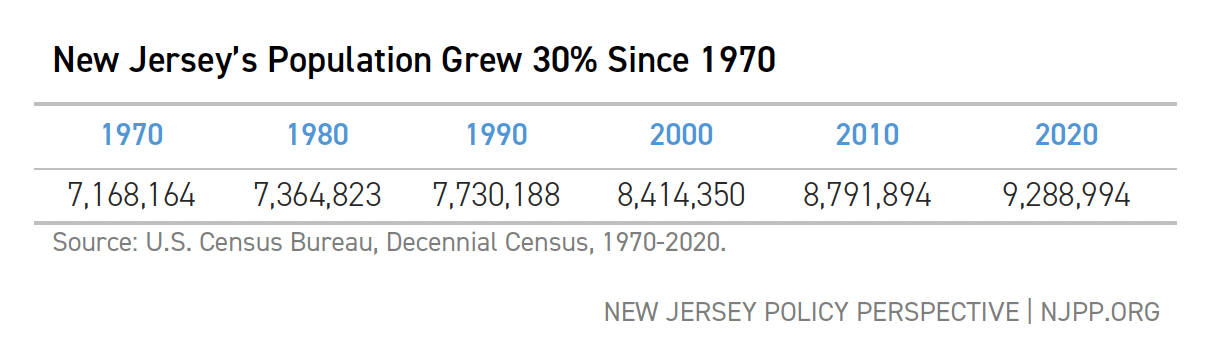
New Jersey’s population is rising, contrary to the conclusions of moving company surveys. Between 1970 and 2020, the state’s population increased by 30 percent, according to the U.S. Census Bureau’s Decennial Census. With its consistent methodologies, comprehensive, inclusive approach, and official government oversight, the Decennial Census is the most reliable measure of population.

New Jersey's Population Grew 30% Since 1970 - Table detailing population growth from 7,168,164 in 1970, to 9,288,994 in 2020.

The Census data contrasts sharply with moving companies’ data conclusions about population changes. Their flawed methodologies only show the interstate movements of people who use one moving company – their company. A single moving business doesn’t encompass the wide range of movers available, and many people move without the use of professional movers or rental trucks. Additionally, consistent with the rest of the country, most New Jersey moves are in-state, not out-of-state.

New Jersey Keeps Adding Wealthy Residents, Not Losing Them

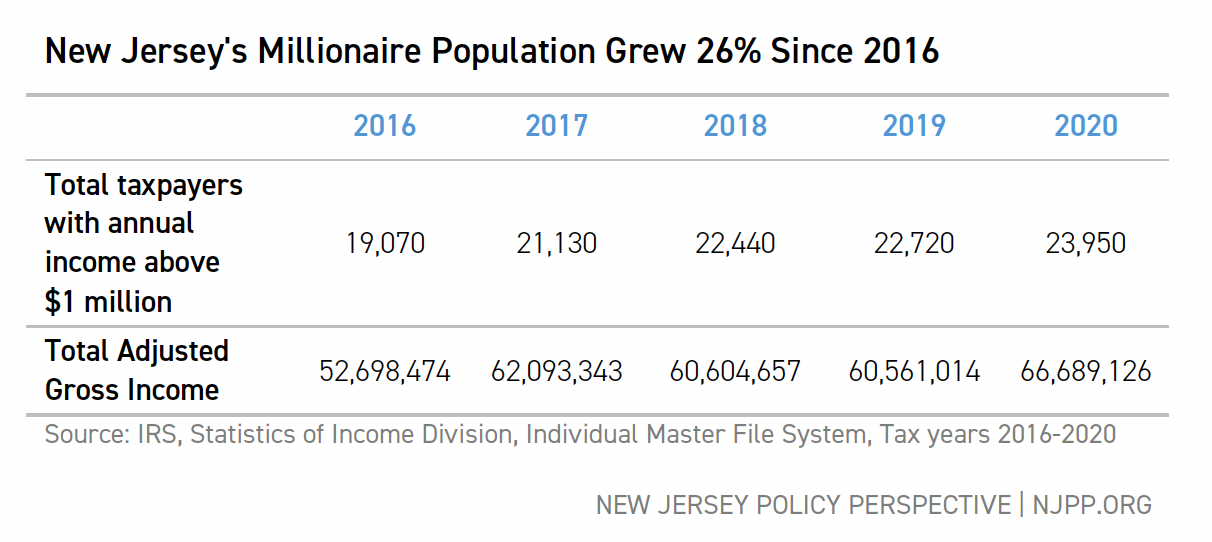
Wealthy people are not leaving the state in droves. Despite anecdotes suggesting otherwise, IRS statistics show that the number of New Jersey high-income households (and their total income) keeps increasing. Specifically, these households have increased by about 26 percent since 2016, according to the IRS Statistics of Income (SOI).

New Jersey's Millionaire Population Grew 26% Since 2016 - Table detailing millionaire population growth from 19,070 in 2016 to 23,950 in 2020.

The SOI IRS data shows that New Jersey continues to add taxpayers, income, and high-income residents. Even when high-earning individuals leave for other states, New Jersey’s booming economic engine generates more than enough wealth and high-income employment to make up for it.

Taxes are rarely the reason why people move, as evidenced by exhaustive research. Rather than resorting to drastic tax cuts for the wealthy that undermine critical infrastructure and services, policymakers should focus on making life more affordable for working families and improving and maintaining the amenities that make New Jersey a great place to live.

State of the State 2024: Rapid Reaction

Governor Phil Murphy delivered his sixth annual State of the State address last week, marking the start of a new legislative session in New Jersey. The address focused on ways to make New Jersey the best place to raise a family, from protecting reproductive rights and freedoms to new policies to make the state more affordable. However, the speech lacked any reference to how the state would pay for these investments, particularly in the aftermath of lawmakers’ decision not to renew the Corporate Business Tax surcharge by year’s end.

Without the corporate surcharge’s $1 billion in annual revenue generation, lawmakers will be hard-pressed to fund the many programs and services the Governor outlined in his speech. To make matters worse, the state’s financial outlook is not as strong as it was a year ago, with tax collections coming in lower than expected and federal pandemic aid running out.

Below are the rapid reactions from NJPP’s team of analysts on what was in the speech, what was notably absent, and what state lawmakers should focus on in the new legislative session.

Peter Chen
Senior Policy Analyst (Tax and Budget)

Governor Murphy spoke at length about how his administration wasn’t afraid to address the “fiscal elephant in the room,” cleaning up the state’s finances with full pension payments and increased school funding. But other “fiscal elephants” went unmentioned, namely the looming deficits for NJ Transit and the child care sector. These services desperately need funding, as do all other services trumpeted in the Governor’s address. There was no mention of additional revenue to replace the $1 billion lost from the corporate surcharge, and we all know that this revenue will have to be made up somewhere else in the budget.

Additionally, for a speech focused on making New Jersey the best place to raise a family, there were few new policies focused directly on family affordability. Certainly, a proposal to expand affordable housing is welcome news, but there was no mention of direct cash programs to help raise families out of poverty. For example, the Governor did not propose any expansion of tax credits for working families, and there was nothing in the speech about infant and toddler child care.

To address the “fiscal elephants” in the room and make New Jersey affordable for families with the lowest incomes, state lawmakers should:

  • Bring back the Corporation Business Tax surcharge. To pay for New Jersey’s long-term investments and ambitious programs, the state must ensure the biggest and most profitable corporations pay their fair share. Bringing back the 2.5 percent surcharge would be a good start.
  • Expand family and child tax credits. Expanding the Child Tax Credit to older children, increasing the benefit amount, and removing barriers to the Earned Income Tax Credit could substantially reduce poverty and make life affordable for low- and middle-income families.


Brittany Holom-Trundy
Senior Policy Analyst (Health and Safety Net)

The Governor used his speech to acknowledge the significant medical challenges residents face across the state, and he outlined some new initiatives to promote affordability in health care. Between medical debt relief through the Louisa Carman Medical Debt Relief Act — named in honor of a young policy analyst who tragically lost her life on New Year’s Day — and the elimination of financial barriers to abortion through the Reproductive Equity Act, the Governor’s proposals would make New Jersey a healthier and more equitable state.

It’s important to note that addressing medical debt on the back end is one piece of a broader puzzle regarding health care affordability. Lawmakers should advance this proposal with initiatives that expand access to affordable health coverage options for all residents. This would ensure New Jersey has the leading health system in the country.

Finally, the word “poverty” was not in the Governor’s remarks, as it had been in years past. Despite a theme of making the state more affordable for families, decision-makers continue to leave direct cash assistance programs — namely WorkFirst NJ — to languish. As a result, federal dollars and state resources continue to fall short of their full potential in supporting families with the lowest incomes.

To make health care more affordable for families with low incomes, lawmakers should consider initiatives that:

  • Expand affordable coverage options for all residents, regardless of immigration status, age, race, or gender. This includes removing barriers to NJ FamilyCare and GetCovered NJ to ensure that additional age groups are eligible, building on the success of the Cover All Kids program.
  • Revamp the WorkFirst NJ program, so families with low incomes have the support they need. This includes increasing monthly grant amounts, smoothing exit ramps, and ensuring the program’s requirements meet the needs of residents looking to build a sustainable future.


Alex Ambrose
Policy Analyst (Transportation and Climate)

Governor Murphy recommitted to New Jersey’s 100 percent clean energy goal by 2035, which is crucial for moving away from harmful fossil fuels. However, he stopped short of action by not taking the opportunity to urge the Legislature to pass bills to ensure these efforts become reality. In the last session, lawmakers failed to codify the goal into law, and this year’s bills remain in the balance due to misinformed opposition. The longer the state waits, the more time these fossil fuel-funded misinformation campaigns have to stop offshore wind projects, holding back the state’s transition to a clean energy future. Typically, these campaigns weaponize “energy privilege” when wealthy white communities oppose wind projects, slowing clean energy goals in the majority of Black and brown communities who bear the brunt of the climate crisis.

Also, a notable omission from the speech is NJ Transit and its impending fiscal cliff, which will face a budget shortfall of $120 million in the upcoming fiscal year. That shortfall will quickly balloon to nearly $1 billion (yes, with a ‘b’) by the next fiscal year, threatening a vital service that millions of New Jersey residents rely on. While the Governor has yet to propose a solution, Senate President Nick Scutari recommended using the corporate surcharge to fully fund NJ Transit in his speech during the swearing-in ceremony for new legislators.

During the new legislative session, lawmakers can make progress on clean energy and public transit if they:

  • Establish clean energy standards that center environmental justice. New Jersey needs comprehensive clean energy legislation that prioritizes Black and brown communities that are disproportionately harmed by pollution and the climate crisis.
  • Fully fund NJ Transit. Lawmakers can fund NJ Transit by bringing back the corporate surcharge. Fully funding the agency is the only way to avoid drastic service cuts and fare hikes.


Marleina Ubel,
Senior Policy Analyst (Criminal Legal Systems and Immigrants’ Rights)

The Governor spent a minor part of his speech restating his commitment to criminal justice reform, where he acknowledged the failures of the drug war and the state’s glaring racial disparities in incarceration. As he spoke about helping those “unjustly thrown behind bars” get back on track, the Governor mentioned the rollout of a new clemency initiative we’re looking forward to learning more about.

While it’s important that the Governor stated these facts, it’s hard to look past how these words stand in stark contrast to last year’s actions when legislators passed, and the Governor signed various tough-on-crime bills and rollbacks to bail reform. This tough-on-crime approach fuels racial disparities in jails and prisons and is proven to be an ineffective response to public safety, running counter to the Governor’s promise to create a more fair and humane system.

On immigrants’ rights, it was refreshing to hear the Governor recognize immigrants as the backbone of New Jersey, especially now with xenophobia and anti-immigrant rhetoric on the rise. However, the context used in his speech was narrow, focusing solely on immigrant business owners. Given the challenges migrants are facing, we would have liked to see the Governor stand up and support all immigrants, from those who have built their lives here to the newcomers dreaming of doing the same.

Looking forward, here are some ways lawmakers can further reform the criminal legal system and make New Jersey a more inclusive state for all:

  • Drop the tough-on-crime rhetoric and policies. We know this approach is ineffective and harmful and that these policies disproportionately harm Black and brown residents. Instead, invest in community-led initiatives and programs that get residents the support they need.
  • Promote accountability in policing. A proposal to create civilian complaint review boards died last legislative session–this year, lawmakers must ensure this bill passes.
  • Codify the Immigrant Trust Directive. The New Jersey Attorney General’s directive currently prevents state agencies from collaborating and sharing private information with ICE. Codifying this directive will build trust between immigrant families and help make New Jersey a truly fair and welcoming state.

New Jersey’s Lowest Income Families Could Lose Their Emergency Assistance

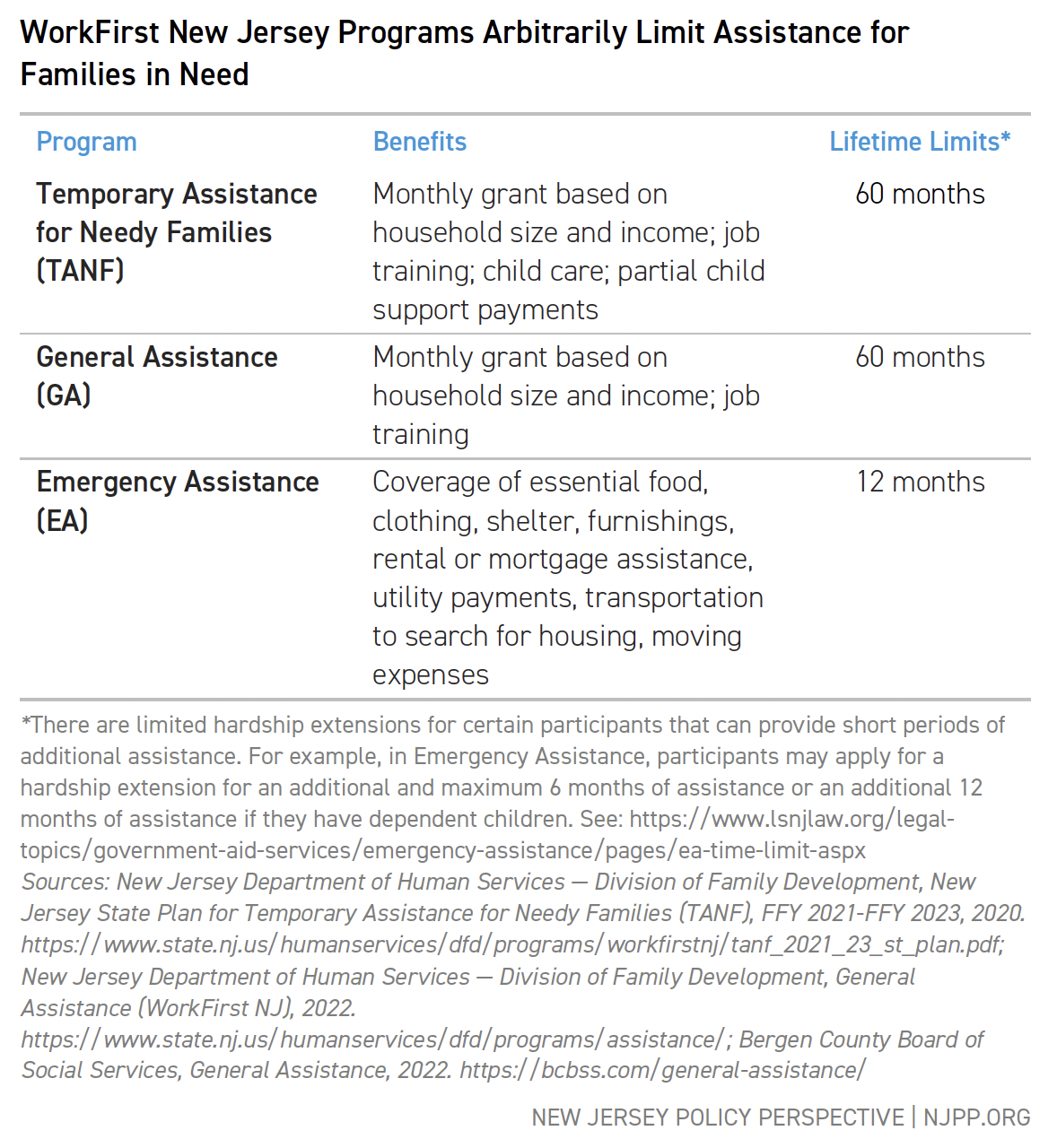
Thousands of low-income families across New Jersey could lose vital cash support in February unless lawmakers extend a provision in the state’s Emergency Assistance program that eased restrictive limits on benefits.[i] A lifeline for families who fall on hard times and risk losing their housing, Emergency Assistance provides direct support to cover the costs of back rent or mortgage payments, utilities, food, clothing, and more to protect residents from the harmful effects of poverty and homelessness.

Like many other cash assistance programs for low-income families, Emergency Assistance is an effective anti-poverty tool that is undermined by outdated and punitive restrictions implemented during the welfare reform movement of the 1990s, including arbitrary lifetime limits on benefits. In 2018, state lawmakers recognized that the 12-month lifetime limit on Emergency Assistance was overly restrictive and created new exemptions for families facing the greatest barriers to stable housing and a secure income. However, the exemptions in this law are temporary and are set to expire in February 2024 unless lawmakers act fast.

The 2018 law lifted the lifetime limit for residents who are: living with a disability; full-time caretakers of children or dependents with disabilities; over 60 years old; receiving Supplemental Security Income (SSI); or facing persistent barriers to employment.[ii] During the current lame duck session, New Jersey lawmakers and Governor Murphy can make sure these low-income residents and their families continue to qualify for the cash support they need by enacting S3960/A5549 and maintaining the exemptions to lifetime limits on Emergency Assistance implemented five years ago.

Arbitrary Time Limits on Cash Assistance are Punitive and Harmful for Low-Income Families

The time limits in New Jersey’s cash assistance programs within Work First New Jersey (WFNJ) are not grounded in evidence but come from outdated and discriminatory stereotypes from the 1990s welfare reform movement.[iii] Lifetime limits on benefits, like the 12-month limit in Emergency Assistance, set arbitrary cutoffs for people who often still need assistance and face an imminent risk of losing their housing. This punitive approach means that assistance is not provided when it is needed most, further contributing to the cycle of poverty and making it harder for families to build a strong foundation and invest in their future.[iv]

Emergency Assistance benefits provide additional support to families participating in other WorkFirst New Jersey programs — Temporary Assistance for Needy Families (TANF) and General Assistance — during crisis situations so they can stay housed, fed, and clothed. The assistance ranges in dollar amounts depending on the circumstances, and families can apply for each month they are in need for up to 12 months total. Continuation of benefits requires regular re-assessments of the participant’s need and development of a plan for recovery.[v] Despite its role in filling a critical gap in the state’s cash support system, Emergency Assistance has the shortest lifetime limit of the WorkFirst New Jersey programs, so most participants are only eligible for one-fifth of the total time they are allowed to access other programs.[vi]

In Fiscal Year 2023, more than 5,700 residents receiving TANF and General Assistance each month also received Emergency Assistance benefits, representing roughly 13 percent of recipients,[vii] with an average grant of $1,032 per month.[viii] Thousands of these families received Emergency Assistance every year due to the 2018 law, further demonstrating how more families can get the support they need without lifetime limits in effect.[ix] With the harm of the pandemic still felt throughout the state and far too many families living in poverty, this additional assistance is essential for low-income families.

Unless lawmakers act soon and pass S3960/A5549, New Jersey risks slipping backward in its support for low-income families. There is no sound policy rationale to maintain arbitrary and outdated lifetime limits on assistance, and this lame duck session is an opportunity to strengthen cash assistance programs and create the robust safety net that New Jersey families deserve.


End Notes

[i] NorthJersey.com, Most vulnerable could become homeless if NJ Legislature fails to extend aid, advocates say, 2023. https://www.northjersey.com/story/news/2023/11/21/vulnerable-could-end-up-homeless-if-nj-legislature-fails-to-extend-aid-shelters/71657027007

[ii] Legal Services of New Jersey, Emergency Assistance and Time Limit Extensions, 2022. https://www.lsnjlaw.org/legal-topics/government-aid-services/emergency-assistance/pages/ea-time-limit-aspx; New Jersey Department of Human Services, Work First New Jersey Emergency Assistance Training, 2019. https://www.nj.gov/humanservices/dmhas/information/provider/Provider_Meetings/2019/DMHAS%20EA_080119_SJM.pdf; N.J. Stat. § 44:10-51 (3). https://casetext.com/statute/new-jersey-statutes/title-44-poor/chapter-4410-reference-to-county-welfare-board-to-mean-reference-to-county-welfare-agency/section-4410-51-provision-of-emergency-assistance

[iii] Center on Budget and Policy Priorities, TANF Policies Reflect Racist Legacy of Cash Assistance, 2021. https://www.cbpp.org/research/income-security/tanf-policies-reflect-racist-legacy-of-cash-assistance. Congressional Research Service, The Temporary Assistance for Needy Families (TANF) Block Grant: A Legislative History, 2023.https://sgp.fas.org/crs/misc/R44668.pdf

[iv] Center on Budget and Policy Priorities, Three Reasons Why Providing Cash to Families With Children Is a Sound Policy Investment, 2022. https://www.cbpp.org/research/income-security/three-reasons-why-providing-cash-to-families-with-children-is-a-sound

[v] New Jersey Department of Human Services, Work First New Jersey Emergency Assistance Training, 2019, pg. 18-19. https://www.nj.gov/humanservices/dmhas/information/provider/Provider_Meetings/2019/DMHAS%20EA_080119_SJM.pdf

[vi] New Jersey Department of Human Services, Work First New Jersey Emergency Assistance Training, 2019, pg. 25. https://www.nj.gov/humanservices/dmhas/information/provider/Provider_Meetings/2019/DMHAS%20EA_080119_SJM.pdf

[vii] NJPP Analysis of New Jersey Treasury – Office of Management and Budget, Governor’s FY2024 Detailed Budget, 2023, pg. D-224. https://www.nj.gov/treasury/omb/publications/24budget/FY2024BudgetDetail-Full.pdf

[viii] New Jersey Treasury – Office of Management and Budget, Governor’s FY2024 Detailed Budget, 2023, pg. D-224. https://www.nj.gov/treasury/omb/publications/24budget/FY2024BudgetDetail-Full.pdf

[ix] New Jersey Office of Legislative Services, Legislative Fiscal Estimate for S866, 2018. https://pub.njleg.state.nj.us/Bills/2018/S1000/866_E2.PDF

The Best Medicine: How the Drug Affordability Council Can Advance Future Drug Pricing Reforms in New Jersey

Every New Jersey resident deserves access to affordable medicine. Yet, the burden of high and rising drug prices has put essential medications out of reach for many, harming their health, well-being, and financial stability. To combat this crisis, New Jersey lawmakers recently enacted a number of prescription drug reforms, including a law establishing the Drug Affordability Council.

Even with these new laws, however, more actions are needed to fully address the prescription affordability crisis in New Jersey. This analysis highlights the significant role of the Drug Affordability Council in advancing future drug pricing reforms, and includes four recommendations for the council so it can reach its full potential.

New Reforms Take Important Steps But Leave Many Behind

During the 2023 state budget negotiations, lawmakers advanced several significant initiatives to address prescription drug affordability. A package of bills signed by Governor Murphy include measures to increase transparency in the pharmaceutical market, better regulate pharmacy benefit managers (the middlemen of the pharmaceutical industry), and cap prices for a few essential drugs (insulin, EpiPens, and asthma inhalers) in certain insurance plans.[i] One of these bills, S1615, also established the Drug Affordability Council. Together, these reforms complement actions taken at the federal level in the Inflation Reduction Act, which took steps to improve drug affordability for Medicare enrollees.[ii]

Yet, like a rope bridge with weak and missing planks, the reforms still leave a significant amount of work to achieve affordable prescription drugs for all who need them. Many of these reforms only help residents enrolled in particular insurance plans: the federal Inflation Reduction Act, as mentioned, focuses on Medicare enrollees, while many of the state-level reforms focus on individuals insured through certain state-regulated plans or, at their broadest, help those with insurance coverage that includes extremely high copays for medicines. This leaves many people without meaningful assistance, including those who are enrolled in employer self-funded plans as well as those who are uninsured.

The Drug Affordability Council Can Help Advance Future Reforms

Addressing this affordability crisis for all residents requires addressing the root causes of high drug prices that harm everyone, regardless of insurance coverage. Fortunately, the new Drug Affordability Council holds enormous potential to address these root causes and transform the lives of countless patients who have struggled to access life-saving treatments. While the Council cannot unilaterally enact and implement new reforms, it can provide policy and regulatory recommendations to state lawmakers and administrative officials to stop pharmaceutical companies from inflating drug prices, thereby holding them accountable and curbing unjustifiable cost hikes that hinder patients’ access to life-saving treatments.

The Council will also have access to data collected through newly enacted transparency measures, as well as any information gathered through its own research and convenings. With this unprecedented level of data access, its members will be able to produce detailed recommendations for legislative and executive measures for effectively lowering pharmaceutical costs. These reports mark a crucial step in prioritizing the needs of patients over corporate interests.

Recommendations for the Drug Affordability Council

State leaders must set a strong foundation for the Council as it gets up and running to ensure it fulfills its potential in meaningfully addressing high prescription drug costs. This starts with thoughtful appointments to the Council, including those with a patient/consumer perspective, and by setting clear expectations on the need for transparency, community input, and bold recommendations based on best practices from other states. Below are four recommendations that the Murphy administration should consider over the coming months.

1. Appoint Members Who Represent the Interests of Patients, Not the Pharmaceutical Industry

Members of the Council will play a crucial role in setting the prescription drug reform agenda, informing data collection and analyses, and communicating recommendations to legislative and executive leadership. This requires a high level of knowledge of the pharmaceutical industry and relevant policy, as well as a critical eye for research. Ensuring that these roles are fulfilled not only by people with experience in the health care profession but also by those who can represent the patients’ perspectives is crucial for the Council’s work.

The Governor, Senate President, and Speaker of the Assembly should carefully review candidates’ expertise and backgrounds when considering their appointments, always remembering that this Council is meant to work for New Jersey residents. The law requires that the Council’s membership be established within 180 days of the bill’s enactment, providing a deadline of January 6, 2024 for the appointments.[iii]

2. Establish a User-Friendly Website to Communicate the Council’s Work

Transparency and accountability must be prioritized in the Council’s research, data collection, and reporting on its own activities. Drug affordability boards in other states have created websites that quickly and easily guide visitors to an explanation of their work, any reports issued, and ways that the public or other interested stakeholders can reach out to discuss priorities.[iv]

New Jersey’s Drug Affordability Council and the Department of Law and Public Safety, the department that will house the Council, should follow the lead of other states by establishing an easy-to-navigate site that can keep the public informed and involved.

3. Build Relationships With Communities Early in the Process

Once the Council’s membership is confirmed, those members should quickly establish a regular schedule of meetings with community organizations to gather input on their work. An in-depth understanding of the major issues facing consumers, and a willingness to incorporate those experiences into the Council’s work, will be essential to conducting successful research and making sound recommendations.

The law requires that the Drug Affordability Council hold open meetings and accept public comments, and that the first of these meetings be held within 30 days once its membership is confirmed.[v] While the public’s involvement in these meetings is a good step for transparency, truncated comments at busy meetings will not be enough to understand the complex landscape of affordability obstacles. Members should incorporate residents’ input even more effectively through regular conversations with community partners throughout the Council’s work.

4. Consider Major Policy Recommendations With Guidance From Other States

The Council will not have to start from scratch, as several other states are many steps ahead in their boards’ and councils’ work. While New Jersey’s Council will approach drug affordability through a Garden State-specific lens, that does not mean that complicated policies explored in detail in other states should be ignored. Instead, the Council should consider major reform recommendations made by other boards, including policies with fully developed frameworks, such as upper payment limits.[vi]

By working with already-existing policies and research from other states, the New Jersey Drug Affordability Council can move quickly to recommend significant reforms and finally help Garden State residents struggling with exorbitant prescription drug prices.


End Notes

[i] Office of Governor Phil Murphy, Governor Murphy Signs Legislative Package to Make Prescription Drugs More Affordable for New Jerseyans, 2023. https://www.nj.gov/governor/news/news/562023/20230710a.shtml

[ii] Kaiser Family Foundation, Explaining the Prescription Drug Provisions in the Inflation Reduction Act, 2023. https://www.kff.org/medicare/issue-brief/explaining-the-prescription-drug-provisions-in-the-inflation-reduction-act/

[iii] P.L.2023, c.106, section 10b. https://pub.njleg.state.nj.us/Bills/2022/S2000/1615_R2.PDF

[iv] Example websites: Colorado Prescription Drug Affordability Board and Advisory Council (https://doi.colorado.gov/insurance-products/health-insurance/prescription-drug-affordability-review-board), Maryland Prescription Drug Affordability Board (https://pdab.maryland.gov/), Oregon Prescription Drug Affordability Board (https://dfr.oregon.gov/pdab/pages/index.aspx).

[v] P.L.2023, c.106, section 10d-g. https://pub.njleg.state.nj.us/Bills/2022/S2000/1615_R2.PDF

[vi] Three states have empowered their prescription drug affordability boards to set upper payment limits (Maryland, Colorado, and Minnesota). While New Jersey’s Council does not have the power to set upper payment limits itself, it can research potential limits and make recommendations based on that research. Helpful resources from Maryland and Colorado with background research on this policy include: Jane Horvath, Presentation for Maryland Prescription Drug Affordability Board, State Prescription Drug Upper Payment Limits Explained, 22 March 2021. Available at: https://pdab.maryland.gov/documents/presentations/Horvath_Health_Policy_Upper_Pymt_Limits_03222021.pdf or on file with author; State of Reform, Maryland’s Prescription Drug Affordability Board to soon publish draft plan for establishing upper payment limits, 2023, https://stateofreform.com/featured/2023/05/marylands-prescription-drug-affordability-board-to-soon-publish-draft-plan-for-establishing-upper-payment-limits/; Program on Regulation, Therapeutics, and Law (PORTAL), presentation to Maryland Prescription Drug Affordability Board, Cost Reviews & Upper Payment Limits, 22 May 2023. Available at: https://pdab.maryland.gov/documents/meetings/2023/havard_med_sch_prst.pdf and on file with author; Colorado Prescription Drug Affordability Board, materials on UPL Methodology. Available at: https://drive.google.com/drive/folders/159F04Zi8bWLkRgXrP_uEfsu-uSf4nSJv and on file with author.