
A phone call home can mean everything for the thousands of people incarcerated in New Jersey’s prisons and jails. Staying connected improves mental health, strengthens family ties, and helps people prepare for a successful return to their communities. But for many, these calls come at a high and unjust price. In 2024, NJPP released a report detailing these costs and who they harm most.
Historically, private companies ViaPath and JPay held monopoly contracts with New Jersey prisons and jails, charging families millions of dollars each year just to stay in touch with their loved ones. The scale of the problem is immense: in 2023 alone, these two companies generated over $7 million from phone calls, electronic messages, and video calls in state prisons.[1] Phone calls alone made up nearly three-quarters of that revenue, with ViaPath collecting almost $5.3 million from incarcerated New Jerseyans.[2]
The New Jersey Department of Corrections (NJDOC) has since renegotiated its contract, ending its relationship with JPay and securing new, lower rates with ViaPath.[3]
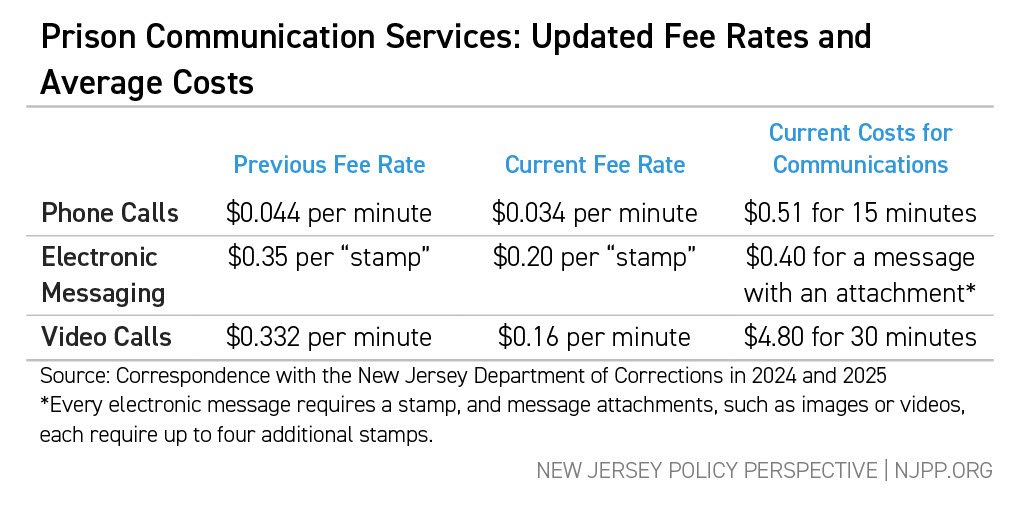
Despite the new rates, families across New Jersey are still projected to pay an astonishing $6.6 million annually just to stay connected to their loved ones.[4]
That is roughly 65 percent of the total wages paid to incarcerated people in 2022, who typically earn just $1.60 to $7.50 a day.[5] For the many people in prison who earn the lowest daily pay rate, making a phone call home or sending an email costs a significant portion of their earnings. As a result, most of these costs fall on loved ones.
The financial burden is heaviest for women of color, specifically Black women, who are disproportionately the ones paying these costs.[6] Nationally, one in three families with an incarcerated loved one goes into debt trying to afford prison phone calls and messages.[7] In New Jersey, where the Black-white incarceration disparity is the highest in the nation, this is not just an economic issue but a racial justice one.[8]
Other states and cities have recognized that charging families for prison communication is both cruel and counterproductive. In recent years, New York, Massachusetts, Minnesota, and several other states have eliminated fees entirely.[9] New Jersey should not lag behind. At a cost of less than half a percent of the state’s $1.1 billion corrections budget, New Jersey could cover communication costs for every person incarcerated in a state prison and end these predatory practices.[10]
Keeping families connected is about more than fairness — it is about building safer, stronger communities. Regular communication reduces recidivism, supports children of incarcerated parents, and helps ensure that people return home ready to succeed.[11] No one should be forced to choose between debt and family ties.
New Jersey should make prison phone calls, emails, and video calls free of charge. Families have carried this cost for too long.
End Notes
[1] Ubel, M. Prison Profiteers: How Private Companies Profit From Prison Phone Calls and Harm New Jersey Residents. New Jersey Policy Perspective. (2024). Number has been adjusted for inflation.
[2] Ubel, M. Prison Profiteers: How Private Companies Profit From Prison Phone Calls and Harm New Jersey Residents. New Jersey Policy Perspective. (2024). Number has been adjusted for inflation.
[3] New Jersey Department of Corrections response to FY26 budget hearing questions. 2025. Pg. 27.
[4] Based on fiscal analysis done by Worth Rises using average DOC and jail population data and 2024 usage data provided by DOC including taxes and deposit fees paid by families. This figure only includes the costs associated with prisons ($6.6 million). The cost to families with loved ones in county jails would be an additional $6.5 million. Methodology is on file with author.
[5] Total wages in 2022 have been adjusted for inflation. New Jersey Department of Corrections response to FY24 budget hearing questions. 2023. Pg. 21; New Jersey Department of Corrections response to FY26 budget hearing questions. 2025. Pgs. 22-23.
[6] deVuono-powell, Saneta, et al. Who Pays? The True Cost of Incarceration on Families. Ella Baker Center, Forward Together, Research Action Design. Sep. 15, 2015. Pg. 9.
[7] deVuono-powell, Saneta, et al. Who Pays? The True Cost of Incarceration on Families. Ella Baker Center, Forward Together, Research Action Design. Sep. 15, 2015. Pg. 9.
[8] Nellis, A. The Color of Justice: Racial and Ethnic Disparity in State Prisons. The Sentencing Project. Oct. 2021. Pg. 10.
[9] Watford, A. New York Becomes Latest State To Offer Free Phone Calls In Prisons. Stateline. Aug. 1, 2025.
[10] Based on fiscal analysis done by Worth Rises which estimates it would cost the state as little as $1.5 million to provide fully free communications across New Jersey state prisons. Methodology on file with author. Fiscal Year 2025-2026 Analysis of The New Jersey Budget: Department of Corrections And State Parole Board. New Jersey Office of Legislative Services. Apr. 2025. Pg. 2.
[11] Wang, L. Research Roundup: The Positive Impacts of Family Contact For Incarcerated People And Their Families. Prison Policy Initiative. Dec. 21, 2021; Worth Rises. The Prison Industry: How It Started, How It Works, and How It Harms. Dec. 2020. Pg. 52.