AI Data Centers Drive 20% Electric Bill Spike, Cost New Jersey Families Billions

Families and small businesses across New Jersey are paying higher electric bills to subsidize the explosive growth of AI data centers, according to a new report from New Jersey Policy Perspective released today.

The report, Fool’s Gold: The Hidden Costs of AI Data Centers for New Jersey,” finds that data centers were the main driver of the 20 percent jump in electric bills that New Jerseyans experienced in June 2025. By 2030, nearly 10 percent of New Jersey’s entire electrical usage will go to data centers, or the equivalent of powering the entire state of Rhode Island.

“New Jersey families are getting hit twice,” said Alex Ambrose, NJPP Senior Policy Analyst and report co-author. “They’re paying more each month to subsidize data center expansion, and they’re breathing dirtier air because these facilities are keeping polluting power plants running. Meanwhile, the companies building these data centers are getting tax breaks and walking away with the profits.”

The report finds that data center growth imposes serious costs: higher utility bills, increased air pollution in environmental justice communities, strain on water resources, and minimal long-term job creation despite state subsidies.

A typical large AI data center uses as much energy as 100,000 households. During the 2025-26 capacity auction, AI data centers accounted for nearly 70 percent of the increase in demand, driving the 20 percent electric bill spike. Utilities are passing infrastructure upgrade costs to households and small businesses with no protections in place.

The environmental costs fall hardest on communities already facing pollution burdens. More than half of all coal and gas plants in the regional grid are within a mile of an environmental justice community. In Vineland, a proposed data center plans to use diesel backup generators in a community where residents already experience asthma, heart disease, and lung cancer at rates higher than the state average.

Despite promises of economic development, a 250,000 square-foot data center employs about 50 people after construction ends. By comparison, warehouses generate one job for every 600 square feet.

States are losing billions in subsidies. Virginia lost $1.6 billion in sales tax revenue, more than 20 percent of its total. New Jersey’s Next New Jersey program offers up to $500 million in tax credits for AI data center construction.

The report recommends four policy-based solutions:

  • create a standard regulatory definition of data centers;
  • require companies to pay higher rates and report energy use publicly;
  • standardize load forecasting to prevent inflated projections;
  • and remove or restrict state subsidies.

“The path forward is clear,” said Ambrose. “Stronger rules, cleaner energy, and a commitment to putting people before corporate profits.”

The full report is available at njpp.org.

Fool’s Gold: The Hidden Costs of AI Data Centers for New Jersey

Introduction

Robust, responsible economic development must ensure businesses bear the costs they create, protect the environment, and uphold sound fiscal policy so that state tax dollars do not subsidize private profits. Data centers and the technological products they support may seem exciting and new, but they also impose costs on local communities and the state as a whole. As with prior economic development booms, from warehouses to shopping malls, an accurate accounting of the hidden costs of these buildings can empower policymakers to make better decisions and protect residents.

Behind the promises of jobs and economic growth, the dramatic expansion of data centers has harmed states and communities: these facilities use large amounts of energy, do not deliver meaningful long-term benefits, and cause the state to lose money from subsidies and credits. The growth in artificial intelligence (AI) products has driven rapid growth in data centers, but that growth strains local communities and infrastructure.[1]

New Jersey residents and small businesses are already paying more for electricity because of data center energy consumption. Data centers were the main driver of the 20 percent jump in electric bills that New Jerseyans experienced in June 2025.[2] And with more data center demand pushing construction across the country, New Jersey will see increased exposure to the risks associated with data centers.

To address these hidden risks to the state’s communities and residents, utility costs, and fiscal stability, NJPP recommends the following:

  1. Create a standard definition of a data center for the purposes of state regulation.
  2. Build strong guardrails for data center companies around cost sharing, transparency, and energy resource requirements.
  3. Standardize energy load forecasting.
  4. Remove or restrict data center subsidies.

The Basics of Data Centers

When a user types a prompt into an AI tool, a data center’s computers use an enormous amount of computing power to generate the tool’s response. What may appear to the user to be magic has very real costs in electricity, water, and infrastructure. At its core, a data center is just a different kind of industrial or commercial facility, designed to maximize profits for its owners and operators. Understanding the costs data centers impose on communities and the reality of their operations can help policymakers develop laws and regulations that protect residents and the places they live.

What is a data center?

Simply put, a data center is a big room filled with computers. As more computing power is needed to conduct operations for artificial intelligence programs, more of these rooms are needed to keep up with demand, with more resource-intensive computers and all the infrastructure needed to run them, including electricity to power the computers and water for their cooling needs.[3] As a result, a medium-sized data center can consume more than 100 million gallons of water per year, roughly as much as a small town.[4]

Because definitions of a data center can include everything from a small server room to a huge warehouse, information on data centers can be difficult to obtain. Different states use different definitions of data centers for regulatory purposes. Some simply identify “large load customers,” defining a facility that needs a certain amount of energy (say, 100 megawatts) as a “large load customer,” without specifying that it must be a data center.[5] For certain tax exemptions, states may have different definitions, which might include specific industry codes, capital investment minimums, or jobs created.[6]

For the purposes of this report, NJPP uses a broad definition of “data centers” that includes a wide range of facilities designed to contain computing infrastructure. The rapid growth in data centers is driven by the computing demands of AI products, sometimes leading to the shorthand of “AI data centers” to describe newer, larger buildings.

Illustrated diagram of a data center

Where are data centers in New Jersey and where are they planned?

New Jersey currently has 48 data centers, with another 12 announced or under construction, according to Aterio, a research firm that tracks the industry.[7] Different publications and firms use different definitions for what constitutes a data center, and no universal database exists. Aterio’s count includes small, midsize, and “hyperscale” facilities categorized by power consumption and public-facing descriptions such as utility filings, public investor statements, and press releases.

Companies decide where to locate or “site” their facility based on a number of factors. Because data centers often require substantial space commitments, they tend to be located outside of denser urban or suburban areas, with new proposed sites in New Jersey in communities such as Vineland, Moorestown, and Clinton.[8] Companies also consider zoning, access to a high-quality network, and the ability of the utility to meet their energy needs; but one of the biggest factors is choosing a place where there are previously developed facilities.[9] This means data centers tend to be concentrated in one area, further straining local grids and communities. Loudoun County, Virginia has the highest concentration of data centers in the world, where new data centers are being constructed near schools, residential neighborhoods, and retirement communities, consuming enormous amounts of resources in the process.[10]

How much energy and water does a data center use?

Data centers use a significant amount of energy, but because of a lack of transparency in energy reporting, exact data is unavailable and the energy usage of data centers can vary widely. A typical large data center that focuses on AI uses as much energy as 100,000 households.[11] However, some larger ones that are currently under construction across the country could use 20 times that much energy.[12] In New Jersey, estimates project nearly 10 percent of New Jersey’s entire electrical usage will go to data centers by 2030, or the equivalent of the energy usage of the entire state of Rhode Island.[13]

In fact, in the next several years, data center energy consumption will grow four times faster than total consumption from all other sectors, and the United States is projected to be the global leader in that explosive growth.[14] According to New Jersey’s regional grid operator PJM, AI data centers accounted for nearly 70 percent of the increase in demand during the 2025/26 capacity auction — the same auction that resulted in a 20 percent increase in electric bills for New Jersey residents.[15]

Approximately 60 percent of the energy a data center uses goes to powering the servers, while the rest goes toward cooling systems.[16] These cooling systems demand large amounts of both electricity and water. In 2024, large AI data centers across the United States consumed about 14 billion gallons of water[17] — a number that could double by 2028.[18]

Precise water usage figures are difficult to verify because data center companies are not required to report them publicly. This lack of transparency is a problem for a state that has experienced several droughts in recent years, including the 2024-25 drought that resulted in crop losses and increased wildfire risk.[19] Any further strain on the state’s water resources could threaten its economic and environmental well-being.

What other costs do data centers impose on ratepayers?

Electricity rates are set by the utility providers in New Jersey and approved by the Board of Public Utilities.[20] Yet there are currently no mechanisms in place to protect everyday ratepayers, such as families and small businesses, from higher costs due to data center buildout. Experts find that despite utility companies saying they keep data center costs separate, these ratepayers are essentially subsidizing big tech companies’ data center projects through higher electricity bills.[21] Aside from the increase in electricity demand, data centers also often require upgrades to transmission infrastructure, and those costs are already being passed on to households and local businesses through increases in their electric bills.[22] If a data center company closes its facility, ratepayers can be left on the hook to pay for those upgrades without strong guardrails in place.

What kinds of jobs do data centers produce?

Data center construction, like any large building project, creates a short-term increase in construction jobs. But once the building is complete, relatively few jobs remain, as the data center is largely space for computers and their cooling and power infrastructure. The limited empirical research has shown no clear evidence of an association between data center development and local tech job creation.[23] Industry estimates place about 50 jobs in a 250,000 square-foot facility — roughly 5,000 square feet per job.[24] By comparison, warehouses generate one job for every 600 square feet, while offices provide one job for every 190.[25] A Brookings Institution report summarizes the existing research: data center development has produced mostly short-term construction jobs in recent years and relatively little long-term, high-value tech activity or large-scale employment.[26]

How Policymakers are Responding to Data Centers

As data center growth has rapidly accelerated, policymakers face a shifting landscape and have been slow to advance policies that address its rising costs. From electrical and water usage to economic development credits, the industry has outpaced policy constraints and regulation.

What makes data centers challenging for state and local policymakers?

Data centers are challenging for state and local policymakers in part because of a lack of transparency in the development process. One major issue is with predicting load growth, or how much electricity a region will need in the future. While it may seem that planning for higher energy use than is needed is a good thing, over-budgeting by too large a margin can artificially drive up costs and continue to increase ratepayer bills. Currently, load growth in New Jersey and surrounding states is predicted by each utility reporting to PJM how much energy it expects it will need in the future. However, this process is not standardized and utility companies often report projects at different stages of development.[27] The demand forecasts that PJM receives may be double- or even triple-counting data center projects because companies will often put in multiple bids for a single project and pull out of all but one once they have chosen their site.[28]

Forecasts through 2030 show demand six times higher than just a few years ago.[29] While there are several factors that contribute to this jump, including manufacturing and electrification, the main driver of this increase in expected demand is data centers.[30] Without a standard system that ensures large load projects like data centers are only counted once, forecasts will remain inflated, driving up costs further. And if policymakers continue to use new and existing oil, coal, and gas plants to meet demand that may never materialize, New Jersey could be locked into using these less reliable, more expensive, and more polluting power plants for decades to come.[31]

How do existing state, regional, and federal policies address AI data centers?

Recent advances in hardware have led to an explosion in the expected development of AI data centers.[32] AI requires dramatically more processing power than traditional computing, driving the skyrocketing demand. U.S. Department of Energy research projects up to 12 percent of total nationwide electricity going to data centers by 2028, or roughly five and a half times what New Jersey uses in a year.[33]

Lawmakers have been unable to keep pace with the rapid growth of data centers, and the regional grid operator PJM has failed to act to protect ratepayers.[34] During the December 2025 capacity auction, existing and planned resources fell short of the reserve needed for grid reliability.[35] This means that if nothing else changes, the region could soon face rolling blackouts on the hottest and coldest days of the year.

PJM recently attempted to adopt policies to address data centers through an expedited decision-making process, but could not secure enough votes on any single proposal.[36] Instead, the board issued a letter outlining six actions it plans to take; but the response falls short of what is needed to hold data centers accountable, protect ratepayers from future increases, and prevent further air pollution across the region.[37]

How do data centers affect environmental justice communities?

On top of higher utility costs, the increase in demand from data centers is delaying the transition to renewable energy, risking local resident health and climate goals. Decision makers, including PJM and the White House, are delaying closures of fossil fuel plants and considering reviving retired ones to meet growing demand.[38] More than half of all coal and gas plants in the PJM region are within a mile of an environmental justice community, which means residents there are not only facing higher bills, but continuing to breathe more polluted air than in other areas.[39]

Using a large generative AI model can produce as much air pollution as more than 10,000 round trips by car between Los Angeles and New York City — and a single model can draw power from multiple data centers.[40] Experts also found that in 2023, air pollution attributed to data centers in the United States caused about $6 billion in public health damages, and that number could increase up to $20 billion per year if lawmakers continue business as usual.[41] For comparison, vehicle emissions in 2016 alone caused $12 billion in health damages for New Jersey.[42] Any increase could be devastating to the health of every state resident.

Data centers have worsened health outcomes for surrounding communities. One facility outside the PJM region in Tennessee runs without pollution controls due to a federal loophole; local residents report that the increase in emissions has made their existing conditions, like asthma, even worse.[43] In New Jersey, a proposed data center in Vineland plans to use diesel backup generators, which would increase local air pollution in a community already suffering from worse health outcomes.[44] A 2022 report found that residents there experience asthma, heart disease, and lung cancer at rates higher than the state average — all conditions worsened by diesel exhaust.[45] Vineland residents have also reported ongoing noise from construction, which can cause permanent hearing damage.[46]

How are states subsidizing and supporting data center growth?

Seeking economic development, many states have rolled out corporate subsidy and tax benefit programs for data centers.

Most states have focused on reductions in sales taxes, particularly those with limited or no taxes on corporate profits. Other states have exemptions on electricity taxes, while others offer property tax reductions.[47] New Jersey’s economic development tax credit program provides tax benefits for data center construction.

The Next New Jersey program allows artificial intelligence or “AI-related” businesses to apply for tax credits of up to $250 million to cover construction, building, or employment-related costs, with a total cap of $500 million in credits.[48]

To define what qualifies as an “AI data center,” the law requires that a facility must handle AI tasks and lists the types of services the facility offers and the systems it houses — namely computing systems and the computers’ support infrastructure.[49] This definition captures a broad range of potential facilities, while not clarifying their size, electrical and water usage, and environmental impact.

Eligibility criteria include:

  • At least 50 percent of the business’s employees are engaged in “artificial intelligence-related activities” or 50 percent of the business’s revenues come from “artificial intelligence-related activities”;
  • At least $100 million in capital investment at the facility; and
  • At least 100 new full-time jobs in New Jersey (construction, building services, etc. may count, but only up to 50 percent of employment).[50]


In addition to Next New Jersey, data centers can qualify for subsidies that apply to all industries, such as the Emerge and Aspire economic development tax credit programs, which create incentives for businesses to locate in New Jersey.[51]

How much do data center subsidies cost states?

As the data center industry has grown, so have the costs of these subsidies for states. Incentives that seem small-scale can quickly balloon as the boom in construction clusters in certain areas, leading to substantial budget instability.[52] At least 10 states have lost more than $100 million in data center subsidies.[53] Virginia is a dramatic example, with its sales tax exemption costing the state $1.6 billion[54] — more than 20 percent of its total sales tax revenue of $7.6 billion.[55] Illinois has seen similar losses, with nearly $1 billion drained from its state budget.[56]

Because of these rapidly rising costs, some states have begun pulling back their subsidies for data centers, including Minnesota, which removed its electricity sales tax exemption.[57]

Currently, New Jersey’s data center tax credit does not anticipate revenue costs in Fiscal Year 2027, though the program is relatively new and has not yet issued any credits.[58]

Solutions for Policymakers to Protect New Jerseyans

The problems data centers create are not going away, and there are many lessons that both New Jersey and PJM can learn from other states and regions. While experts predict future demand could continue to explode and drive up costs, good policy could be the difference between modest increases with no additional pollution and higher costs with higher pollution.

The following are proposals to mitigate the hidden costs of data centers:

1. Create a standard definition of a data center for the purposes of regulation.

New Jersey’s current definition of an “AI data center” for the purposes of administering the Next New Jersey tax credit program does not effectively capture the broad range of facilities, nor does it assist in regulation of their electrical, water, or environmental costs to communities.[59] NJPP recommends creating a standard statutory definition of a data center for specific regulatory purposes (such as electrical and water usage) to ensure that regulations are consistently applied to this class of buildings and the costs associated with them.

2. Build strong guardrails for data center companies around cost sharing, transparency, and energy resource requirements.

Data centers are driving up electricity prices for families and small businesses, and lawmakers can require them to pay more to offset those increases — but as it stands right now, there are no safeguards in place. At the end of his term, Gov. Murphy refused to sign a bill that would have created a new rate for data centers, charging them more for their energy usage to help offset the increases on household and small business energy bills.[60] New Jersey would not be the first state to do this – at least 33 other states have either proposed or implemented different rate structures for large load customers including data centers.[61] In fact, Minnesota enacted a fee on data centers with funds going towards energy efficiency for low-income residents.[62] A rate structure such as this ensures that families and small businesses are not paying more for their electricity and instead puts the cost on the companies that are causing rates to increase. It also incentivizes energy efficiency and other innovative ways to reduce energy use, benefiting both the data center company and the state’s residents.

Second, New Jersey can join other states in requiring data centers to report their energy and water usage to the state’s Board of Public Utilities. By requiring more transparency, both lawmakers and community members can make informed decisions about future policy.

Finally, lawmakers can require data center companies to bring their own generation, specifically clean energy, if they want to build data centers in the state. Other states have learned hard lessons about what happens when a data center company is left unregulated and can run polluting energy sources unchecked, as in Tennessee, where gas turbine pollution has been a problem. New Jersey can set the standard now to protect energy affordability and cleaner air in the future.

3. Standardize load forecasting.

Because AI data centers are an emerging technology, and the idea of large load projects “shopping around” in multiple jurisdictions is a new problem, policies have not yet standardized how utilities and states report their future energy needs to entities such as PJM. Standardizing load forecasting can be done at the state level; it is even more powerful at the regional level, so each utility uses the same protocols to report its energy needs. While PJM has failed to address this issue, the BPU can work with PJM and utilities to reduce duplication of projects and ensure load forecasting is as accurate as possible in New Jersey. This will also reduce the need to keep older coal, oil, and gas plants online, protecting New Jerseyans and the entire PJM region from more air pollution. Additionally, the state and PJM can consider policies that will ensure any necessary blackouts during peak energy days prioritize families and small businesses over data centers.

4. Remove or restrict data center subsidies.

As the state approaches a substantial budget gap, programs that provide subsidies to private corporations need reevaluation.[63] Many states are already reevaluating these subsidies, and New Jersey’s relatively new program has yet to issue an approved credit, providing time to reduce its cost before substantial revenue losses occur.[64] Given the substantial hidden costs of these centers, reducing these incentives or increasing restrictions on their use may help alleviate the burden on communities and the state budget. National experts also have proposed guardrails in the absence of full repeal that can limit the negative impact of these subsidies on communities and their budgets, including lowering the duration and amount of subsidies, prohibiting non-disclosure agreements, requiring public listing of all recipients and applicants, and requiring community benefits agreements in line with other tax incentive programs.[65]

Conclusion

Because of AI data centers, communities are facing higher costs, a more unreliable grid, more pollution, and a lack of transparency that makes holding these companies accountable nearly impossible. New Jersey’s families and small businesses are already paying to subsidize them through higher electric bills. But these problems can be solved. The future of New Jersey’s affordable clean energy, along with its economic and environmental well-being, hinges on lawmakers prioritizing everyday New Jerseyans over for-profit technology companies. The path forward is clear: stronger rules, cleaner energy, and a commitment to putting people before corporate profits.


End Notes

[1] Leppert, R. What we know about energy use at U.S. data centers amid the AI boom. Pew Research Center. Oct. 24, 2025.

[2] Chavin, Sabine, et al. Tackling the PJM Cost Crisis. Evergreen Collaborative. Apr. 15, 2025. p.2.

[3] Metz, C. et al. “How A.I. Is Changing the Way the World Builds Computers,” New York Times. Mar. 16, 2025.

[4] Yanez-Barnuevo, M. Data Centers and Water Consumption. Environmental and Energy Study Institute. June 25, 2025.

[5] Utah Code Sec. 54-26-101 (2025).

[6] Compare N.C. Stat. Sec. 105-164.3(47) (2025) (defining data center as “a facility that provides infrastructure for hosting or data processing services and that has power and cooling systems that are created and maintained to be concurrently maintainable and to include redundant capacity components and multiple distribution paths serving the computer equipment at the facility”) with Ga. Rules and Regulations Rule 560-12-2-.117 (2025) (requiring that a “high-technology data center” “power, cool, secure, and connect” computer equipment, as well as certain investment thresholds).

[7] Aterio. US Data Centers Dashboard. Feb. 2026.

[8] FracTracker Alliance. Data Centers Identified by FracTracker Alliance. 2025.

[9] Leppert, R. What we know about energy use at U.S. data centers amid the AI boom. Pew Research Center. Oct. 24, 2025.

[10] Chen, A. “A.I. Is on the Rise, and So Is the Environmental Impact of the Data Centers That Drive It.” Smithsonian Magazine. Sept. 29, 2025.

[11] Copley, M. “Data centers are booming. But there are big energy and environmental risks.” NPR. Oct. 14, 2025.

[12] Leppert, R. What we know about energy use at U.S. data centers amid the AI boom. Pew Research Center. Oct. 24, 2025.

[13] Blanford, G. et al. Powering Intelligence 2026: Updated Scenarios of U.S. Data Center Electricity Use and Power Strategies. Electric Power Research Institute. 2026.

NJPP analysis of U.S. EIA data. See table C1. p.3.

[14] Ibid. See “Energy Demand from AI”

[15] Ambrose, A. Why Are New Jersey’s Electricity Bills Going Up, and What Does PJM Have to Do With It? New Jersey Policy Perspective. (2025).

[16] Leppert, R. What we know about energy use at U.S. data centers amid the AI boom. Pew Research Center. Oct. 24, 2025.

[17] Leppert, R. What we know about energy use at U.S. data centers amid the AI boom. Pew Research Center. Oct. 24, 2025.

[18] Ibid.

[19] National Integrated Drought Information System. New Jersey conditions. National Oceanic and Atmospheric Administration Accessed March 2026.

[20] New Jersey Board of Public Utilities. About NJBPU. Access Mar. 2026.

[21] Martin, E. and Peskoe, A. Extracting Profits from the Public: How Utility Ratepayers Are Paying for Big Tech’s Power. p.1.

[22] Ibid. p.15.

[23] Gargano, A. & Giacoletti, M. Subsidizing the Cloud: U.S. State Incentives to Data Centers. SSRN Working Paper No. 5881105. Feb. 2026. P. 39.

[24] Joint Legislative Audit and Review Commission. Report to the Governor and the General Assembly of Virginia: Data Centers in Virginia, 2024. Dec. 9, 2024. P. i.

[25] Fuller, S. NAIOP Research Foundation. Economic Impacts of Commercial Real Estate, 2021 Edition. 2021. P. 17.

[26] Goetzel, D. et al. Turning the data center boom into long-term, local prosperity. Brookings Institution. Feb. 5, 2026.

[27] National Association of Regulatory Utility Commissioners. Forecasting Load Growth: Assumptions and Risks, February 10, 2025. p.2.

[28] Ibid.

[29] Wilson, J.D. et al. Power Demand Forecasts Revised Up for Third Year Running, Led by Data Centers. Grid Strategies. Nov. 2025. p.3.

[30] Ibid.

[31] Goldsmith, I. and Byrum, Z. Powering the US Data Center Boom: Why Forecasting Can Be So Tricky. World Resources Institute. Sept. 17, 2025.

[32] Shehabi, A. et al. 2024 United States Data Center Energy

Usage Report. Berkeley Lab, Energy Analysis & Environmental Impacts Division. December 2024. P. 6.

[33] Shehabi, A. et al. 2024 United States Data Center Energy

NJPP analysis of U.S. EIA data.

Usage Report. Berkeley Lab, Energy Analysis & Environmental Impacts Division. December 2024. P. 5-6.

[34] Ambrose, A. Why Are New Jersey’s Electricity Bills Going Up, and What Does PJM Have to Do With It? New Jersey Policy Perspective. (2025).

[35] Hanawa, A. PJM’s 2027/2028 Base Residual Auction results: demand response prices climb for the third straight year. Enel North America. Dec. 22, 2025.

[36] Howland, E. “PJM stakeholders fail to agree on data center interconnection rules.” Utility Dive. Nov. 20, 2025.

Brandon, E. CUB Q&A: PJM’s Critical Issue Fast Path (CIFP) Policy Proposals on Data Centers. Citizens Utility Board. Nov. 13, 2025.

[37] Mills. D. Board Decisional Letter on Critical Issue Fast Path – Large Load Additions. PJM Interconnection, LLC. Jan. 16, 2026;

Yelda, R. PJM Board Announces Final Proposal to Address Data Center Demand. NRDC. Jan. 16, 2026.

[38] Yelda, R. PJM Board Announces Final Proposal to Address Data Center Demand. NRDC. Jan. 16, 2026.

Ebbs, S. Trump’s cozy deal with Big Tech promotes empty promises to tackle energy affordability. Southern Environmental Law Center. Mar. 4, 2026.

[39] Castigliego, J.R., et al. PJM’s Capacity Market: Clearing Prices, Power Plants, and Environmental Justice. Oct. 2021. p.i.

[40] Han, Y. et al. The Unpaid Toll: Quantifying and Addressing the Public Health Impact of Data Centers. Cornell University.

[41] Ibid.

[42] University of North Carolina Institute for the Environment. New study identifies leading source of health damages from vehicle pollution in 12 states and Washington, D.C. Jun. 8, 2021.

[43] Wittenberg, A. ‘How come I can’t breathe?’: Musk’s data company draws a backlash in Memphis. Politico. May 6, 2025.

[44] New Jersey Environmental Justice Alliance. Vineland Case Study. Accessed March 2026.

New Jersey Department of Health. Healthy Community Planning Report, Vineland, Cumberland County. 2022. P.6.

[45] New Jersey Department of Health. Healthy Community Planning Report, Vineland, Cumberland County. 2022. P.6.

U.S. Environmental Protection Agency. Learn About Impacts of Diesel Exhaust and the Diesel Emissions Reduction Act. Accessed Mar. 2026.

[46] Corin, C. Residents raise concerns about humming noise near South Jersey data center. 6abc. Mar. 12, 2026.

Pavlinich, E.J. The Dangers of Data Centers. Environmental Health Project. Feb. 27, 2026.

[47] N.C. Gen. Stat. § 105-164.13(55) (electricity exemptions); Fitzgerald, M. “Data center tax breaks are on the chopping block in some states.” Stateline. Feb. 24, 2026.

[48] P.L. 2024, c.49 (“a scalable facility specifically to handle the demanding computational needs of artificial intelligence applications, designed for tasks like machine learning training, deep learning algorithms, and complex data analysis utilizing purpose-built processing units, whose services are the storage, management, and processing of digital data; that is used to house: computer and network systems, including, but not limited to, associated components such as servers, network equipment and appliances, telecommunications, and data storage systems . . . .”)

[49] N.J. Annotated Code Sec. 19:31CC-1.2 (2026).

[50] P.L. 2024, c.49

[51] NJ Economic Development Authority. Emerge Program: At a Glance. Aug. 2025; NJ Economic Development Authority. Aspire Overview. Feb. 2025.

[52] LeRoy G. & Tarczynska, K. Cloudy with a Loss of Spending Control: How Data Centers Are Endangering State Budgets. Good Jobs First. Feb. 2025.

[53] LeRoy G. & Tarczynska, K. Cloudy with a Loss of Spending Control: How Data Centers Are Endangering State Budgets. Good Jobs First. Feb. 2025.

[54] Report of the Comptroller to the Governor of Virginia. An Annual Comprehensive Financial Report For the Fiscal Year Ended June 30, 2025. Dec. 15, 2025. P. 191.

[55] Report of the Comptroller to the Governor of Virginia. An Annual Comprehensive Financial Report For the Fiscal Year Ended June 30, 2025. Dec. 15, 2025. P. 31

[56] Illinois Department of Commerce & Economic Opportunity. Data Center Investment Program: 2024 Annual Report. 2025.

[57] Griffith, M. “Minnesota lawmakers extend tax breaks for Big Tech data centers.” Minnesota Reformer. Jun. 11, 2025.

[58] State of New Jersey. Tax Expenditure Report Fiscal Year 2027. Mar. 10, 2026. Pp. 11, 85.

[59] N.J. Annotated Code Sec. 19:31CC-1.2 (2026).

[60] Office of Governor Phil Murphy. Governor Murphy Takes Action on Legislation. Jan. 20, 2026.

[61] Smart Electric Power Alliance. Database of Emerging Large-Load Tariffs. Accessed March 2026.

[62] M.N. HF 16. Data center regulatory bill. 94th Legislature. Enacted Jun. 14, 2025.

[63] Biryukov, N. “Gov. Sherrill provides grim outlook on state finances ahead of budget speech.” New Jersey Monitor. Feb. 26, 2026.

[64] Fitzgerald, M. “Data center tax breaks are on the chopping block in some states.” Stateline. Feb. 24, 2026.

[65] Tarczynska, K. Data Centers: Key Reforms for State Subsidy Legislation. Good Jobs First. Sept. 23, 2025.

New Jersey’s Clean Energy Funds: What They Are and Why They Matter

From: Alex Ambrose, New Jersey Policy Perspective

Date: February 27, 2026

RE: Clean Energy Fund and Regional Greenhouse Gas Initiative Fund

This memo serves as a briefing on the Clean Energy Fund and the Regional Greenhouse Gas Initiative Fund. It summarizes the purpose of these funds as well as provides examples of their uses. Investing in medium- and long-term clean energy solutions benefits all ratepayers, especially those already struggling with high energy costs — yet continued diversions of these funds undermine that promise. This memo summarizes the purpose of each fund, provides examples of their uses, documents the history and scale of diversions, and explains the threat of future diversions.

The Clean Energy Fund

The Clean Energy Fund is New Jersey’s primary mechanism for financing clean energy investments and incentivizing the use of clean energy. Established in 1999, the fund is supported by a portion of the Societal Benefits Charge (SBC), an existing line item on residential and commercial energy bills.[1] In Calendar Year 2024, the SBC collected over $868 million in revenue, with the average electric customer paying less than five percent of their bill towards the SBC.[2] The SBC as well as the Clean Energy Program are overseen by the NJ Board of Public Utilities (BPU).[3]

What does it fund?

The Clean Energy Fund supports the Clean Energy Program, which includes two types of primary investments: energy efficiency measures and renewable energy infrastructure. Energy efficiency measures include providing funding for businesses, homeowners, and public buildings to retrofit for clean energy technology as well as purchasing more energy-efficient appliances. Renewable energy infrastructure investments include support for solar technology, development of offshore wind, creation of energy storage, and more.[4]

In FY2025, the Clean Energy Program funded initiatives such as:[5]

  • Triennium 2, an energy efficiency program
  • Dual-Use Solar Program, a program to put solar panels on farmland
  • Community Energy Grant, a program to give municipalities funding to create community energy plans
  • Residential Energy Assistance Payments or targeted ratepayer relief
  • Clean Transportation, which incentivizes zero-emission vehicles and charging infrastructure
  • State Energy program, which incentivizes the efficient use of energy including through benchmarking


In FY2026, the BPU proposed new initiatives for the Clean Energy Program including the Garden State Energy Storage Program and the Urban Heat Island program.[6] As of June 2025, the estimated amount in the Clean Energy Fund was approximately $653 million.[7]

The BPU notes that there is often carryover year-to-year with the Clean Energy Fund since projects can take many years to implement; therefore, some funds may be assigned to future projects but not yet given out and need to be carried over to the next year’s budget.[8]

History of Annual Budget Diversions

Since Fiscal Year 2010, state lawmakers have diverted the Clean Energy Fund to plug budget holes and finance line items unrelated to clean energy such as park maintenance and utility bills for state buildings. In total, lawmakers have raided nearly $2.62 billion (in 2026 dollars) from the Clean Energy Fund.[9]

History of Use for Ratepayer Relief

In 2024, the Murphy Administration offered a one-time $175 bill credit to households that already qualified for existing energy assistance programs through the Residential Energy Assistance Payment (REAP).[10] In total, approximately $46 million from the Clean Energy Fund was distributed to customers, although the Board attempted to use more, but nearly $3 million was returned to the Board due to “unsuccessful application to eligible accounts.”[11] While the exact mechanism for the lack of success is not clear, it is an example of structural barriers to assistance programs.

In 2025, the BPU offered a similar credit in the form of seven $25 bill credits applied monthly, starting in August 2025. The BPU directed approximately $49 million from the Clean Energy Fund to bill credits for qualifying low-income households.[12]

With billions of dollars of investments already missing due to continued diversions, the time to end the inappropriate use of the Clean Energy Fund is now. While the Clean Energy Fund has flexibility in how it is used, the need for more investment in longer-term solutions, such as energy storage, clean transportation, and more, is clear.

Regional Greenhouse Gas Initiative (RGGI) Fund

The Regional Greenhouse Gas Initiative (RGGI) — or as New Jersey refers to it in the annual state budget, the Global Warming Solutions Fund — is a cap-and-invest effort among participating states aimed at reducing pollution from power plants.[13]

How does it work?

A total of 165 power-generating facilities across the ten RGGI states are subject to the requirements of the program as the facility must have more than 25 megawatts of generating capacity.[14] States set an allowable limit on pollution and regulated facilities must purchase allowances equal to the amount of carbon emissions they emit at quarterly regional auctions.[15] From that auction, each state then receives funds equal to their contribution to the planned decline in emissions; these funds are put into each state’s RGGI fund to be invested back into communities for energy efficiency, clean energy infrastructure, and other programs.[16] Regionally, the program has created a net of $669 million in economic benefits as well as nearly 8,000 jobs added between 2018 and 2020.[17]

While Governor Christie pulled New Jersey out of RGGI, the state rejoined under Governor Murphy in 2020.[18] As of 2025, the total amount the state has received in RGGI funds is over $1.11 billion.[19] The estimated amount in the state Fund as of June 2025 was approximately $535 million.[20]

How are the funds used in New Jersey?

The funds are divided between three state entities: the Department of Environmental Protection (DEP), the Board of Public Utilities (BPU), and the Economic Development Authority (EDA).[21] According to the enabling statute, the funding is to be used by each agency for the following purposes:[22]

EDA (60 percent)

  • Supporting energy efficiency and renewable energy for commercial, institutional, and industrial entities
  • Developing combined heat and power production
  • Stimulating or rewarding investment in innovative carbon abatement technology
  • Developing offshore wind

BPU (20 percent)

  • Reducing electricity demand or costs to electricity customers in the low- and moderate-income (LMI) sector with a focus on urban areas, such as addressing urban heat island effect

DEP (20 percent) for greenhouse gas reduction

  • 10 percent to supporting local governments reducing greenhouse gas emissions, such as through energy efficiency, renewable energy, distributed energy resources, and land use planning, and 10 percent for stewardship and restoration of forests and tidal marshes


Examples of successful RGGI-funded projects include the microtransit program “GoTrenton!” and the tree-planting Trenton-based project “Throwin’ Shade.”[23] The New Jersey RGGI Climate Investments Dashboard also provides examples of successful RGGI-funded projects across the state.[24]

Funding decisions are guided by the RGGI Strategic Funding Plan, which is jointly created every three years with the three funded entities: the BPU, the DEP, and the EDA.[25]

History of Use for Ratepayer Relief

In 2025, the Board of Public Utilities approved a Universal Bill Credit, a $100 credit applied to all New Jersey residential bills regardless of income.[26] The total amount committed was $385 million, $123 million of which was from the BPU’s RGGI funds — the full amount of the Board’s unspent funds from the 2023-2025 funding round.[27]

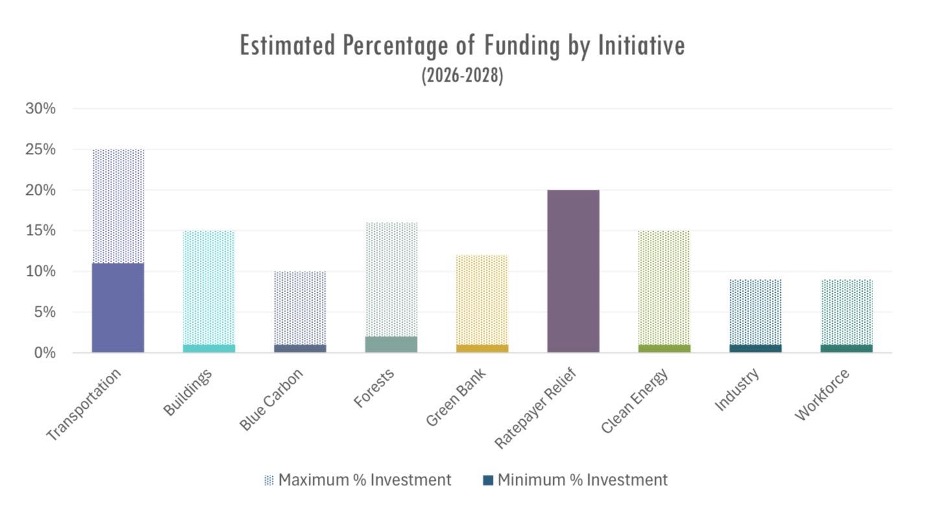
The RGGI Strategic Plan outlines nine specific initiatives for the funding, only one of which is ratepayer relief. The rest are clean transportation, building decarbonization, coastal and forest restoration, New Jersey’s Green Bank, clean energy infrastructure, clean manufacturing, and clean energy workforce and supply chain.[28] However, one graph appears to give priority to ratepayer relief over other initiatives:

Source: NJ RGGI 2026-28 Strategic Funding Plan. p.17

This graph appears to state that the only priority the agencies plan to fully fund to the maximum percentage is ratepayer relief; while transportation has a minimum investment of approximately 11 percent, the rest of the priorities received a commitment to only receive approximately 1 to 2 percent of funding. The lack of commitment to the other priorities could demonstrate the intent or desire to use funds outside of the BPU’s 20 percent allocation in ways not aligned with the strategic plan and the state statute.

Conclusions and recommendations

It is clear from the law that the BPU portion of the RGGI funds is the only portion eligible to be used for ratepayer relief, and specifically must be used only for low- and moderate-income ratepayers. Additionally, the Clean Energy Fund diversions, both for the annual budget and for ratepayer relief, must be immediately scaled back. The Clean Energy Fund must be used for its intended purpose — funding clean energy — to provide both medium- and long-term ratepayer relief. Using both RGGI and CEF for ratepayer relief is a stopgap measure that does nothing to address the underlying causes for higher electric bills.


End Notes

[1] Ambrose, A. Stop the Raids: The Clean Energy Fund Should Fund Clean Energy. New Jersey Policy Perspective. (2023).

[2] Email from New Jersey Board of Public Utilities. Feb. 10, 2026. On file with the author.

[3] N.J. Stat. Sec. 48:3-60.12a. 2022.

[4] Ambrose, A. Stop the Raids: The Clean Energy Fund Should Fund Clean Energy. New Jersey Policy Perspective. (2023).

[5] New Jersey Board of Public Utilities. BPU Response to OLS Questions. FY 2025-26. Accessed Feb. 2026. p.22.

[6] Ibid.

[7] New Jersey Board of Public Utilities. Docket No. QO25040206: In the Matter of the Clean Energy Programs and Budget for Fiscal Year 2026. p.4.

[8] Ibid.

[9] NJPP analysis of annual legislative budgets. See also Ambrose, A. Stop the Raids: The Clean Energy Fund Should Fund Clean Energy. New Jersey Policy Perspective. (2023).

[10] New Jersey Board of Public Utilities. Docket No. QO24020120: In the Matter of Disbursement of Clean Energy Program Funds for the Residential Energy Assistance Payment. p.2.

[11] Ibid.

[12] New Jersey Board of Public Utilities. June 25, 2025 Meeting Minutes. p.21.

[13] RGGI, Inc. Elements of RGGI. Accessed Feb. 2025.

[14] Congressional Research Service. The Regional Greenhouse Gas Initiative: Background, Impacts, and Selected Issues. Jul. 16, 2019. p.2.

[15] RGGI, Inc. RGGI 101 Fact Sheet. Accessed Feb. 2026.

[16] Ibid.

[17] Stuart, D. and Hibbard, P. The Economic Impacts of the Regional Greenhouse Gas Initiative on Ten Northeast and Mid-Atlantic States. Analysis Group. May 2023. p.8-9.

[18] RGGI, Inc. RGGI States Welcome New Jersey as Its CO2 Regulation is Finalized. Jun. 17, 2019.

[19] New Jersey Department of Environmental Protection. Regional Greenhouse Gas Initiative. Accessed Feb. 2026.

[20] New Jersey Department of Treasury. FY 2026 Supplementary Information. p.80.

[21] N.J. Stat. 26:2C-51

[22] N.J. Stat. 26:2C-51(7b(1-4)).

[23] New Jersey Department of Environmental Protection. Regional Greenhouse Gas Initiative: Investing in NJ’s Climate-Smart Future. Accessed Feb. 2025.

[24] New Jersey Department of Environmental Protection. New Jersey RGGI Climate Investments Dashboard. Accessed Feb. 2025.

[25] New Jersey Department of Environmental Protection. RGGI Strategic Funding Plan FAQs. Accessed Feb. 2025.

State of New Jersey. 2026-28 Regional Greenhouse Gas Initiative Strategic Funding Plan. Accessed Feb. 2025.

[26] New Jersey Board of Public Utilities. Docket No. QO25070389: In the Matter of the Establishment of the Residential Universal Bill Credit (“RUBC”). Aug. 13, 2025.

Note: the remaining $263 million is from the Solar Alternative Compliance Payment (ACP) account. ACP is widely considered an appropriate fund for ratepayer relief.

[27] Ibid. p.4.

[28] State of New Jersey. 2026-28 Regional Greenhouse Gas Initiative Strategic Funding Plan. Accessed Feb. 2025.

NJPP Statement on Final Day of Legislative Action

On January 12, the New Jersey Legislature voted on more than 100 bills to close out the 2024-25 legislative session. Several bills will help protect New Jersey residents, while others weaken fiscal accountability and create challenges for the next legislature and administration.

In response to these bills, NJPP issues the following statements:

On paid family leave job protection expansion (A3451/S2950):

“No New Jersey worker should ever have to choose between bonding with their new child and keeping their job,” said NJPP Senior Policy Analyst Peter Chen. “This bill protects hundreds of thousands of workers from being fired or demoted for taking family leave. The next legislature should finish the job by closing remaining loopholes and extending these protections to everyone.”

On higher rates on heavy users of electricity (A5462/S4307):

“As New Jerseyans are already dealing with sky-high utility bills, this bill makes sure energy-intensive businesses, like data centers, pay for the costs they’re passing on to families. ” said Alex Ambrose, Policy Analyst at New Jersey Policy Perspective. “With PJM adding more data centers to the grid, New Jersey needs to protect residents from footing the bill. Governor Murphy must sign this to hold heavy electricity users accountable and keep costs down for families.”

On bills loosening and expanding corporate subsidy programs (A6298/S5025 and A6306/S5031):

“The state is staring down a deficit of more than $1 billion and working-class families are struggling to afford basics,” said Peter Chen, New Jersey Policy Perspective Senior Policy Analyst. “Now is not the time for more giveaways to politically connected corporations. A $300 million tax credit to the Prudential Center and loosened accountability rules chip away at the reformed 2020 corporate subsidy law. Governor Murphy should reject these bills and protect his legacy of reining in billionaire giveaways.”

3.6 Million New Jerseyans Live in Hazmat Rail Evacuation Zones, State Lacks Basic Safety Rules

More than 3.6 million New Jersey residents live within the evacuation zone of a hazardous materials train route, yet the state lacks basic safety rules and transparency measures, according to a new report from New Jersey Policy Perspective (NJPP). The report comes one week before the 13th anniversary of the Paulsboro derailment, which released 23,000 gallons of vinyl chloride into the air and water.

The report, “Millions of New Jerseyans at Risk from Hazardous Materials Transported by Rail,” documents how New Jersey’s dense population faces unique threats from trains carrying hazardous materials. In 2024, New Jersey had 55 rail incidents, far more than the previous year. Five involved hazardous materials where toxic chemicals spilled or were vented.

“Freight rail companies have spent years lobbying against safety rules while prioritizing their own profits over better infrastructure. Meanwhile, millions of New Jerseyans live in evacuation zones without knowing what chemicals are rolling past their kids’ schools. Lawmakers need to stop letting corporate interests block protections that could save lives,” said Alex Ambrose, NJPP Policy Analyst and author of the report.

The report finds that Hudson and Bergen counties have the largest at-risk populations, with nearly half a million residents each living within an evacuation zone. The statewide evacuation zone includes 1,306 schools, 119 hospitals, 170 long-term care facilities, and 9 airports, including Newark Liberty International.

“Safety must always be our top priority,” said District 18 Senator Patrick J. Diegnan. “This legislation requires improving oversight and strengthening emergency response requirements to manage the risk of high-hazard rail shipments with the goal of protecting lives, communities, and the environment.”

“More than a decade after the Paulsboro train derailment, too many New Jersey communities continue to live with the daily risk posed by freight lines that transport hazardous materials through their neighborhoods,” said Assemblyman Clinton Calabrese, Chair of the Assembly Transportation and Independent Authorities Committee. “A4460 would deliver long overdue and commonsense reforms by requiring appropriate crew staffing, addressing unsafe train lengths, enhancing oversight of bridge inspections, and expanding the use of preventative wayside detector systems. While federal action has stalled, New Jersey cannot wait for another public health emergency to remind us of what is at stake. This bill would provide the tools we need to strengthen rail safety and protect our residents before another preventable disaster occurs.”

“Far too many people, including state decision makers, are not truly aware of the risk associated with the thousands of trains carrying hazardous materials throughout every corner of our state,” said Debra Coyle, Executive Director of the NJ Work Environment Council. “More than just a report, today’s release is a call to action for decision makers to address the current shortcomings of state policy and take all steps possible to prevent another major rail disaster in New Jersey.”

The report recommends lawmakers pass legislation requiring increased transparency on cargo information, mandatory safety upgrades including wayside defect detectors and two-person crews, specialized first responder training, and financial accountability requirements for rail companies. These policies cost the state little to implement. Freight companies — not taxpayers — would bear the costs.

Read the full report at njpp.org.

Millions of New Jerseyans at Risk from Hazardous Materials Transported by Rail

More than 3.6 million New Jerseyans live within the evacuation zone of a hazardous materials train route — yet the state lacks basic safety rules and transparency measures.[1]

New Jersey faces unique threats from trains carrying hazardous materials because of its dense population.[2] While freight rail is considered one of the safest ways to transport hazardous materials, it still poses risks to human and environmental health.[3] The 2023 East Palestine, Ohio and the 2012 Paulsboro, New Jersey derailments show the dangers posed by toxic cargo that immediately harm surrounding areas.[4] Rollbacks of labor, safety, and rail regulations can make these disasters worse.

Unlike neighboring states, New Jersey has resisted efforts to increase safety and has restricted public information about train routes carrying hazardous materials and the type and amount of dangerous cargo. The federal government has stalled in creating policies to make hazmat transportation safer, so state lawmakers must act. To protect rail workers and reduce risks to the public, New Jersey should update its hazmat freight rail policies, especially regarding safety and transparency, to protect the millions of residents who live in harm’s way.

Hazardous Materials Endanger New Jersey Residents’ Health and Environment

For many New Jerseyans, the threat of a hazmat rail incident is real, not theoretical. In 2024, New Jersey had 55 rail incidents, far more than the previous year.[5] Five of those incidents involved hazardous materials where toxic chemicals spilled or were vented.[6]

Exposure to hazardous materials (hazmat) released during a derailment can have short- and long-term health risks. Hazmat is defined as any material that when transported, may pose an unreasonable risk to health and safety or property.[7] This includes chemicals that can poison the air and water, cause fires and explosions, or damage vital organs with long-term exposure. The federal government defines hundreds of chemicals as hazmat, including vinyl chloride, one of the materials released from the derailed trains in East Palestine and Paulsboro.[8] The gas poses a threat to human health — including long-term risks of damage to vital organs — and is highly flammable, reactive, and an explosion hazard.[9] The U.S. Department of Health and Human Services, the U.S. Environmental Protection Agency, and the International Agency for Research on Cancer have all classified vinyl chloride as a human carcinogen.[10]

The 2012 derailment of a freight train in Paulsboro, New Jersey demonstrates the risk New Jerseyans face with hazmat. While crossing a bridge, the conductor of a Conrail freight train incorrectly determined it was safe to proceed despite the red signal indicating danger.[11] Four freight cars fell into the creek. One punctured and released 23,000 gallons of vinyl chloride into the water and air.[12]

A toxic vapor cloud spread over the town and town officials failed to immediately evacuate residents. Many still report long-term health issues from exposure to the chemical and inadequate warning from town officials.[13] A Centers for Disease Control and Prevention (CDC) study found that most first responders did not use breathing protection, and only a quarter had specific hazardous response training despite stating they felt they had received sufficient instruction.[14] The study concluded that changes to safety procedures were needed to improve risk assessment for first responders.[15] However, no state or federal agency has conducted a long-term evaluation of the health effects on Paulsboro residents and emergency personnel — meaning we still don’t know the full cost of that disaster more than a decade later.

Despite the devastating impacts of these incidents, New Jersey has not made significant improvements to rail safety policies since the 2012 Paulsboro incident. While the East Palestine derailment and explosion educated many on the dangers of hazmat — even prompting bipartisan proposals in Congress to improve rail safety — the proposal has not moved forward.[16]

Over One-Third of New Jersey Residents Live Near Hazmat Rail Lines

Without increased safety measures, a significant portion of New Jersey’s population remains at risk during a hazmat rail incident. With about 1,000 miles of freight rail lines in New Jersey, the threat to homes, schools, hospitals, and businesses is widespread.[17] More than one-third of New Jersey’s residents, or over 3.6 million people, live in a potential evacuation zone.[18] An evacuation zone for the most common types of hazmat, including vinyl chloride, extends half a mile on each side of a freight rail line.[19] However, this is the minimum requirement for large spills, and a fire would necessitate an evacuation zone of at least one mile.[20]

The counties with the largest at-risk populations are Hudson and Bergen counties, each with nearly half a million residents living within an evacuation zone.[21] That’s nearly 70 percent of the population in Hudson County and around 50 percent of the population in Bergen County. People in these counties face particular risk because these are the densest counties in the state. Despite having fewer residents in the evacuation zone, rural communities are less likely to be equipped for a hazmat rail incident, posing a different kind of danger for residents and first responders.[22]

Number of Residents in Evacuation Zone by County

The statewide evacuation zone for all freight lines includes 1,306 schools, 119 hospitals, 170 long-term care facilities, and 9 airports, including Newark Liberty International.[23] Should an incident occur near any of these facilities, it would disrupt access to emergency care, put young students at risk, and cause major delays and disruptions for transportation and emergency response efforts.

Critical Infrastructure is at Risk in the Event of a Hazmat Rail Incident

Shortfalls in Federal and State Law Leave Residents Vulnerable

While the safety of New Jersey should remain a top priority, lawmakers at both the state and federal levels have failed to address dangerous shortfalls in hazmat rail policy. The federal Emergency Planning and Community Right-to-Know Act (EPCRA) grants public access to information about the location, amounts, and types of hazmat stored at stationary facilities.[24] This information is published on the New Jersey Department of Environmental Protection’s website and updated regularly.[25] Yet efforts to require federal or New Jersey lawmakers to grant public access to mobile sources of hazmat, such as freight rail trains, have not been successful.

Federal initiatives to increase rail safety and transparency have fallen short. In 2014, the federal government proposed a suite of safety regulations to create stronger requirements for trains carrying flammable liquids.[26] However, the rail industry criticized the proposal, and the final rule was narrowed to apply only to crude oil and ethanol while exempting other chemicals.[27] In 2018, the Trump administration repealed that rule.[28] The second Trump administration continues to propose rollbacks to rail safety rules, worrying rail workers and creating the potential for even more dangerous conditions for New Jersey residents.[29]

Corporate Lobbying Against Safety Regulations Stalls Progress

Despite safety concerns, corporate lobbyists from wealthy freight companies have repeatedly blocked state-level reforms. After CSX lobbied his administration, Governor Christie vetoed a 2017 bill that would have required corporations to develop hazmat response plans and to publicly disclose freight train routes, citing national security risks.[30] Yet there is little evidence that transparency increases the likelihood of a security breach.

Restricting this information leaves first responders and communities unprepared for potential disasters.[31] After the East Palestine derailment, the National Transportation Safety Board reaffirmed that communities have the right to know what chemicals are moving through their neighborhoods — information critical for local emergency response.[32] [33] Still, efforts to revive similar transparency laws in New Jersey have faced the same corporate opposition, even as calls for reform continue to grow.[34]

Corporations are unlikely to voluntarily increase safety measures. Between 2010 and 2021, the seven biggest railroad corporations spent 33 percent more on stock buybacks, cash distributions, and dividends compared to infrastructure investments.[35] However, when corporations invest more in safety, incidents can decline. Four of the top five largest freight rail corporations reported an increase in incidents in the first 10 months of 2023.[36] But Norfolk Southern, which increased its investments in infrastructure and safety upgrades after East Palestine, reported a decrease in incidents.[37]

The pattern is clear: Without state action, corporate interests will continue to block safety improvements while millions of residents remain at risk. New Jersey cannot wait for federal action or voluntary corporate responsibility.

Lawmakers Must Act to Protect New Jersey Residents

With inconsistent progress on federal safety measures, states must act to protect their residents. New Jersey needs strong safety and transparency measures to ensure that residents, first responders, and communities can prepare for and respond to hazmat rail incidents. New Jersey lawmakers should pass laws requiring the following measures to reduce risks to residents, many of which have been proposed at the federal level or by other states.[38] These policies cost the state very little to implement because freight rail companies — not taxpayers — would bear the costs. In fact, preventing major derailments can save more than these safety measures cost. The East Palestine cleanup alone has cost Norfolk Southern hundreds of millions of dollars.[39]

Increase Transparency: Grant public access to hazmat cargo information while implementing safeguards against security risks.

Allowing reasonable public access to cargo information for communities near freight rail lines will bring New Jersey in line with neighboring states and bring freight rail hazmat in line with stationary sources of hazardous materials, which are already required to be public under the federal EPCRA. A proposed compromise is to allow access to a list of past cargo and their components published by the NJ Department of Environmental Protection (DEP) after a reasonable amount of time. Additionally, bridge inspection reports, which the NJ Department of Transportation generates based on inspections of bridge integrity and appraisal, should be sent to NJ DEP, the agency responsible for hazmat control. For example, the bridge in Paulsboro was known to be malfunctioning, yet the rail company that owned it failed to address it.[40] By sharing these reports, agencies can break down regulatory siloes and work together to create more transparency and higher standards for rail safety.

Mandate Safety Upgrades: Require rail companies to upgrade safety technologies such as wayside defect detectors, maintain a minimum two-person crew on all hazmat freight trains, and restrict train length to reduce derailment risks.

Increasing the frequency of wayside defect detectors, which are devices placed alongside rail lines to detect issues with train equipment, has been shown to increase safety and reduce dangerous incidents.[41] However, there are no current federal laws requiring the use of these detectors. Additionally, requiring a two-person crew allows for flexible sharing of responsibilities and increases the likelihood of catching a problem. While this is currently a federal rule, it is not yet a law and could be rolled back.[42] Restricting train length reduces its total weight, lowering the likelihood of a derailment, while also reducing the overall amount of hazmat carried by the train. Longer trains are more likely to derail and should only be used if emergency response systems are capable of dealing with a derailment.[43]

Strengthen First Responder Training: Mandate specialized training for emergency personnel in communities along freight lines, ensuring they can respond effectively to hazmat incidents.

Requiring the owners and operators of freight rail companies to provide specialized training for first responders in areas near freight rail lines will improve responses if and when an incident occurs. As shown in the Paulsboro derailment, first responders had a clear gap in understanding the risk of not using breathing protection. And officials did not order an immediate evacuation of the area affected by the cloud of vinyl chloride. Helping first responders prepare for any kind of incident also helps civilians. The better equipped first responders are, the more likely they will be able to limit damage and protect their community.

Ensure Financial Accountability: Require freight companies to demonstrate financial responsibility for disaster response, preventing communities from bearing the costs of corporate negligence.

Without strict policies requiring freight rail corporations to prove they can pay, taxpayers may have to bear the burden of paying to clean up after an incident.[44] After the East Palestine and Paulsboro derailments, the freight companies paid for the entire cost of the cleanup and emergency response.[45] This requirement must be written into law, and corporations must provide the government with proof of financial ability to pay for disaster response and cleanup before an incident occurs.

Conclusion

New Jersey lawmakers must reject corporate lobbying efforts that put profit over public safety. Transparency, improved emergency preparedness, stronger safety policies, and stricter corporate accountability are essential to protect the 3.6 million residents living in potential hazmat rail evacuation zones. Lawmakers need multiple layers of safety to both prevent incidents and to ensure that if an incident does occur, the damage is limited. Strengthening regulations will not only enhance public safety but also prevent future derailments from becoming full-scale disasters.

New Jersey lawmakers should pass comprehensive hazmat rail safety legislation in the current session — before the next derailment puts communities at risk.


End Notes

[1] NJPP Analysis of 2020 U.S. Census Data and New Jersey freight rail lines. 2020 U.S. Census Data was used because it is the most recent available data down to census block level.

[2] United States Census Bureau, 2024 Highest Density States Table.

[3] U.S. Department of Transportation Federal Railroad Administration. Hazardous Materials Transportation.

[4] National Transportation Safety Board. Failed Wheel Bearing Cause Norfolk Southern Train Derailment in East Palestine, Ohio. June 25, 2024.

National Transportation Safety Board. Conrail Train Derailment with Vinyl Chloride Release, Paulsboro, New Jersey, November 30, 2012. July 29, 2014.

[5] See New Jersey data at Federal Railroad Administration’s Office of Safety Analysis accident database.

[6] See New Jersey data for 2024 at PHMSA’s incident database.

[7] U.S. Department of Transportation Pipeline and Hazardous Materials Safety Administration. Federal Hazmat Law. p. 2.

[8] 49 CFR § 172.101. Hazardous Materials Table.

[9]  New Jersey Department of Health. Hazardous Substance Fact Sheet: Vinyl Chloride. Oct. 2015.

[10] Agency for Toxic Substances and Disease Registry. Vinyl Chloride – ToxFAQs™.

[11] National Transportation Safety Board. Conrail Train Derailment with Vinyl Chloride Release, Paulsboro, New Jersey, November 30, 2012. Jul. 29, 2014. p.2.

[12]National Oceanic and Atmospheric Administration. A Train Derails in Paulsboro, N.J., Releasing 23,000 Gallons of Vinyl Chloride Gas. Dec. 17, 2012.

[13] Read, Zoë. A decade after Paulsboro, N.J. train derailment, questions linger over rail safety and public health. WHYY. Apr. 6, 2023.

[14] Centers for Disease Control and Prevention. NIOSH Technical Assistance Report: Assessment of Emergency Responders Following Vinyl Chloride Release from a Train Derailment—New Jersey, 2012. Dec. 2013. p.13.

[15] Centers for Disease Control and Prevention. NIOSH Technical Assistance Report: Assessment of Emergency Responders Following Vinyl Chloride Release from a Train Derailment—New Jersey, 2012. Dec. 2013. p.13.

[16] Railway Safety Act of 2023, S.576, 118th Congress.

[17] New Jersey Department of Transportation. Freight Rail Strategic Plan. Jun. 2014. p.ES-2.

[18] NJPP Analysis of 2020 U.S. Census Data and New Jersey freight rail lines. 2020 U.S. Census Data was used because it is the most recent available data down to census block level.

[19] U.S. Department of Transportation Pipeline and Hazardous Materials Safety Administration. 2024 Emergency Response Guidebook. pp.30, 162.

[20] U.S. Department of Transportation Pipeline and Hazardous Materials Safety Administration. 2024 Emergency Response Guidebook. pp.30, 162.

[21] NJPP Analysis of 2020 U.S. Census data and New Jersey freight rail lines. 2020 U.S. Census Data was used because it is the most recent available data down to census block level.

[22] Junod, Anne N. Urban Institute. Why Hazardous Train Derailments Happen, Who Pays, and How to Prevent Them. Feb. 22, 2023.

[23] NJPP Analysis of NJGIN Open Data: Hospitals of NJ, Long Term Care Facilities of New Jersey, New Jersey Aviation Facilities, and School Point Locations of NJ.

[24] United States Environmental Protection Agency. Hazardous Chemical Inventory Reporting. Accessed Oct. 2025.

[25] New Jersey Department of Environmental Protection. How to Get Community Right to Know Information. Accessed Sept, 2025.

[26] Hazardous Materials: Enhanced Tank Car Standards and Operational Controls for High-Hazard Flammable Trains. Vol 79, No. 148, Fed. Reg. 45016. Proposed Aug. 1, 2014.

[27] Wolfe, K. A. and Schor, E. Politico. DOT issues final rules on flammable oil trains. May 1, 2015.

U.S. Department of Transportation. DOT Announces Final Rule to Strengthen Safe Transportation of Flammable Liquids by Rail. May 1, 2015.

[28] U.S. Department of Transportation Pipeline and Hazardous Materials Safety Administration. PHMSA Rescinds ECP Brake Mandate After RIA Finds Costs Outweigh Benefits. Sept. 24, 2018.

[29] Gallagher, John. Freight Waves. Rail unions warn DOT rollbacks could jeopardize train safety. Jun. 24, 2025.

[30] Tate, Curtis. NorthJersey.com. CSX lobbied Christie officials before he vetoed oil-train bill. Aug. 11, 2017.

[31] NorthJersey.com. Editorial: Oil train veto leaves New Jerseyans at risk. Jul. 17, 2017.

[32] Fischler, Jacob. New Jersey Monitor. Priorities for rail safety bill debated in U.S. Senate hearing with Norfolk Southern CEO. Mar. 23, 2023.

[33] Fischler, Jacob. New Jersey Monitor. Priorities for rail safety bill debated in U.S. Senate hearing with Norfolk Southern CEO. Mar. 23, 2023.

[34] Weinberg, Loretta. NJ.com. We need protection from the ‘bombs’ that rumble through New Jersey. Jul, 14, 2022.

[35] Rowland, Darrel. ABC6. Norfolk Southern plied Ohio politicians with campaign cash, extensive lobbying. Feb. 20, 2023.

[36] Eavis, Peter. New York Times. Since Ohio Train Derailment, Accidents Have Gone Up, Not Down. Jan. 28, 2024.

[37] Eavis, Peter. New York Times. Since Ohio Train Derailment, Accidents Have Gone Up, Not Down. Jan. 28, 2024.

[38] Evans, Nick. Ohio Capital Journal. Bipartisan rail safety bill headed for U.S. Senate Vote. May 12, 2023.

New York State Senate. Senate Passes Comprehensive Rail Safety Legislation in Light of Recent National Train Disasters. May 23, 2023.

Williams, David O. Colorado Newsline. New rail safety office could add protections for Colorado residents and environment. May 9, 2024.

Caruso, Stephen. Spotlight PA. A train safety bill inspired by the East Palestine derailment faces tough odds in the Pa. legislature. June 12, 2023.

[39] Guillen, Alex and Marquette, Chris. Politico. “Norfolk Southern to pay over $500M for cleanup, rail safety after East Palestine derailment.” May 23, 2024.

[40] National Safety Transportation Board. “Conrail Freight Train Derailment with Vinyl Chloride Release.” Accessed Nov. 2025.

[41] U.S. Department of Transportation Federal Railroad Administration. Effectiveness of Wayside Detector Technologies on Train Operation Safety. May 2022.

[42] Federal Railroad Administration Office of Railroad Safety. Compliance Guide for Train Crew Size Safety Requirements. May 2024. p.7.

[43] Madsen, P. M., et al. Risk Analysis. The relationship between freight train length and the risk of derailment. Nov. 2024. P.1.

Verma, M. Transportation research part C: emerging technologies, 19(5). Railroad transportation of dangerous goods: A conditional exposure approach to minimize transport risk. Aug 2011. p.801.

[44] Junod, Anne N. Why Hazardous Train Derailments Happen, Who Pays, and How to Prevent Them. Feb. 22, 2023.

[45] U.S. Environmental Protection Agency. EPA Orders Norfolk Southern to Conduct All Cleanup Actions Associated with the East Palestine Train Derailment. Feb. 21, 2023.

Walsh, Jim. Courier Post. Conrail sues insurers over losses from 2012 Paulsboro derailment. Dec. 1, 2017.

Hold Corporations Responsible for Hazmat Rail Safety

Good afternoon Chairman Sarlo and members of the committee. Thank you for this opportunity to provide my testimony in opposition to S3389, which will move forward common sense safety measures for hazmat rail. My name is Alex Ambrose and I am a policy analyst with New Jersey Policy Perspective. NJPP is a non-partisan, non-profit research institution that focuses on policies that can improve the lives of low- and middle-income people, strengthen our state’s economy, and enhance the quality of life in New Jersey.

While moving hazardous materials (hazmat) by rail is the safest form of transportation for these dangerous chemicals, it still poses risks, particularly for the most vulnerable New Jersey communities and our first responders. Even as rail incidents have declined overall, incidents involving hazardous materials have increased and are still growing. One of the most startling revelations that came out of the 2023 East Palestine, Ohio disaster is that the train involved in the explosion was headed for south Jersey. That disaster was all too familiar for those New Jerseyans who still remember the 2012 Paulsboro derailment, in Senator Burzichelli’s district; many of those residents are still dealing with long-term physical and emotional consequences of exposure to toxic chemicals.

Policies like those proposed in this bill — including reducing train length, requiring wayside defect detectors, requiring a two-person crew, and mandating safety reporting and inspections — are how we start to mitigate those disasters. Requiring corporations to have a response plan in place prior to an incident is just common sense.

State leaders must take action to require safety measures because it is clear that corporations are unlikely to voluntarily increase safety measures. In the last decade, the seven biggest railroad corporations spent nearly double as much on stock buybacks, cash distributions, and dividends than on infrastructure investments. More specifically, in 2022, Norfolk Southern, the corporation responsible for the East Palestine disaster, spent three times as much on stock buybacks than on safety.

But when corporations are forced to prioritize safety measures, there are improvements. While four of the five biggest railroads faced higher accident rates last year, one saw them go down: Norfolk Southern saw their accident rates reduced after they were essentially forced to invest more in safety and infrastructure updates after the 2023 disaster in Ohio.

This bill moves forward evidence-based corporate responsibility measures to better protect New Jersey communities. Research shows that the two biggest factors that lead to hazmat rail incidents are track factors and human error. This bill, with its provisions to reduce train length, require wayside defect detectors, require a two-person crew, and mandate safety inspections and reporting, starts to address those factors. The train length requirement is a particularly important provision because it not only reduces the total overall amount of hazmat that could be involved in an incident, but also addresses the fact that the length of the train itself can be a hazard. The longer the train during a derailment incident in a densely populated state like New Jersey, the more likely a stopped train can block off parts of a community from emergency services.

It’s time to take the lessons to heart: We need lawmakers to lead the way on increasing corporate responsibility for safety to ensure that we do not continue to see disasters like Paulsboro and East Palestine. Residents’ safety, health, and well-being should come first in the Garden State and shouldn’t be threatened by opaque and unregulated corporate policies.

Thank you for moving this bill forward and we look forward to your continued leadership on this issue.

NJPP Supports Bipartisan Governor Group Calling On PJM to Reform

This week, a bipartisan group of nine Governors within the PJM region sent a letter to the PJM Board of Managers urging the Board to make certain reforms. The letter requests approving new Board members put forward by the states, meeting with the governors during the July 23 member meeting, and creating a formal group of PJM governors. The letter ended with a commitment from the governors to work with PJM to deliver affordable and reliable power. The letter comes just after the July 2025 PJM capacity auction closed and before the auction results are announced.

In response to this letter, New Jersey Policy Perspective issues the following statement:

Alex Ambrose, policy analyst, NJPP:

“PJM has had years to create a more transparent voting process, improve its governance, and lower customer bills. Instead, New Jersey families are stuck paying even more for electricity. Governor Murphy and his allies aren’t only asking for a seat at the table — they are asking for a working relationship. The message they are sending is loud and clear: this is PJM’s chance to change from being a barrier to affordable, reliable energy to becoming a partner instead.”

Read more about New Jersey’s rising energy rates.

###

NJPP Calls for Targeted Energy Relief Without Sacrificing Affordable Clean Energy Progress

On Thursday, June 5, Governor Murphy and legislative leaders announced a new proposal to provide short-term utility bill relief to New Jersey households using funds from the Regional Greenhouse Gas Initiative (RGGI), Solar Alternative Compliance Payments, and the Clean Energy Fund. While aimed at lowering costs for residents amid rising energy prices, the plan would divert funding from long-term climate and clean energy programs to offer short-term financial assistance to all ratepayers, regardless of income level.

In response, New Jersey Policy Perspective (NJPP) issues the following statement.

Alex Ambrose, Policy Analyst, NJPP:

“We appreciate that the Governor and lawmakers are taking seriously the strain high energy costs place on families, but how we deliver relief matters. Diverting funds from RGGI and the Clean Energy Fund risks weakening the very programs that lower long-term costs, strengthen our grid, and create local jobs. Lawmakers should prioritize targeted, sustainable solutions, like expanding the Whole House Pilot, scaling up Community Solar, and extending the Winter Termination Program to support those who need it most, without compromising our clean energy future.”

Read more about New Jersey’s rising electricity rates.

Read more about New Jersey’s history of Clean Energy Fund diversions.

###

Why Are New Jersey’s Electricity Bills Going Up, and What Does PJM Have to Do With It?

Energy powers our everyday life, from keeping homes warm in the winter to keeping food safe and allowing kids to study at home. But in New Jersey, electricity costs are 20 percent higher than the national average, which means low-income families often have to choose between basic needs like groceries or keeping the lights on. The most cost-effective way to keep energy affordable is by expanding clean, reliable energy sources, such as solar and wind, paired with battery storage.

PJM — the grid operator named for its original member states: Pennsylvania, “Jersey,” and Maryland — manages the power grid for New Jersey and 12 other states and Washington, D.C. But PJM is stalling the transition to clean energy by delaying the connection of new renewable projects and failing to adequately plan for growing demand. These delays are contributing to rising electricity prices. As a result, starting in June 2025, New Jersey households will see their utility bills increase by more than $20 per month.

This explainer provides an overview of PJM’s role in New Jersey’s energy system, why energy prices are rising, and how key policy options and a faster transition to clean energy could protect families from even higher bills.

Table of Contents
    Add a header to begin generating the table of contents

    What is PJM?

    PJM is the Regional Transmission Organization (RTO) responsible for managing the power grid and electricity markets in 12 states and Washington, D.C.[1] PJM provides electricity to approximately 67 million people across the region and is the nation’s largest RTO.[2]

    As a private entity overseen by federal regulators, PJM has significant authority over the state’s electricity system, yet operates with limited transparency. Its decisions influence:

    • How much residents pay for electricity,
    • Which energy sources supply residents’ access to power, and
    • How and when new energy projects connect to the electric grid.


    How is PJM Different from Utility Companies?

    In New Jersey, most residents get electricity from one of the four major utility providers: Atlantic City Electric (ACE), Jersey Central Power & Light (JCP&L), Public Service Electric & Gas (PSE&G), or Rockland Electric Company (RECO).

    Unlike these companies, PJM is not a consumer-facing utility company. Instead, PJM operates at the regional level, overseeing the generation and transmission of electricity across multiple states. Generation refers to how electricity is produced from sources like solar or wind farms, natural gas, or coal plants. Transmission refers to how that electricity travels long distances from where it’s generated to local utility systems. PJM manages the energy markets and plans and approves new energy infrastructure.

    By contrast, utility companies are responsible for distributing energy to homes and businesses. They maintain local infrastructure, like wires and poles, and they handle billing and customer service. Basically, PJM handles the big picture grid and wholesale electricity markets, while your utility company delivers the power to your door.

    If you look at your electric bill, you’ll usually see two main charges: supply and distribution.

    • Supply charges reflect the costs of the electricity itself, which is set through PJM’s competitive markets. These processes are regulated by the Federal Energy Regulatory Commission, or FERC, an agency within the federal government.
    • Distribution charges are the costs of getting electricity to your home, which are set by the local utility company and regulated by the New Jersey Board of Public Utilities (BPU).


    Example Bill from PSE&G, A New Jersey Utility Company

    Starting in June 2025, the supply portion of your bill will increase. This part of your bill is shaped by PJM’s planning decisions and market structure — not by state regulators. 

    What Does PJM Do?

    PJM has three main jobs: transmission planning, managing the energy market, and managing the capacity market, giving PJM significant influence over which energy projects come online, how electricity flows across the region, and ultimately, how much consumers pay.[3]

    1. Transmission Planning:
      PJM oversees the planning and development of the high-voltage transmission system that carries electricity from where it’s generated, like power plants and large solar fields, to where it’s used, like homes and businesses. This includes planning and designing a grid that can reliably meet the region’s energy needs, both now and in the future, and prepare for disruptions, such as extreme weather or equipment failures.
    2. Managing the Energy Market:
      PJM operates a wholesale energy market that balances electricity supply and demand in real time — day by day and hour by hour. Acting as a broker between companies that generate electricity and utility companies, PJM determines which power sources will run and how much electricity they should generate at any given time. The goal is to meet demand at the lowest possible cost while maintaining grid reliability.
    3. Managing the capacity market:
      To plan for future demand, PJM forecasts electricity needs for the region to ensure enough electricity is available during peak usage, such as during summer heat waves. This is done through the capacity market, where electricity suppliers participate in auctions and utilities buy as much electricity as they expect customers will need. This system between PJM, electricity suppliers, and utilities helps maintain a reliable grid by ensuring enough power will be available when it’s needed most and helps avoid price spikes due to shortages.

    Why are Energy Bills Going Up June 2025?

    The increase in energy bills beginning in June 2025 is largely driven by higher prices in PJM’s capacity market. As previously mentioned, the capacity market functions like an auction where utility companies buy energy in advance to meet future demand during peak periods, such as extremely cold or hot days.

    In PJM’s most recent auction in early 2025, prices rose higher than expected due to a surge in projected demand. PJM attributes this increase to two main factors:

    1. Rapid growth in energy use for expected data centers, and
    2. A shortage of new, reliable energy projects being built and connected to the grid.[4]

    According to PJM, data centers alone account for 70 percent of the projected increase in demand.[5] But supply has not kept pace with this unexpected increase in demand. As a result, utilities paid more for future capacity, and those costs are passed on to customers.

    A significant reason for this supply shortfall is PJM’s own delays in connecting new energy projects to the grid. Before a new project, such as a solar or wind farm, can connect to the grid and deliver electricity, it must go through PJM’s interconnection queue. This is a review process that assesses whether the project can be safely added to the grid, but in practice, this has become a major bottleneck. As of March 2025, 143 gigawatts worth of projects — including 79 projects in New Jersey — were awaiting approval in the interconnection queue, enough to power about 115 million homes.[6] For comparison, PJM currently has about 179 gigawatts on the grid as of 2025.[7] In 2022, PJM decided it would not review newer project applications until early 2026, and it’s unlikely that projects currently applying to join the grid will come online before 2030. However, PJM’s recent Resource Reliability Initiative fast-tracked primarily fossil fuel projects, even though over 95 percent of projects awaiting approval are renewable and storage projects, giving gas-powered energy an unfair advantage.[8]

    Other regional grid operators (RTOs), like the Midcontinent Independent System Operator (MISO), engage in long-term, comprehensive planning, grouping infrastructure projects, and evaluating them based on total system benefits.[9] PJM has lagged in its planning and market reforms, leaving the region more vulnerable to price spikes.

    Adding to the challenge is PJM’s governance structure, which gives significant influence to for-profit, utility and fossil fuel companies.[10] Unlike public agencies, PJM operates largely behind closed doors with limited transparency and few opportunities for public input or accountability. This lack of transparency makes it difficult for state governments or consumers to inform decisions that directly affect utility bills.

    According to a recent analysis from Evergreen Collaborative, if PJM continues business-as-usual, New Jersey residents could see their electricity bills increase to over $2,000 a year by 2040.[11] However, if PJM reforms its planning and governance processes, accelerates clean energy connections to the grid, and improves transparency, New Jersey households could see up to $405 in annual savings.[12]

    How Does Clean Energy Affect Rates and Reliability?

    Clean energy, especially solar and wind, helps reduce electricity costs for both utilities and consumers.[13]  These sources are among the cheapest forms of electricity available, in part because they run on free, renewable resources, like sunshine and wind, and they do not require fuel purchases, imports, or costly maintenance associated with fossil fuel systems. When paired with battery storage, clean energy can reliably meet demand even when it’s not sunny or windy.[14]

    States that added clean energy to their grid at the highest rates, like Iowa, New Mexico, Kansas, and Oklahoma, saw the lowest electricity rate increases between 2020 and 2023.[15] Thanks to federal incentives like the Inflation Reduction Act, clean energy will become increasingly cheaper to build and operate over time. In PJM’s interconnection queue, over 95 percent of pending projects are clean energy and energy storage projects.[16] Delays in approving and connecting these projects are directly contributing to higher electricity bills for households and could also hinder states like New Jersey from meeting their clean energy and climate goals.[17]

    In contrast, New Jersey continues to rely heavily on fossil fuel energy sources such as natural gas, which has become increasingly expensive and unreliable.[18] Natural gas plants in New Jersey require out-of-state fuel, need regular maintenance to prevent dangerous gas leaks, and often fail during extreme hot and cold weather — two major periods when customers need electricity the most.[19] For example, during Winter Storm Elliot in 2022, natural gas plants' failures accounted for 70 percent of the forced outages in PJM territory, while wind energy production in MISO territory remained high.[20]

    New Jersey will need more reliable energy sources as the climate crisis continues to drive more extreme weather. Expanding clean energy, like solar and wind paired with battery storage, would provide a large supply of affordable electricity, reducing dependence on aging and unstable fossil fuel infrastructure and improving grid reliability.[21]

    How Can PJM’s Decisions Affect Environmental Justice Communities?

    PJM’s decisions have significant implications for environmental justice (EJ) communities, which are disproportionately burdened by pollution from fossil fuel plants. In fact, a recent study by Applied Economics Clinic found that over half of PJM’s fossil fuel power plants are within one mile of an EJ community.[22]

    These communities — often Black, Latinx, Indigenous, and low-income neighborhoods — have long faced the cumulative impacts of environmental harm, including higher exposure to air pollution, elevated rates of respiratory illness and cancer, and limited access to clean energy solutions. Nationally, Black and Latinx/Hispanic residents are exposed to 56 percent and 63 percent more air pollution, respectively, than they produce.[23]

    While New Jersey’s landmark Environmental Justice law gives the state authority to deny new permits in overburdened areas, PJM’s market structure continues to allow older, uneconomical plants to operate, prolonging pollution and public health risks.

    By accelerating the integration of clean energy sources like solar and wind, PJM can reduce reliance on these aging plants and begin to remedy long-standing environmental inequities.

    What Can be Done to Prevent Even Higher Bills and Improve the Grid?

    With energy bills set to rise by over $20 per month for the average household starting in June 2025, state lawmakers must take immediate and long-term policy actions to protect residents from future price spikes. State lawmakers should prioritize the following:

    Increase Transparency and Public Oversight of PJM:

    State leaders should require PJM to operate with greater transparency and prioritize consumer interests. Governor Josh Shapiro and the Commonwealth of Pennsylvania sued PJM to cap prices and won, saving customers in PJM regions up to $21 billion over the next few years.[24] In New Jersey, the Legislature held hearings to learn more about the cause of these rate hikes, and Governor Murphy called on the organization to take action to lower costs.[25] The New Jersey Division of Rate Counsel joined with Maryland and Delaware to call on FERC to require PJM to re-run the recent auction to reduce costs.[26] Additionally, as of early March 2025, six states plus New Jersey have introduced bills to increase PJM transparency.[27]

    Reduce Energy Demand

    • Invest in Energy Efficiency: New Jersey should expand programs that incentivize the use of energy-efficient appliances, building retrofits, and weatherization projects to lower overall electricity consumption. New Jersey’s offerings include the Comfort Partners program, which reduces eligible residents’ energy bills through better insulation at no cost, rebates for qualifying appliances, and incentives for commercial equipment upgrades.[28]
    • Manage Data Center Growth: PJM cites data center growth as the primary driver of the demand increase. As data centers drive new energy demand, states could explore policy models that require large energy users to directly offset their consumption with new clean energy generation. Models like New Jersey’s proposed "bring your own clean energy" approach, which would require data centers to build and use clean energy sources, or California’s proposed differentiated electricity rates for industrial users may offer paths forward that would ensure industrial users, not households, bear the cost of increased energy demand.[29]


    Increase and Accelerate Energy Supply by Expanding DERs:

    Expand Distributed Energy Resources (DERs) are small-scale projects that provide energy to customers “behind the meter,” or before they interact with the larger grid.[30] Encouraging investments in rooftop solar and battery storage systems can help expand local energy supply, improve reliability, and reduce overall costs without waiting for large grid-scale projects to be approved through PJM. States can remove barriers and create incentive programs to encourage customers to install solar and battery storage on their properties, helping to increase supply while reducing customers' energy bills.

    Strengthen Energy Affordability and Assistance Programs

    • Defend and Expand LIHEAP and State Energy Assistance: Building on existing programs like the Low-Income Home Energy Assistance Program (LIHEAP) can help cushion households from rising energy costs. LIHEAP provides federal funding to states to help low-income households with utility bills and energy-related repairs, and New Jersey's LIHEAP program can provide up to $1,278 to eligible residents.[31] But the federal government is also considering cutting LIHEAP program funding, leaving states to either step up to fill the shortfall or be forced to cut people from the program. States can also consider complementary programs that provide targeted assistance to low-income populations.
    • Grow Community Solar Programs: Expanding access to community solar programs enables households, especially renters and lower-income families, to benefit from clean energy savings without needing individual installations. New Jersey’s landmark Community Solar program provides a discount on electricity bills.[32] The program allows customers who can’t build their own solar projects to still reap the benefits of clean energy while saving money.
    • Create Consumer Energy Relief Funds: New Jersey can evaluate innovative funding approaches, such as using proceeds from climate programs or penalties from utilities that do not meet clean energy targets, to establish consumer assistance funds. For example, Delaware has proposed creating an energy fund to help consumers whose annual household income is less than 350% of the federal poverty level, or $112,525 for a family of four.[33] Similarly, Maryland has a proposal that would create an “energy hardship credit,” funded by payments from utility companies that don’t meet clean energy targets.[34] Finally, Washington proposed establishing a statewide low-income energy assistance program funded by proceeds from the state’s cap-and-invest auction revenues.[35]
    • Expand Utility Shutoff Protections: New Jersey protects customers from having their utilities shut off during the winter months under the Winter Termination Program.[36] However, that protection is only during the winter months and for people with medical conditions. Expanding shutoff prevention programs to include times of extreme heat will help residents as the climate crisis increases temperatures and threatens public health.[37]

    Conclusion

    PJM must do better — and it can.

    Adding more clean energy to the grid is one of the most effective ways to lower costs for ratepayers and improve grid reliability across the PJM region. However, achieving that goal will require greater transparency in PJM’s decision-making and meaningful reforms to its planning and interconnection processes so that new energy projects can come online faster.

    State lawmakers also have a critical role to play. By advancing policies that promote energy efficiency, strengthen consumer support programs, and manage demand from large energy users like data centers, New Jersey can help build an energy system that is more affordable, resilient, and equitable. With cleaner, more stable sources of power, the state can not only meet its climate goals but also protect residents from rising energy costs and ensure that no community is left behind.


    End Notes

    [1] PJM - At a Glance. PJM Interconnection. Apr. 8, 2025.

    [2] PJM - At a Glance. PJM Interconnection. Apr. 8, 2025.

    [3] PJM 101 Presentation. Consumers for a Better Grid. Jan. 22, 2025.

    [4] 2025 Long-Term Load Forecast Report Predicts Significant Increase in Electricity Demand. PJM Inside  Lines. Jan. 30, 2025.

    [5] Chavin, Sabine, et al.Tackling the PJM Cost Crisis. Evergreen Collaborative. Apr. 15, 2025. p.6.

    [6] Stanel, Jason M. New Jersey Senate Legislative Oversight Committee. Mar. 3, 2025. p.4.; Written Testimony Christine Guhl-Sadovy President, New Jersey Board of Public Utilities Senate Select Committee Assembly Telecommunications and Utilities Committee. Apr. 1, 2025; NJPP Analysis of PJM’s interconnection queue.

    [7] PJM Summer Outlook 2025: Adequate Resources Available for Summer Amid Growing Risk. PJM Inside Lines. May 9, 2025.

    [8]PJM Interconnection, L.L.C., 181 F.E.R.C. ¶ 61,162 at p. 15 (2022); Howland, E. “PJM fast-tracks 11.8 GW, mainly gas, to bolster power supplies.” Utility Dive. May 5, 2025.

    Silverman, Abraham, et al. Outlook for Pending Generation in the PJM Interconnection Queue. May 8, 2025.

    [9]Lang-Ree, C. and McIntire, N. What PJM Can Learn from MISO About Transmission Planning. NRDC. Jan. 9, 2024.

    [10] Transparency and Good Governance. Consumers for a Better Grid.

    [11] Chavin, Sabine, et al.Tackling the PJM Cost Crisis. Evergreen Collaborative. Apr. 15, 2025. p.1.

    [12] Chavin, Sabine, et al.Tackling the PJM Cost Crisis. Evergreen Collaborative. Apr. 15, 2025. p.5.

    [13] Allen, Lauren. Green energy is cheaper than fossil fuels, a new study finds. Jan. 20, 2023.

    [14] Benefits of Energy Storage. American Clean Power.

    [15] Pierpont, Brendan. Clean Energy Isn’t Driving Power Price Spikes. Energy Innovation Policy & Technology LLC. Jul. 2024. p.2.

    [16] Meet the Organization Raising Energy Bills Up to 30 Percent in 13 States. Evergreen Action. Jan. 23, 2025.

    [17] Ammann, Dana. Waiting Game: How the Interconnection Queue Threatens Renewable Development in PJM. NRDC. May 18, 2023.

    [18] New Jersey State Energy Profile. U.S. Energy Information Administration. Accessed Apr. 30, 2025.

    [19] Pennsylvania State Energy Profile. U.S. Energy Information Administration. Accessed Apr. 30, 2025.

    [20] Winter Storm Elliott Event Analysis and Recommendation Report. PJM Interconnection. Jul. 17, 2023. p. 2.

    Overview of Winter Storm Elliott December 23, Maximum Generation Event. MISO. Jan. 17, 2023. p. 11.

    [21] Chang, Rachel. Renewable Energy Is the Key to Building a More Resilient and Reliable Electricity Grid. Center for American Progress.

    [22] Castigliego, J.R., et al. PJM's Capacity Market: Clearing Prices, Power Plants,and Environmental Justice. Oct. 2021. p.i.

    [23] Tessum, C. et al. Inequity in consumption of goods and services adds to racial–ethnic disparities in air pollution exposure. PNAS. Mar. 11, 2019.

    [24] FERC Approves Governor Shapiro’s Settlement with PJM to Prevent Unnecessary Price Hikes and Save Consumers Over $21 Billion on Utility Bills. Commonwealth of Pennsylvania. Apr. 22, 2025

    [25] Public Hearing Before Senate Select and Assembly Telecommunications and Utilities Committees (March 28, 2025) available at https://www.njleg.state.nj.us/archived-media/2024/SSC-meeting-list/media-player?committee=SSC&agendaDate=2025-03-28-10:00:00&agendaType=J&av=A

    Letter from Governor Philip Murphy to Mark Takahashi, Chair of PJM Interconnection (January 17, 2025) available at https://www.pjm.com/-/media/DotCom/about-pjm/who-we-are/public-disclosures/2025/20250121-nj-gov-murphy-letter-re-capacity-market-price-cap.pdf

    [26] Howland, Ethan. FERC should order PJM to rerun last capacity auction: ratepayer advocates. Utility Dive. Apr. 14, 2025.

    [27] States Introduce Legislation to Increase Transparency in PJM Interconnection. National Caucus of Environmental Legislators. Mar. 10, 2025; N.J. A5463 (2025). https://www.njleg.state.nj.us/bill-search/2024/A5463

    [28] Find A Program. New Jersey’s Clean Energy Program.

    [29] N.J. S4143 (2025). https://pub.njleg.state.nj.us/Bills/2024/S4500/4143_I1.PDF

    C.A. SB57 (2025). https://leginfo.legislature.ca.gov/faces/billPdf.xhtml?bill_id=202520260SB57&version=20250SB5796AMD

    [30] Johnson, Tom. Thinking Small Could Alter Power Grid by Integrating Small-Scale Power Systems. NJ Spotlight News. Jul. 11, 2019.

    [31] LIHEAP Benefit Levels for Heating, Cooling, and Crisis: States and Territories. LIHEAP Clearinghouse. Access Apr. 30, 2025.

    [32] For Subscribers - Community Solar. New Jersey’s Clean Energy Program.

    [33] D.E. HB 50 (2025). https://www.legis.delaware.gov/BillDetail/142102.

    2025 Poverty Guidelines: 48 Contiguous States. U.S. Department of Health and Human Services. Accessed Apr. 30, 2025.

    [34] Condon, Christine. Lawmakers toss consumer electric bill refund into grab bag of energy bills. Baltimore Sun. Mar. 26, 2025.

    [35] W.A. HB 1903 (2025). https://app.leg.wa.gov/billsummary?BillNumber=1903&Initiative=False&Year=2025; Washington’s Cap-and-Invest Program. Department of Ecology, State of Washington.

    [36] Winter Termination Program. New Jersey Department of Community Affairs.

    [37] Hu, Akielly. Utilities are shutting off power to a growing number of households. Grist. Mar. 18, 2025.