
From: Alex Ambrose, New Jersey Policy Perspective
Date: February 27, 2026
RE: Clean Energy Fund and Regional Greenhouse Gas Initiative Fund
This memo serves as a briefing on the Clean Energy Fund and the Regional Greenhouse Gas Initiative Fund. It summarizes the purpose of these funds as well as provides examples of their uses. Investing in medium- and long-term clean energy solutions benefits all ratepayers, especially those already struggling with high energy costs — yet continued diversions of these funds undermine that promise. This memo summarizes the purpose of each fund, provides examples of their uses, documents the history and scale of diversions, and explains the threat of future diversions.
The Clean Energy Fund
The Clean Energy Fund is New Jersey’s primary mechanism for financing clean energy investments and incentivizing the use of clean energy. Established in 1999, the fund is supported by a portion of the Societal Benefits Charge (SBC), an existing line item on residential and commercial energy bills.[1] In Calendar Year 2024, the SBC collected over $868 million in revenue, with the average electric customer paying less than five percent of their bill towards the SBC.[2] The SBC as well as the Clean Energy Program are overseen by the NJ Board of Public Utilities (BPU).[3]
What does it fund?
The Clean Energy Fund supports the Clean Energy Program, which includes two types of primary investments: energy efficiency measures and renewable energy infrastructure. Energy efficiency measures include providing funding for businesses, homeowners, and public buildings to retrofit for clean energy technology as well as purchasing more energy-efficient appliances. Renewable energy infrastructure investments include support for solar technology, development of offshore wind, creation of energy storage, and more.[4]
In FY2025, the Clean Energy Program funded initiatives such as:[5]
- Triennium 2, an energy efficiency program
- Dual-Use Solar Program, a program to put solar panels on farmland
- Community Energy Grant, a program to give municipalities funding to create community energy plans
- Residential Energy Assistance Payments or targeted ratepayer relief
- Clean Transportation, which incentivizes zero-emission vehicles and charging infrastructure
- State Energy program, which incentivizes the efficient use of energy including through benchmarking
In FY2026, the BPU proposed new initiatives for the Clean Energy Program including the Garden State Energy Storage Program and the Urban Heat Island program.[6] As of June 2025, the estimated amount in the Clean Energy Fund was approximately $653 million.[7]
The BPU notes that there is often carryover year-to-year with the Clean Energy Fund since projects can take many years to implement; therefore, some funds may be assigned to future projects but not yet given out and need to be carried over to the next year’s budget.[8]
History of Annual Budget Diversions
Since Fiscal Year 2010, state lawmakers have diverted the Clean Energy Fund to plug budget holes and finance line items unrelated to clean energy such as park maintenance and utility bills for state buildings. In total, lawmakers have raided nearly $2.62 billion (in 2026 dollars) from the Clean Energy Fund.[9]
History of Use for Ratepayer Relief
In 2024, the Murphy Administration offered a one-time $175 bill credit to households that already qualified for existing energy assistance programs through the Residential Energy Assistance Payment (REAP).[10] In total, approximately $46 million from the Clean Energy Fund was distributed to customers, although the Board attempted to use more, but nearly $3 million was returned to the Board due to “unsuccessful application to eligible accounts.”[11] While the exact mechanism for the lack of success is not clear, it is an example of structural barriers to assistance programs.
In 2025, the BPU offered a similar credit in the form of seven $25 bill credits applied monthly, starting in August 2025. The BPU directed approximately $49 million from the Clean Energy Fund to bill credits for qualifying low-income households.[12]
With billions of dollars of investments already missing due to continued diversions, the time to end the inappropriate use of the Clean Energy Fund is now. While the Clean Energy Fund has flexibility in how it is used, the need for more investment in longer-term solutions, such as energy storage, clean transportation, and more, is clear.
Regional Greenhouse Gas Initiative (RGGI) Fund
The Regional Greenhouse Gas Initiative (RGGI) — or as New Jersey refers to it in the annual state budget, the Global Warming Solutions Fund — is a cap-and-invest effort among participating states aimed at reducing pollution from power plants.[13]
How does it work?
A total of 165 power-generating facilities across the ten RGGI states are subject to the requirements of the program as the facility must have more than 25 megawatts of generating capacity.[14] States set an allowable limit on pollution and regulated facilities must purchase allowances equal to the amount of carbon emissions they emit at quarterly regional auctions.[15] From that auction, each state then receives funds equal to their contribution to the planned decline in emissions; these funds are put into each state’s RGGI fund to be invested back into communities for energy efficiency, clean energy infrastructure, and other programs.[16] Regionally, the program has created a net of $669 million in economic benefits as well as nearly 8,000 jobs added between 2018 and 2020.[17]
While Governor Christie pulled New Jersey out of RGGI, the state rejoined under Governor Murphy in 2020.[18] As of 2025, the total amount the state has received in RGGI funds is over $1.11 billion.[19] The estimated amount in the state Fund as of June 2025 was approximately $535 million.[20]
How are the funds used in New Jersey?
The funds are divided between three state entities: the Department of Environmental Protection (DEP), the Board of Public Utilities (BPU), and the Economic Development Authority (EDA).[21] According to the enabling statute, the funding is to be used by each agency for the following purposes:[22]
EDA (60 percent)
- Supporting energy efficiency and renewable energy for commercial, institutional, and industrial entities
- Developing combined heat and power production
- Stimulating or rewarding investment in innovative carbon abatement technology
- Developing offshore wind
BPU (20 percent)
- Reducing electricity demand or costs to electricity customers in the low- and moderate-income (LMI) sector with a focus on urban areas, such as addressing urban heat island effect
DEP (20 percent) for greenhouse gas reduction
- 10 percent to supporting local governments reducing greenhouse gas emissions, such as through energy efficiency, renewable energy, distributed energy resources, and land use planning, and 10 percent for stewardship and restoration of forests and tidal marshes
Examples of successful RGGI-funded projects include the microtransit program “GoTrenton!” and the tree-planting Trenton-based project “Throwin’ Shade.”[23] The New Jersey RGGI Climate Investments Dashboard also provides examples of successful RGGI-funded projects across the state.[24]
Funding decisions are guided by the RGGI Strategic Funding Plan, which is jointly created every three years with the three funded entities: the BPU, the DEP, and the EDA.[25]
History of Use for Ratepayer Relief
In 2025, the Board of Public Utilities approved a Universal Bill Credit, a $100 credit applied to all New Jersey residential bills regardless of income.[26] The total amount committed was $385 million, $123 million of which was from the BPU’s RGGI funds — the full amount of the Board’s unspent funds from the 2023-2025 funding round.[27]
The RGGI Strategic Plan outlines nine specific initiatives for the funding, only one of which is ratepayer relief. The rest are clean transportation, building decarbonization, coastal and forest restoration, New Jersey’s Green Bank, clean energy infrastructure, clean manufacturing, and clean energy workforce and supply chain.[28] However, one graph appears to give priority to ratepayer relief over other initiatives:
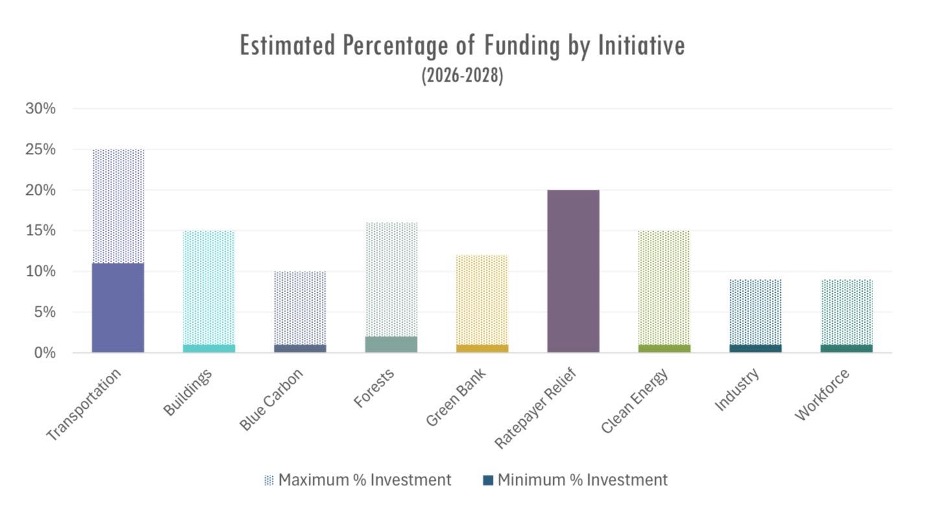
Source: NJ RGGI 2026-28 Strategic Funding Plan. p.17
This graph appears to state that the only priority the agencies plan to fully fund to the maximum percentage is ratepayer relief; while transportation has a minimum investment of approximately 11 percent, the rest of the priorities received a commitment to only receive approximately 1 to 2 percent of funding. The lack of commitment to the other priorities could demonstrate the intent or desire to use funds outside of the BPU’s 20 percent allocation in ways not aligned with the strategic plan and the state statute.
Conclusions and recommendations
It is clear from the law that the BPU portion of the RGGI funds is the only portion eligible to be used for ratepayer relief, and specifically must be used only for low- and moderate-income ratepayers. Additionally, the Clean Energy Fund diversions, both for the annual budget and for ratepayer relief, must be immediately scaled back. The Clean Energy Fund must be used for its intended purpose — funding clean energy — to provide both medium- and long-term ratepayer relief. Using both RGGI and CEF for ratepayer relief is a stopgap measure that does nothing to address the underlying causes for higher electric bills.
End Notes
[1] Ambrose, A. Stop the Raids: The Clean Energy Fund Should Fund Clean Energy. New Jersey Policy Perspective. (2023).
[2] Email from New Jersey Board of Public Utilities. Feb. 10, 2026. On file with the author.
[3] N.J. Stat. Sec. 48:3-60.12a. 2022.
[4] Ambrose, A. Stop the Raids: The Clean Energy Fund Should Fund Clean Energy. New Jersey Policy Perspective. (2023).
[5] New Jersey Board of Public Utilities. BPU Response to OLS Questions. FY 2025-26. Accessed Feb. 2026. p.22.
[6] Ibid.
[7] New Jersey Board of Public Utilities. Docket No. QO25040206: In the Matter of the Clean Energy Programs and Budget for Fiscal Year 2026. p.4.
[8] Ibid.
[9] NJPP analysis of annual legislative budgets. See also Ambrose, A. Stop the Raids: The Clean Energy Fund Should Fund Clean Energy. New Jersey Policy Perspective. (2023).
[10] New Jersey Board of Public Utilities. Docket No. QO24020120: In the Matter of Disbursement of Clean Energy Program Funds for the Residential Energy Assistance Payment. p.2.
[11] Ibid.
[12] New Jersey Board of Public Utilities. June 25, 2025 Meeting Minutes. p.21.
[13] RGGI, Inc. Elements of RGGI. Accessed Feb. 2025.
[14] Congressional Research Service. The Regional Greenhouse Gas Initiative: Background, Impacts, and Selected Issues. Jul. 16, 2019. p.2.
[15] RGGI, Inc. RGGI 101 Fact Sheet. Accessed Feb. 2026.
[16] Ibid.
[17] Stuart, D. and Hibbard, P. The Economic Impacts of the Regional Greenhouse Gas Initiative on Ten Northeast and Mid-Atlantic States. Analysis Group. May 2023. p.8-9.
[18] RGGI, Inc. RGGI States Welcome New Jersey as Its CO2 Regulation is Finalized. Jun. 17, 2019.
[19] New Jersey Department of Environmental Protection. Regional Greenhouse Gas Initiative. Accessed Feb. 2026.
[20] New Jersey Department of Treasury. FY 2026 Supplementary Information. p.80.
[21] N.J. Stat. 26:2C-51
[22] N.J. Stat. 26:2C-51(7b(1-4)).
[23] New Jersey Department of Environmental Protection. Regional Greenhouse Gas Initiative: Investing in NJ’s Climate-Smart Future. Accessed Feb. 2025.
[24] New Jersey Department of Environmental Protection. New Jersey RGGI Climate Investments Dashboard. Accessed Feb. 2025.
[25] New Jersey Department of Environmental Protection. RGGI Strategic Funding Plan FAQs. Accessed Feb. 2025.
State of New Jersey. 2026-28 Regional Greenhouse Gas Initiative Strategic Funding Plan. Accessed Feb. 2025.
[26] New Jersey Board of Public Utilities. Docket No. QO25070389: In the Matter of the Establishment of the Residential Universal Bill Credit (“RUBC”). Aug. 13, 2025.
Note: the remaining $263 million is from the Solar Alternative Compliance Payment (ACP) account. ACP is widely considered an appropriate fund for ratepayer relief.
[27] Ibid. p.4.
[28] State of New Jersey. 2026-28 Regional Greenhouse Gas Initiative Strategic Funding Plan. Accessed Feb. 2025.