
Testimony

Closing Loophole on Alternative Business Losses for High-Income Individuals Will Save NJ $120 Million Annually


New law will shut down deduction for incomes over $1 million, affecting less than 1 percent of tax filers.

Published on Jun 28, 2026 in Tax and Budget

The Alternative Business Calculation (ABC) deduction has drifted from its original purpose of closing a gap in the tax code into a fast-growing benefit for very high-income individuals. The bill today takes a key step towards ending this benefit for high-income households with over $1 million in annual income.FY

  • Since 2016, the ABC deduction has more than doubled in size, outpacing all other personal income tax deductions combined.
  • And that growth has been concentrated in very wealthy households. Sixty percent of the benefits go to roughly 0.6 percent of New Jersey tax filers, all with more than $1 million in income.
  • Reforming the deduction for the highest-income households raises more than $120 million in much-needed revenue while affecting less than 1 percent of New Jersey tax returns.
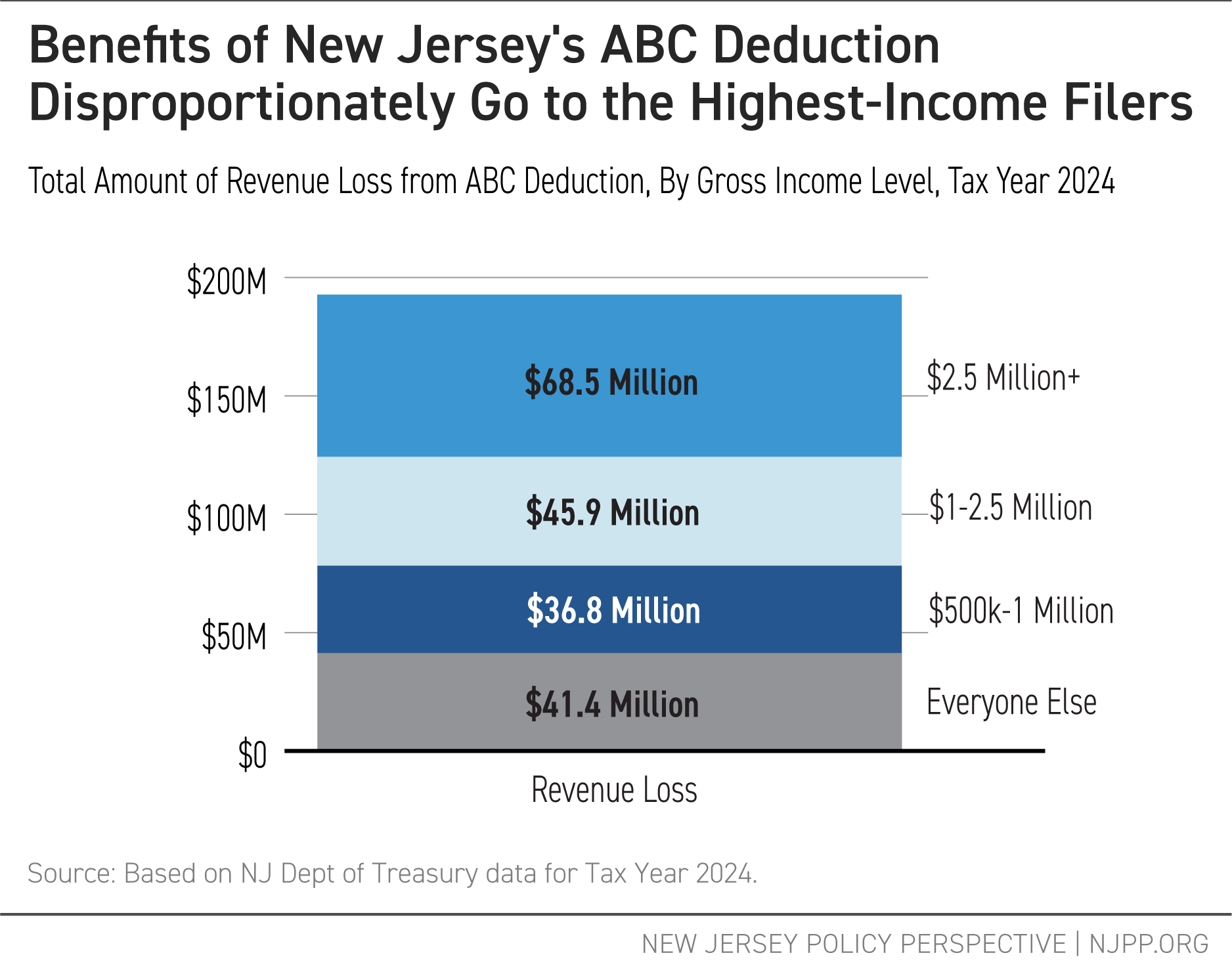
Benefits of New Jersey's ABC Deduction Disproportionately Go to the Highest-Income Filers

I urge the committee to pass a bill that aligns with the governor’s original proposal and to oppose and eliminate any carveouts or exemptions. As the original ABC deduction compromise made clear, opening any additional loopholes will result in likely exploitation and enrichment for the already-wealthy.

Author

  • Peter Chen, Senior Policy Analyst, has worked on child and family policy advocacy in New Jersey since 2014. Most recently, he coordinated New Jersey’s nonprofit campaign for a complete count of the 2020 Census. Additionally, Peter has written reports on topics including: childhood lead poisoning prevention, chronic absenteeism from school, teacher certification, and summer meals.

    Prior to New Jersey Policy Perspective, Peter was Policy Counsel at Advocates for Children of New Jersey, where he also served as a Skadden Fellow from 2014-16. Peter received his JD from Yale Law School and his Bachelors of Arts from Indiana University-Bloomington. He served as a law clerk for Chief Justice Shirley Abrahamson of the Wisconsin Supreme Court.

Like this publication?

Please consider supporting NJPP.

Your support powers the research, communications, and partnership building necessary to make policy work for people, so every New Jerseyan can achieve their goal for a healthy and vibrant life.