
Civilian Complaint Review Boards (CCRBs) Foster Transparency, Fairness, and Safety in Policing Practices

Good morning, Chairwoman Sumter, Vice Chair Verrelli, and distinguished members of the committee. My name is Marleina Ubel, and I am a policy analyst at New Jersey Policy Perspective (NJPP), a nonpartisan think tank focused on advancing economic, social, and racial justice for New Jersey residents.

I am here to express NJPP’s strong support for A1515, which allows municipalities to establish Civilian Complaint Review Boards (CCRBs). We believe that the establishment of these boards is crucial for fostering transparency, fairness, and safety in policing practices, ultimately promoting positive relations between law enforcement and the communities they serve.

And while I appreciate the positive strides this bill takes in enhancing police accountability and am thrilled to see the inclusion of subpoena power and that disciplinary recommendations carry weight, I would like to urge you to consider the following three points:

Statewide Application: A1515 should be enacted as a statewide bill to ensure that all communities across the state benefit from the establishment of CCRBs.

Concurrent Investigatory Power: The 120 day delay included in the bill undermines the goals of this legislation, namely trust, transparency, and accountability. Concurrent investigatory power is necessary to empower CCRBs to initiate and conduct investigations simultaneously with internal affairs units, preventing delays and ensuring a prompt and impartial inquiry into alleged misconduct. Moreover, members of the public are less likely to report complaints to the board if they do not trust that the board has the power to fully investigate their complaint.

And finally, CCRBs should be reflective of the communities they serve. A community-driven approach ensures diverse perspectives, enhances trust, and promotes transparency. The inclusion of community members on CCRBs is fundamental to building bridges between law enforcement and the communities they serve.

I also just want to address the concerns around police recruitment. End of year state trooper counts are expected to be higher than they have been in almost a decade, and New Jersey has almost double the national average of police officers to population. The national average is about two police officers for every thousand people, and in New Jersey we have roughly four police officers for every thousand people.

In conclusion, I strongly urge you to support A1515 and to consider these recommendations. By enacting this legislation with the aforementioned provisions, we can build a more accountable, transparent, and community-oriented law enforcement system in our state. And most importantly, a safer one.

Thank you for your attention to this matter.
It’s Time for New Jersey to Eliminate Public Defender Fees

Good morning, Chairman Sarlo and distinguished members of the committee. My name is Marleina Ubel, and I am a policy analyst at New Jersey Policy Perspective (NJPP), a nonpartisan think tank focused on advancing economic, social, and racial justice for New Jersey residents.

Thank you for posting this bill and allowing me the opportunity to testify in support of eliminating public defender fees. As a social worker and policy analyst with extensive knowledge of this issue, I am compelled to highlight the importance of this legislation for our legal system and the urgent need for its implementation.

New Jersey has long been a trailblazer in criminal legal system reform, recognizing the importance of equitable access to justice for all individuals, regardless of their socioeconomic status. However, the imposition of public defender fees creates an insurmountable burden for low-income individuals, exacerbating existing inequities and undermining the principles of fairness and equality upon which our justice system is built. Most Americans cannot afford a $400 emergency and based on the federal poverty level, over 800,000 New Jerseyans live in poverty, whereas estimates based on the “True Poverty Level” suggest that closer to 3 million residents—a third of the state’s population—live in poverty.[i] These individuals often struggle to afford to meet their basic needs, let alone bear the financial burden of legal representation.

Eliminating public defender fees is not only a matter of justice but also a fiscally responsible decision. The administrative costs associated with collecting and enforcing these fees often surpass the revenue generated. Additionally, by removing this financial burden, we can redirect resources towards the Office of the Public Defender, ultimately leading to better outcomes for defendants, the public defenders who represent them, and the justice system as a whole.

Moreover, the general public is largely under the assumption that public defenders are free. Many people were shocked to learn that in New Jersey, of all places, this is not the case. This is because everyone has a constitutional right to representation and has heard time and time again in popular media that if you cannot afford an attorney one will be appointed for you. I know that being a lawmaker involves balancing what one believes to be good policy, grounded in facts, and the wants and needs of the public that one is chosen to represent. This is one of those bills that does both.

Several states across the country, including our neighbors New York and Pennsylvania, do not charge for public defenders. By joining them, New Jersey can continue to lead by example and demonstrate its commitment to upholding the principles enshrined in our Constitution.

In conclusion, I urge you to support S3771 and work towards the elimination of public defender fees in New Jersey. By doing so, we can ensure that our justice system remains accessible to all, regardless of their socioeconomic status. Let us strive towards a more equitable future, where constitutional rights are not behind a paywall.

Thank you for your attention. I am available for any questions.


End Note

[i] New Jersey State Policy Lab, Rutgers University. October 21, 2022. https://policylab.rutgers.edu/perspectives-on-poverty-in-new-jersey-2008-2020/#:~:text=Based%20on%20the%20federal%20poverty,in%20poverty%20the%20same%20 year.

Police Killing of Najee Seabrooks is the Result of a Systemic Policy Failure

Earlier today, the New Jersey Office of the Attorney General released body camera footage from the police killing of Najee Seabrooks, a violence intervention specialist with the Paterson Healing Collective, who called 9-1-1 while experiencing a mental health crisis. The video footage depicts multiple officers responding to the mental health crisis with guns drawn and pointed toward Najee. Minutes after officers stated, “Nobody is going to shoot you,” officers opened fire. In response to the release of the footage, New Jersey Policy Perspective (NJPP) releases the following statement. 

Nicole Rodriguez, President, NJPP:

“Najee Seabrooks should be alive right now. This is not only tragic but the result of a systemic policy failure that had heavily armed police respond to a mental health crisis. What outcome should we expect when someone in crisis is met with police armed for war with their guns drawn? Our system failed Najee, just as it continues to fail our Black and brown neighbors who put their lives in jeopardy when they call 9-1-1 for help. State and local lawmakers must act with urgency so mental health crises are met with trained professionals, not armed police, and that people are connected to the care they need.”

For more information on, and examples of, alternatives to policing, read NJPP’s 2021 report, To Protect and Serve: Investing in Public Safety Beyond Policing.
# # #

“Tough-on-Crime” Bills Do Not Address the Root Causes of Crime

Good morning, Chairman Stack and members of the committee. Thank you for the opportunity to testify today.

I’m Marleina Ubel from New Jersey Policy Perspective (NJPP), a nonpartisan think tank focused on advancing economic, social, and racial justice for New Jersey residents.

First, I want to acknowledge that the work you do is challenging. You are pulled in different directions by people who feel passionately about these issues, and I believe that you are all trying to do what you feel is right. When I was in college, I had a professor tell me once, “doing the right thing is easy. It is knowing what the right thing is that is the hard part.” So, today I will share some information to help you determine what the right thing is.

As written, S3346 will essentially turn trespassing into 2nd degree burglary subject to NERA. What that means is, this legislature is asking that someone who enters any place with an accommodation for sleeping without permission, whether or not the place is empty, be sent to prison for 5 to 10 years, have to serve at least 85% of their sentence before they are even eligible for parole, and have an additional mandatory period of supervision tacked on. Make no mistake, this will create a new mandatory minimum, even if those words do not appear in the bill. It will also make that person essentially ineligible for other programming, such as diversion programs for juveniles or recovery court for individuals who use drugs.

Given that research has shown that property crime like burglary is tied to economic circumstances, this bill will target some of the most vulnerable New Jerseyans and make them ineligible for services that might actually reduce the chances for reoffense. Thus, this bill will have unintended consequences and increase the chances that people reoffend by making support services — the kind that actually address root causes of crime — out of reach. This bill will also adversely affect juveniles, because a 2nd degree NERA offense makes it more likely that they are tried in an adult court even if their record is clean.

Lengthy sentences do not serve as deterrents or address root causes, and they do not reduce crime. In fact, research has shown that increased and continuous exposure to the penal system increases recidivism and exacerbates the circumstances that lead to criminal activity in the first place, things like, employment and educational opportunities, economic stability, relationships with community members and family – all of these things are ripped away from people when they are sent to prison. In this case, ripped away from someone who is likely vulnerable and nonviolent for what could be a decade.

Bills like this are how we got to where we are today, known across the world as the incarceration nation. Please do the right thing and vote no on this bill.

Thank you and happy to take any questions.


The High Cost of “Free” Representation: Why New Jersey Should Eliminate Public Defender Fees

Published on Oct 24, 2022 in Public Safety

Every person should have access to a lawyer when accused of a crime. In fact, the phrase “if you cannot afford an attorney, one will be appointed for you,” is commonly heard on television and in popular culture.[i] However, free legal counsel is a myth in New Jersey. Despite the constitutional right to a lawyer, New Jersey charges fees for clients who are appointed to public defenders — fees that can leave their clients in debt and can influence how they navigate the justice system.

New Jerseyans with low incomes — even those under the federal poverty rate — have to pay for their right to representation with a public defender, even when they demonstrate financial indigence. The costs — or fees — are presented after a client goes through an application process to prove their inability to pay for an attorney,[ii] and the costs can be upwards of $1,000 per client.

At minimum, state law requires that the public defender’s office charge defendants at least $150 and requires payment within six months of the case.[iii] If the defendant cannot pay in full within that timeframe, they will become in debt to the State of New Jersey.[iv] This debt can result in liens on assets, which can damage an individual’s credit and result in garnishing any tax returns or inheritance.[v] Further, the consequences of these fees can be devastating —  roughly one-third of American adults cannot cover a $400 expense without going into debt or selling assets.[vi]

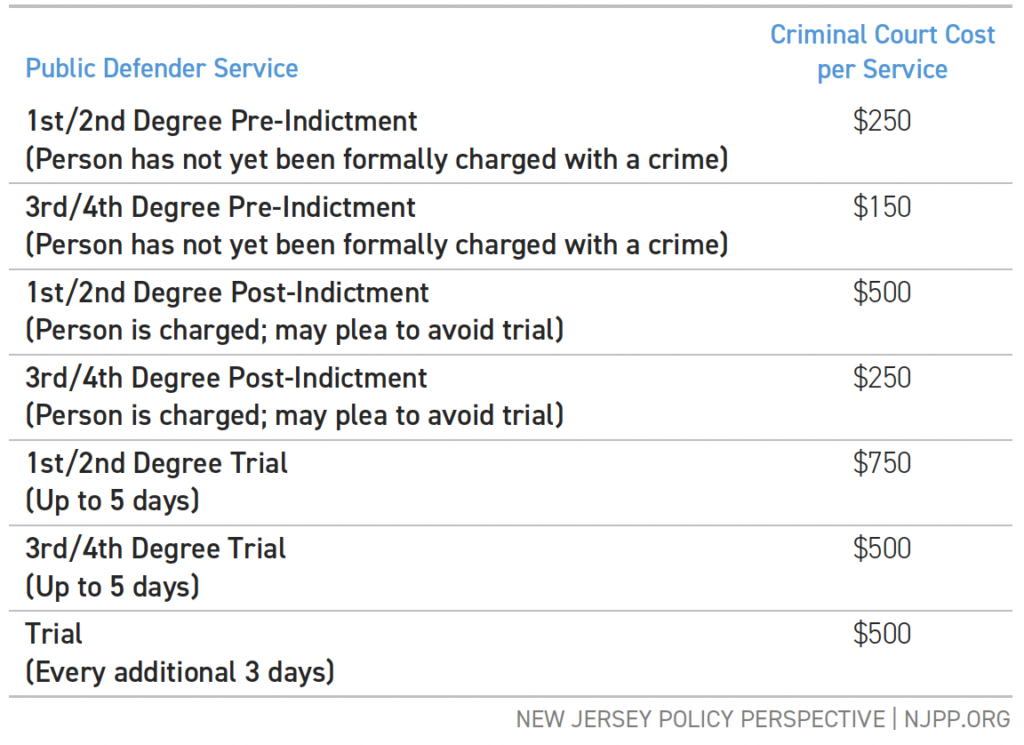
What’s worse, these fees encourage defendants to plead, regardless of the facts of their case. For example, accepting a plea bargain for a lower-degree offense not only reduces potential prison time or other penalties but also can reduce public defender costs by 65 percent (from $750 to $250).[vii]

Public Defender

A lawyer who works for and is appointed by the state for clients that cannot afford representation.

Indigence

When a client has proven that not only do they live below the poverty line, but they have no resources to help pay for an attorney.

Plea

An agreement in which the defendant pleads guilty to a less serious charge, or to one of several charges, in return for the dismissal of other charges; or they may plead guilty to the original criminal charge in return for a lighter sentence.

Fee Schedule For New Jersey Office of the Public Defender[viii]

Table outlining the different fees for each Public Defender Services. Costs range from $150 to $750.While the costs for indigent New Jerseyans can be insurmountable, the cash returns for the state are small. Anticipated revenue for Fiscal Year 2022 from clients of the Office of the Public Defender (OPD) is about $4 million,[ix] a mere 0.008 percent of the state budget.[x] There are also unaccounted-for administrative costs associated with debt collection.[xi]
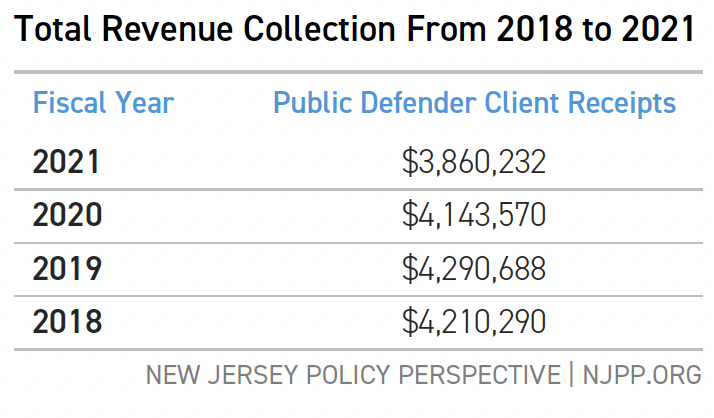
The High Cost of Public Representation[xii]

Table outlining total revenue collection from 2018 to 2021. Receipts range from $3,860,232 to $4,290,688.The state Legislature, Judiciary, and Attorney General have taken some steps to reduce the negative impact of fines and fees, such as halting arrest warrants for debt from unpaid fines and fees.[xiii] However, even cursory interaction with criminal courts can result in long term financial disaster for individuals and families across New Jersey.[xiv]

Due to inequitable outcomes for individuals in the criminal justice system, neighboring states, like New York and Pennsylvania, do not charge for legal representation, and neither should New Jersey.[xv] To have a more equitable justice system, the state should eliminate all public defender fees and fund residents’ constitutional right to an attorney through sustainable public funding. Access to a constitutional right should not come with a price tag.


End Notes

[i] Ronald Steiner, Rebecca Bauer & Rohit Talwar, The Rise and Fall of the Miranda Warnings in Popular Culture, 59 Cleveland St. L. Rev. 219 (2011).

[ii] In municipal courts, application fees for representation by a public defender can be as high as $200. N.J. Stat. Sec. 2B:24-17. However, the New Jersey Office of the Public Defender has eliminated application fees.

[iii] N.J. Admin. Code Sec. 17:39-3.1

[iv] N.J. Stat. Sec. 2A:158A-17

[v] N.J. Stat. Sec. 2A:158A-17

[vi] Board of Governors of the Federal Reserve System, Economic Well-Being of U.S. Households in 2021 (May 2022),  p. 35-36.

[vii] According to the fee schedule, pre-trial costs for 3rd and 4th degree offenses are $250, but can jump to $750 as soon as one decides to go to court.

[viii] N.J. Admin. Code Sec. 17:39-3.1

[ix] https://pub.njleg.state.nj.us/bills/2022/S2500/2023_I1.PDF#page=6

[x] New Jersey State Budget for Fiscal Year 2023 is $50.6 billion.

[xi] Marea Beeman et al., National Legal Aid and Defender Association, At What Cost? Findings from an Examination into the Imposition of Public Defense System Fees (July 2022), tbl. 2 at p. 15, https://www.nlada.org/sites/default/files/NLADA_At_What_Cost.pdf?v=2.0

[xii] NJPP analysis of state budget documents, all dollar amounts are adjusted for inflation.

[xiii] New Jersey Office of the Attorney General. Acting AG Platkin Issues Policy to Address Negative Consequences of Large Number of Outstanding Bench Warrants for Low-Level Offenses (May 2022). https://www.njoag.gov/acting-ag-platkin-issues-policy-to-address-negative-consequences-of-large-number-of-outstanding-bench-warrants-for-low-level-offenses/

[xiv] Joni Hirsch & Priya Sarathy Jones, Driver’s License Suspension for Unpaid Fines and Fees: The Movement for Reform, 54 U. Mich. J. Law Reform 875 (2021) (outlining how relatively minor driver’s license suspensions harm earnings ability without improving public safety).  https://repository.law.umich.edu/cgi/viewcontent.cgi?article=2535&context=mjlr

[xv] Marea Beeman et al., National Legal Aid and Defender Association, At What Cost? Findings from an Examination into the Imposition of Public Defense System Fees (July 2022), pgs. 98-99, https://www.nlada.org/sites/default/files/NLADA_At_What_Cost.pdf?v=2.0

New Internal Affairs Dashboard is a Historic Step Towards Police Transparency

Earlier today, Acting Attorney General Matt Platkin announced a new online dashboard detailing information on police internal affairs investigations. The searchable dashboard, which compiles information that was previously only accessible through hundreds of different agencies, allows the public to search information by law enforcement agency, the types of allegations, and what, if any, disciplinary action was taken. In response to the launch of the dashboard, New Jersey Policy Perspective (NJPP) releases the following statement.

Marleina Ubel, Policy Analyst, NJPP:

“This is a historic step towards police transparency and accountability in the state of New Jersey. By making information on internal affairs investigations available to the public and continuing to share detailed information on police use of force, the Attorney General and Office of Justice Data are giving the public the power to hold problematic officers accountable. The Legislature should follow this example by passing S371/A996 and finally make police disciplinary records accessible to the people they are sworn to protect.”

# # #

Reevaluation of Fines and Fees in the Criminal Legal System is Essential to Reducing Wealth Inequality

Good evening. Thank you for the opportunity to testify. My name is Marleina Ubel and I am a policy analyst at New Jersey Policy Perspective (NJPP), a nonpartisan think tank focused on advancing economic, racial, and social justice for New Jersey residents.

The criminal justice system creates and exacerbates racial wealth gaps. Mass incarceration and its disparate application to Black and Hispanic/Latinx communities has reduced their earnings potential, employment opportunities, and wealth accumulation. However, my focus today will be on monetary fines and fees, which can turn minor offenses into massive and long-lasting disparities, especially for people already in dire economic circumstances.

A brief overview of the terminology: fines and fees, or monetary sanctions, are costs imposed by the courts. Fines are meant to serve as a punishment, such as a ticket for jaywalking, while fees are meant to pay for the day-to-day operations of the criminal justice system. Often, when one is charged with a fine, they also are charged with a fee. However, for a person with outstanding fines or fees, the effect is the same — an amount owed that they likely cannot pay, which can balloon into substantial economic hardship down the road. A recent study showed that Black and Hispanic/Latinx defendants spent more time in the court system before disposition and owed more fines and fees 90 days after disposition than white defendants with similar charges.[i]

Let me illustrate how broken the system of fines and fees is with a fairly commonplace criminal justice system interaction: When a person is accused of a crime but can’t afford their own attorney, they are entitled to representation by a public defender. But in New Jersey, this is not free — despite the defendant having to demonstrate financial indigence to qualify for the service. State law requires that the public defender’s office bill defendants a minimum of $150.[ii] Within six months of disposition of the case, the defendant must pay the bill or be in debt to the State of New Jersey.[iii]

This applies to municipal public defenders for municipal offenses, meaning that even low-level municipal offenses can result in liens placed on low-income defendants, yet another drag on ability to build wealth, even if the charges are dismissed or other fines and fees are successfully paid.[iv]

And, while these costs do not appear enormous, roughly one-third of American adults cannot cover a $400 expense without going into debt or selling assets.[v]

Although steps have been taken by the Legislature, judiciary, and the Attorney General to reduce the impact of these fines and fees on individuals, the reality is that even cursory interaction with criminal courts can result in charges that hamper wealth accumulation. Getting a lawyer, obtaining court documents pertaining to one’s own case, and applying for expungement of one’s record all come with costs that low-income individuals are unlikely to afford.

NJPP recommends eliminating all public defender fees and funding residents’ constitutional right to an attorney through sustainable public funding. Neighboring states like New York and Pennsylvania do not charge for legal representation and neither should we.[vi]

However, beyond these fees, NJPP recommends a wholesale reevaluation of fines and fees across the criminal legal system, in line with recent legislation that heavily reduces or eliminates juvenile-justice-related fees.[vii] The vicious cycle of fines and fees, inability to pay, and subsequent increased interaction with police and courts — leading to lost work time, drained savings, and of course, additional fines and fees — must be broken to reduce wealth inequality in New Jersey.


End Notes

[i] Lindsay Bing et al., Incomparable Punishments: How Economic Inequality Contributes to the Disparate Impact of Legal Fines and Fees, RSF: The Russell Sage Foundation Journal of the Social Sciences January 2022, 8 (2) 118-136. https://www.rsfjournal.org/content/8/2/118

[ii] N.J. Admin. Code Sec. 17:39-3.1

[iii] N.J. Stat. Sec. 2A:158A-17

[iv] N.J. Stat. Sec. 2B:24-13

[v] See Board of Governors of the Federal Reserve System, Economic Well-Being of U.S. Households in 2021 (May 2022),  p. 35-36.

[vi] Marea Beeman et al., National Legal Aid and Defender Association, At What Cost? Findings from an Examination into the Imposition of Public Defense System Fees (July 2022), tbl. 2 at p. 15, https://www.nlada.org/sites/default/files/NLADA_At_What_Cost.pdf?v=2.0

[vii] P.L. 2021, c.342.

Racial Impact Statements Are Essential When Changing Criminal Justice Policy to Advance Racial Justice

Good morning, Chairwoman Greenstein and members of the committee. Thank you for the opportunity to testify today.

I’m Marleina Ubel from New Jersey Policy Perspective (NJPP), a nonpartisan think tank focused on advancing economic, social, and racial justice for New Jersey residents.

While the bill is less than ideal and unlikely to actually reduce gun violence, NJPP supports the amendments that have been made to narrow the scope of S513. However, we cannot fully support this legislation without a racial impact statement. Legislation like S513 will likely change the number of people being held in our jails and it is critical that a racial impact statement accompany this bill given that New Jersey has a history of arresting and incarcerating people of color at disproportionate rates. Moreover, it is required by statute that the Office of Legislative Services produce and make publicly available racial impact statements when there is a change in criminal justice policy.

Thank you.

New Jersey Could Do More to Expand Reentry Services

Public safety demands more than policing and prisons, including robust reentry services that support people returning home from incarceration. Reentry services are proven to reduce recidivism, improve neighborhood safety, and save the state money.[i] Without them, returning community members face unemployment, limited housing options and educational opportunities, and disconnection from society. Instead of building a holistic support system, however, Governor Murphy’s budget proposal for Fiscal Year (FY) 2023 continues a path of flat-funding for a patchwork of reentry programs, while law enforcement budgets receive millions in increased investment.

Due to the lack of reentry infrastructure, people leaving incarceration are released with little more than letters from friends, and without any support or even identification.[ii] The state largely relies on non-profit organizations for reentry, which the budget funds through the Department of Community Affairs. Thus, unless an individual is placed on parole, few services are available aside from those provided through non-profit organizations.[iii]  Given that New Jersey has the highest Black-white disparity in incarceration in the country,[iv] the lack of a holistic reentry system is not just a humanitarian issue, but also an issue of racial justice.

The governor’s proposed budget for FY 2023 leaves reentry largely unchanged from the previous year. The budget adds $4 million to the New Jersey Locally Empowered, Accountable, and Determined (NJ LEAD) grants program, which provides funding to local non-profit organizations to enhance or expand services to people leaving prison.[v] The state also plans to use cannabis revenue for reentry, though it is unclear how much will actually be allocated for this purpose.

At the same time, the governor’s budget proposes $10 million in cuts to programs through the Department of Community Affairs. The result is flat or decreased funding for New Jersey’s reentry programs.  Given the state’s record-setting, multi-billion-dollar surplus, this is a big opportunity missed to support residents returning from incarceration.

New Jersey’s budget proposal fails to invest in robust reentry services, non-police crisis response, or directly in communities most harmed by the pandemic. When this is taken into account with the announcement that millions of federal American Rescue Plan dollars would be used to fund state police, it illustrates New Jersey’s single-minded approach to public safety and an equitable pandemic recovery.[vi]

People returning from incarceration need support to thrive in their communities. The state should take a proactive approach to ensure that those reentering their communities have what they need to thrive, rather than depending on smaller non-profit organizations to pick up the slack.  


End Notes

[i] Urban Institute, John Roman et al. “Impact and CostBenefit Analysis of the Maryland Reentry Partnership Initiative” January, 2007. https://www.urban.org/sites/default/files/publication/46196/311421-Impact-and-Cost-Benefit-Analysis-of-the-Maryland-Reentry-Partnership-Initiative.PDF

[ii] New Jersey Monitor, Sophie Nieto-Munoz. “Early release for hundreds of ex-offenders across N.J.” February 11, 2022. https://newjerseymonitor.com/2022/02/11/early-release-for-hundreds-of-ex-offenders-across-n-j/

[iii] New York Times, Tracey Tully. “2,258 N.J. Prisoners Will Be Released in a Single Day,” November, 9 2020. https://www.nytimes.com/2020/11/04/nyregion/nj-prisoner-release-covid.html

[iv] The Sentencing Project, Ashley Nellis, PhD. “The Color of Justice,” Pg. 21. 2021. https://www.sentencingproject.org/wp-content/uploads/2016/06/The-Color-of-Justice-Racial-and-Ethnic-Disparity-in-State-Prisons.pdf

[v] New Jersey Office of Management and Budget. Summary of Governor’s Budget Recommendations: State of New Jersey FY2023 Budget in Brief, Pg. 42. March 8, 2022. https://www.nj.gov/treasury/omb/publications/23bib/BIB.pdf

[vi] New Jersey Monitor, Dana DiFilippo. “In reversal, New Jersey to again allow cops to chase car thieves,” February 11, 2022. https://newjerseymonitor.com/2022/04/29/n-j-reverses-policy-that-barred-cops-from-pursuing-stolen-vehicles/

Local Government Should Not Be Funded With Fines and Fees

Good afternoon, Chairman Spearman and members of the Committee. Thank you for the opportunity to testify today.

I’m Marleina Ubel from New Jersey Policy Perspective (NJPP), a nonpartisan think tank focused on advancing economic, social, and racial justice for New Jersey residents, and it is in keeping with this mission that I testify in opposition to A-959.

Municipal government and services should be funded with robust, reliable, and progressive revenues, not fines and fees extracted by law enforcement or court systems. A-959 would divert funds generated by fines and fees from state coffers to the municipal government where a motor-vehicle violation happens to take place. “Taxation by citation” for local government through law-enforcement-generated fines and fees has a history of being discriminatory, falls heavily on low-income residents, and creates an unreliable source of revenue.

Motor vehicle fines and fees disproportionately fall on lower-income residents and communities of color. In the first half of 2021, Black motorists made up more than 24 percent of State Police summonses, despite making up only 13 percent of the state’s total population.

Law enforcement and government finance groups on the left, right, and center agree that funding government through motor vehicle fines and fees distorts government services and undermines public safety and public trust in law enforcement and courts.

If the goal of A-959 is to ensure appropriate funding for municipal courts, NJPP recommends robust state funding for municipal courts. As the Supreme Court Working Group on Municipal Courts report from 2019 suggests, the Legislature should focus on reducing local reliance on law-enforcement- and judicially-imposed fines and fees, rather than deepening municipal reliance on these unstable and discriminatory revenue sources.