
The latest update to the annual Fortune 500 list of the largest American companies was released this week, and 21 Garden State businesses made the list. It’s an impressive showing for a state that usually falls to the bottom of misleading national rankings that claim to measure how attractive different states are to business investment. In fact, most of these so-called “studies” are promoted by organizations that are not advocating for a truly stronger business climate but only for lower corporate taxes.
Perhaps the most popular of these rankings is the Tax Foundation’s annual “Business Tax Climate” index. Business lobbying groups in New Jersey and anti-tax lawmakers frequently cite New Jersey’s perennial dismal ranking on this survey as proof that the Garden State’s taxes are stifling business investment and creating a drag on economic growth.
But an interesting trend emerges when one cross-references the Fortune 500 with the “Business Tax Climate” index: The “worst” states in the Tax Foundation’s index have a disproportionate share of America’s largest corporations, while the “best” states hardly have any.
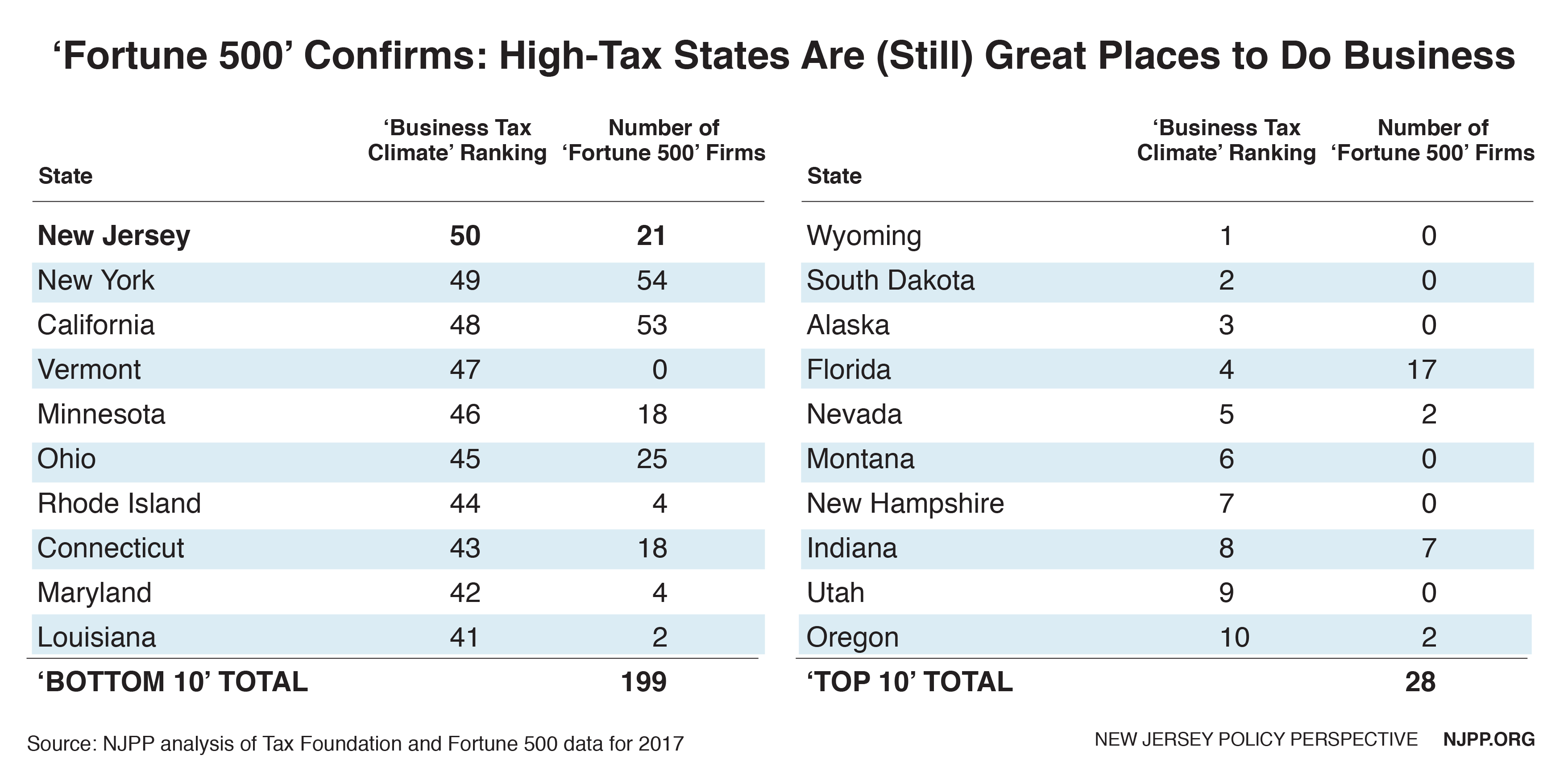
In fact, not a single state that ranks in the top 10 of the Tax Foundation’s index has more Fortune 500 companies than New Jersey, which ranks dead last in the index. And the entire top 10 states, with just 28 Fortune 500 companies, barely have more of these big businesses than the Garden State alone.
The 10 “worst” Tax Foundation states – New Jersey, New York, California, Vermont, Minnesota, Ohio, Rhode Island, Connecticut, Maryland and Louisiana – have a total of 199 Fortune 500 companies. In other words, these represent 20 percent of all states but 40 percent of the Fortune 500.
Meanwhile, the Tax Foundation’s 10 “best” states – Wyoming, South Dakota, Alaska, Florida, Nevada, Montana, New Hampshire, Indiana, Utah and Oregon – have just 28 Fortune 500 companies, or 6 percent.
The bottom line: Despite the drumbeat of anti-tax groups and politicians, there is a long list of factors – like location, workforce, quality of life and more – that are far more important to most businesses than low taxes. And in a cruel and ironic twist, the more our elected leaders travel down the tax-cutting path, the less money there is to ensure the state is nurturing these far more important assets.