
More than 727,000 New Jerseyans — roughly 1 in 13 residents — face daily life without health insurance.[1] That number is about to grow dramatically.
Congress is stripping coverage from hundreds of thousands more residents by eliminating subsidies, imposing new Medicaid work requirements, and creating unnecessary paperwork barriers.[2] These actions will reverse a decade of progress in expanding health coverage and leave working families without access to medical care.
Health insurance is not optional for a thriving New Jersey. Coverage reduces debt, improves health outcomes, and allows families to plan for their futures.[3] It improves public health through preventive care and reduces costs for hospitals and the state.[4] Yet continued gaps in coverage options and rising costs keep quality health coverage out of reach for many working families.
Without immediate state action to counter federal cuts, hundreds of thousands more New Jerseyans will lose coverage. State leaders must act now to protect residents by providing increased financial assistance, expanding coverage options, and standardizing outreach across counties.
Congress Is Stripping Coverage Through Four Major Actions
Through the recently enacted "One Big Beautiful Bill Act" (H.R. 1), federal lawmakers are dismantling health coverage supports with actions that will devastate New Jersey families. These actions will strip coverage from working people, increase medical debt, and push families into crisis, directly contradicting the hard-won lessons of the COVID-19 pandemic about the importance of accessible, affordable health care.[5]
Enhanced subsidies have expired. Congress allowed enhanced federal subsidies on health insurance marketplaces to expire, pulling $500 million in assistance out of New Jersey residents alone.[6] Without these subsidies, many working families will no longer be able to afford marketplace plans through GetCovered NJ.
New work requirements will kick eligible people off coverage. Starting in 2027, federal law will require adult Medicaid enrollees ages 19 to 64 to complete 80 hours of work or community service each month — or lose coverage.[7] Evidence from Arkansas shows that work requirements don’t increase employment, they cause mass coverage losses because people cannot navigate complex reporting systems. New Jersey families will lose coverage not because they are ineligible, but because paperwork barriers block access to care.[8]
Increased paperwork requirements create barriers to coverage. Adults enrolled through Medicaid expansion must now submit paperwork proving they still qualify every six months instead of once a year.[9] This will cause eligible people to lose coverage simply because they miss paperwork deadlines. Recent coverage losses when pandemic protections ended revealed that thousands of New Jerseyans lost coverage not because they were ineligible but because they could not navigate the system.[10]
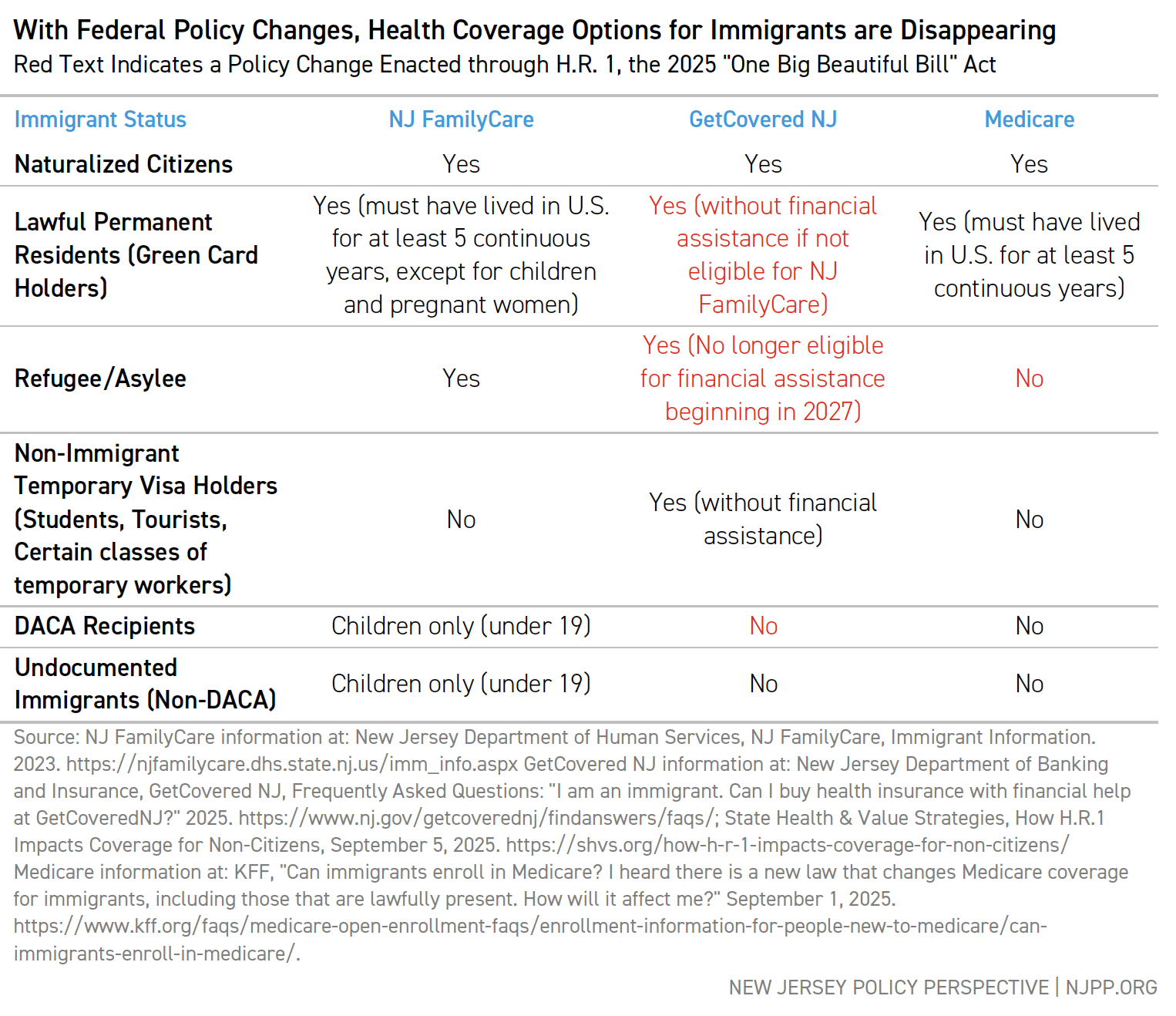
Immigrant coverage is being eliminated. Federal lawmakers are eliminating affordable coverage options that immigrants previously relied on through provisions of H.R. 1, the “One Big Beautiful Bill Act.”[11] This will increase the already severe barriers that immigrant residents face in accessing health coverage.
Impact on New Jersey
These federal actions threaten to:
- Strip coverage from hundreds of thousands of residents
- Eliminate $500 million in marketplace subsidies
- Create paperwork barriers that will cause massive coverage losses among eligible Medicaid enrollees
- Further increase the uninsured rate among immigrant communities already facing the highest barriers
With federal support disappearing, state leaders must stabilize access and protect residents and their futures.
Working Families and Immigrants Face the Highest Barriers
Gaps in the health care system leave hundreds of thousands of New Jerseyans without coverage. Eligibility limits, bureaucratic barriers, and lack of information about programs prevent many residents from enrolling in coverage they need and can afford.[12]
Most Uninsured New Jerseyans Work — But Employers Don't Provide Coverage
Most uninsured New Jerseyans have jobs but their employers do not provide health coverage. They work as retail cashiers, farm workers, construction workers, and social service workers; the same jobs considered "essential" during the COVID-19 pandemic.[13]
Immigrants and residents working low-wage, temporary, or seasonal jobs struggle the most to enroll in coverage.[14] These barriers perpetuate racial and income inequities in coverage, reflecting the ongoing effects of historical racism, xenophobia, and discrimination.[15]
Racial Inequities Persist Due to Historical Racism
Because of historical racism, Black and Latinx/Hispanic residents are more likely to work in industries and jobs that do not provide coverage.[16] This worsens racial inequities in coverage.[17] The jobs most likely to lack coverage are also the jobs that Black and Latinx/Hispanic workers are disproportionately employed in due to discriminatory hiring practices and occupational segregation.
Immigrants Face the Highest Barriers to Coverage
Immigrants face the highest barriers to coverage of any group. They qualify for fewer programs than citizens, and the programs they can access offer less financial help.
New Jerseyans who are not citizens are nearly nine times more likely to be uninsured than native-born citizens and nearly five times more likely to be uninsured than naturalized citizens.[18]
Immigrants are overrepresented among the uninsured because they have so few affordable coverage options, especially those living on low incomes. Even in counties with strong outreach and low uninsured rates overall, immigrants remain ineligible for programs or face significant obstacles to purchasing affordable coverage.
Without affordable coverage options, immigrant residents who cannot pay expensive premiums on their own are left uninsured. Strong outreach efforts are critical to connecting eligible immigrants with coverage by addressing language barriers, providing information, and building trust.[19] This is especially important when federal policies threaten immigrant communities more broadly.[20]
Working-Age Adults Are Most Affected
Working-age adults face the highest barriers to coverage. Four out of every five uninsured residents across all counties are working-age adults. Seniors make up the smallest proportion of uninsured residents.[21] Medicare coverage ensures they are the least likely to struggle with access.[22]
While these coverage gaps reflect national problems, state leaders can address them by protecting residents through policy action.
The ACA Proves State Action Can Expand Coverage
The Affordable Care Act transformed health coverage in New Jersey. Since 2014, when the law's major provisions took effect, 515,000 more residents gained insurance — coverage that protects their health and financial security.[23]
Two provisions drove this progress: the creation of GetCovered NJ, the state health insurance marketplace, and the expansion of Medicaid to cover more adults with low incomes.

GetCovered NJ Enrollment Has More Than Tripled
GetCovered NJ serves residents who cannot get affordable insurance through their jobs and do not qualify for Medicaid. The marketplace allows them to purchase coverage with financial help from the state and federal government.[24]
Since 2014, enrollment has more than tripled — from 161,775 in the first year to 513,217 in 2025.[25] The marketplace now provides essential coverage to more than 350,000 additional New Jerseyans.[26]
Fast Facts: New Jersey’s Uninsured Residents
3 of every 4 uninsured residents who are working-age are employed at least part-time.Residents with incomes below 100% of the federal poverty level are nearly 5 times more likely to be uninsured than those with higher incomes.
1 of every 3 uninsured residents work in industries with more low-wage and temporary jobs, such as construction or arts, entertainment, accommodation, or food services.
1 of every 9 uninsured residents work in the essential services of education, health care, and social assistance.
Hispanic/Latinx residents are 6 times more likely to be uninsured than non-Hispanic/Latinx white residents.
Black residents are over twice as likely to be uninsured as non-Hispanic/Latinx white residents.
Source: NJPP Analysis of U.S. Census Bureau, American Community Survey - 2024 5-Year Estimates, Tables S2701 and S2702.
Medicaid Expansion Closed the Coverage Gap
Medicaid expansion brought coverage to nearly 390,000 New Jerseyans who previously fell through the cracks.[27] These residents — adults with incomes up to 138 percent of the federal poverty level ($22,025 per year for a single adult in 2026) — earn too much to qualify for traditional Medicaid but too little to afford coverage on their own, especially with limited financial help.[28]
Their jobs do not offer health insurance, and their paychecks leave little room for premiums. Medicaid expansion closed this gap, providing quality coverage to residents working hard to get by.
Progress Is Now Threatened by Federal Cuts
Despite these improvements, residents living on low incomes and immigrants continue to face barriers to affordable health insurance. Now, federal lawmakers are withdrawing support from programs that serve families with the fewest resources, threatening to leave even more people without coverage.[29]
The ACA’s success shows that policy solutions work when properly funded and implemented. State leaders must build on this progress by countering federal cuts with state action.
State Leaders Must Counter Federal Cuts
New Jersey leaders must continue to adequately fund existing programs like Cover All Kids and take these additional actions to protect residents from federal cuts:
Expand State Subsidies on the GetCovered NJ Marketplace
The elimination of the protections provided during the COVID-19 pandemic — including enhanced premium tax credits on the health insurance marketplaces and fewer administrative barriers for continuous coverage — has set health coverage back in direct contradiction to the lessons learned during that crisis.[30]
By expanding state subsidies — the New Jersey Health Plan Savings — already provided through GetCovered NJ, the gaps created by federal cuts can be filled with a reliable funding source, ensuring that residents can continue to afford plans through the marketplace.[31] In recent years, the state spent $215 million in funds raised through a state assessment paid by health insurance companies on these subsidies to help lower the cost of plans for residents. Dedicating more state funds toward these subsidies can help to fill some of the gap left by the expected loss of $500 million in federal assistance.[32]
Improve Data Sharing and Enrollment Systems to Prevent Paperwork-Driven Coverage Loss
Beginning in 2027, adult Medicaid enrollees aged 19 to 64 will be required to complete 80 hours of “community engagement,” defined as qualifying work or community service unless enrolled in certain educational programs. If they do not meet the requirement and do not qualify for an exemption, they will lose coverage.[33] Additionally, many of those same enrollees — those adults enrolled through the ACA Medicaid expansion — will now be required to submit redetermination paperwork every 6 months, rather than once a year.[34] Both of these requirements increase the likelihood that people will lose coverage simply due to administrative barriers.[35]
The state must take immediate action to invest in cross-departmental data sharing to reduce the paperwork required of residents with low incomes to receive all of the support for which they are eligible. Additionally, improving the accessibility of programs dealing with enrollment and reporting in order to ensure that the paperwork is as easy to understand, fill out, and submit as possible will help to reduce the number of people who struggle to complete the requirements.[36] The recent massive coverage losses during the Medicaid unwinding — when the state had to reevaluate all Medicaid enrollees’ eligibility as pandemic protections were removed — emphasized the communication gaps and paperwork system barriers that residents face to maintain coverage.[37] Improvements to these systems are critical for protecting New Jerseyans.[38]
Establish a State Government-Backed Insurance Plan to Close Coverage Gaps
When people cannot afford health insurance, they go without coverage to pay rent, keep the lights on, and put food on the table.[39] Without immediate health concerns, these needs feel more urgent. No one should face this choice, yet it is the reality for many New Jerseyans because gaps in coverage options define the state's health care system.
Currently, every affordable coverage option in the state, except NJ FamilyCare for children, limits eligibility based on immigration status or other factors. Many people cannot even buy into Medicaid, CHIP, or marketplace coverage by paying a reasonable premium — they are simply shut out.
State leaders should establish a government-backed health insurance plan — a “public option” — open to all residents regardless of age or immigration status. This would provide affordable coverage to residents who have limited or no options in the current system. A well-designed public option can also reduce costs system-wide and improve affordability for everyone.[40]
Ensure Equal Access to Enrollment Across Counties
County social services boards help residents enroll in coverage, but their staffing and outreach vary widely.[41] In counties where leaders refuse to commit resources, fewer eligible residents get enrolled.
The state should strengthen oversight of county boards and require better pay and benefits to attract qualified staff. These steps would reduce gaps between counties and help more New Jerseyans get covered.
Adequate staffing allows county workers to conduct targeted outreach to communities that face the highest barriers to enrollment, including immigrant communities that need language assistance and trust-building efforts.[42] This is especially true when exclusionary policies threaten immigrant communities more broadly.[43] When counties lack resources, these critical outreach efforts simply do not happen.
Conclusion
New Jersey has made remarkable progress expanding health coverage over the past decade. The Affordable Care Act brought insurance to more than half a million residents who previously went without. GetCovered NJ and Medicaid expansion closed critical gaps in the system.
Federal cuts now threaten to reverse this progress. Enhanced subsidies have expired, new work requirements will create paperwork barriers, and immigrants are losing access to affordable options. Without state action, thousands more New Jerseyans will lose coverage.
State leaders have the power to protect residents and their families. By increasing state subsidies, fixing broken enrollment systems, creating a public option, and ensuring equal county access to enrollment support, New Jersey can counter federal cuts and continue expanding coverage to those who need it most.
The choice is clear: act now to protect New Jerseyans, or watch a decade of progress disappear.
The stakes are clear. Will state leaders act to protect residents, or will they allow federal cuts to strip coverage from hundreds of thousands of working families?
End Notes
[1] U.S. Census Bureau, American Community Survey -- 2024 1-Year Estimates, Table S2701, 2025. The 1-year estimate, rather than the 5-year estimate, is provided here to give the most current picture of the number of uninsured in light of the significant changes that have happened through the Medicaid unwinding and other point-in-time effects.
[2] For a full timeline of the federal cuts affecting New Jersey, see: Ambrose, A., Chen, P., Holom-Trundy, B., and Ubel, M., State Lawmakers Should Protect Residents from Federal Cuts to Vital Services, New Jersey Policy Perspective, Aug. 2025.
[3] McGough, M., State-Based Efforts Will Provide Limited Relief from Enhanced Tax Credit Expiration, KFF, Jan. 2026. New Jersey Department of Banking and Insurance, Impact of Proposed Congressional Reconciliation Bill Package on New Jersey Residents Enrolled in Health Coverage Through Get Covered New Jersey, Jun. 2025.
[4] New Jersey Department of Human Services, Statement from Human Services Commissioner Sarah Adelman, Jul. 2025.
[5] Holom-Trundy, B., Beyond the Pandemic: New Data Reveals Growing Health Insurance Coverage Gaps, New Jersey Policy Perspective, Sep. 2024. Buettgens, M., et al., 4.8 Million People Will Lose Coverage in 2026 If Enhanced Premium Tax Credits Expire, Urban Institute, Sep. 2025. Lo, J., et al., ACA Marketplace Premium Payments Would More than Double on Average Next Year if Enhanced Premium Tax Credits Expire, KFF, Sep. 2025.
[6] McGough, M., State-Based Efforts Will Provide Limited Relief from Enhanced Tax Credit Expiration, KFF, Jan. 2026.; New Jersey Department of Banking and Insurance, DOBI Response to OLS Questions on FY 2026 Budget, Jun. 2025. Biryukov, N., Rates on NJ health insurance marketplace to skyrocket, state regulator warns, New Jersey Monitor, Oct. 2025.
[7] Centers for Medicare & Medicaid Services, Bulletin on Section 71119 of the “Working Families Tax Cut” Legislation, Public Law 119-21: Requirements for States to Establish Medicaid Community Engagement Requirements for Certain Individuals, Dec. 2025.
[8] Sommers, B.D., Goldman, A.L., Blendon, R.J., Orav, J., and Epstein, A.M., Medicaid Work Requirements — Results from the First Year in Arkansas, The New England Journal of Medicine, v. 381, no. 11, Jun. 2019. Medicaid and CHIP Payment and Access Commission (MACPAC), An Updated Look at Rates of Churn and Continuous Coverage in Medicaid and CHIP, Oct. 2021.
[9] KFF, Health Provisions in the 2025 Federal Budget Reconciliation Bill, Jul. 2025.
[10] New Jersey Department of Human Services, Stay Covered NJ Renewal Data, Jun. 2024.
[11] Stainton, L., Thousands of legal immigrants in NJ could be thrown off Medicaid, NJ Spotlight News, Jul. 2025.
[12] For eligibility limitations, see the NJ FamilyCare website: New Jersey Department of Human Services, NJ FamilyCare - Who is Eligible? and NJ Familycare - Immigrant Information, 2025. For the estimate of the loss due to recent federal changes, see: New Jersey Department of Human Services, Statement from Human Services Commissioner Sarah Adelman on Impact of Medicaid and SNAP Cuts on NJ, Jul. 2025. Imperato, N. and Doobay, K., Evaluating the Policy Implications and Impact of Health Insurance Literacy Initiatives, New Jersey State Policy Lab, Rutgers University, 2025.
[13] National Conference of State Legislatures, COVID-19: Essential Workers in the States, Jan. 2021.
[14] NJPP Analysis of U.S. Census Bureau, American Community Survey – 2024 5-Year Estimates, Tables S2701 and S2702, 2025.
[15] Holom-Trundy, B., Unprecedented and Unequal: Racial Inequities in the COVID-19 Pandemic, New Jersey Policy Perspective, Oct. 2020. Ndugga, N., Pillai, D., Hill, L., & Artiga, S., Race, Inequality, and Health, In Altman, Drew (Editor), Health Policy 101, KFF, Oct. 2025. Philbin, M., et al. State-Level Immigration and Immigrant-Focused Policies as Drivers of Latino Health Disparities in the United States, Social Science & Medicine, v. 199, pp. 29-38, 2018.
[16] Yearby, R., Clark, B., and Figueroa, J.F., Structural Racism in Historical and Modern US Health Care Policy, Health Affairs, Feb. 2022.
[17] Holom-Trundy, B., Unprecedented and Unequal: Racial Inequities in the COVID-19 Pandemic, New Jersey Policy Perspective, Oct. 2020.
[18] NJPP Analysis of U.S. Census Bureau, American Community Survey -- 2024 5-Year Estimates, Table S2701, 2025.
[19] Clemente, I., and Casau, A., Covering All Kids: Strategies to Connect Children of Undocumented Status to Health Care Coverage, Center for Health Care Strategies, Feb. 2023.
[20] Novak, N.L., Kline, N., LeBrón, A.M.W., Lopez, W., Michelen, M., De Trinidad Young, M-E., Mitigating The Health Impacts Of Exclusionary Immigration Policies: An Evidence Review, Health Affairs Health Policy Brief, Nov. 2025.
[21] NJPP Analysis of U.S. Census Bureau, American Community Survey -- 2024 5-Year Estimates, Table 2701, 2025.
[22] Telesford, I., Winger, A., and Rae, M., Beyond Cost, What Barriers to Health Care do Consumers Face?, Peterson-KFF Health System Tracker, Aug. 2024.
[23] NJPP Analysis of U.S. Census Bureau, American Community Survey – 2010-2024 1-Year Estimates, Table S2701, 2025. The 1-year estimates were used for this comparison because the purpose was to compare two single points in time rather than an overall trend.
[24] New Jersey Department of Banking and Insurance, GetCovered NJ, 2025.
[25] KFF, Marketplace Enrollment, 2014-2025, 2025. Note that "marketplace" here refers to New Jersey's enrollment through the federally-run marketplace on HealthCare.Gov from 2014-2020 and then to the state-based marketplace, GetCovered NJ, from 2021 to today. New Jersey passed legislation in 2019 to create the state-based marketplace. See Office of Governor Phil Murphy, Governor Murphy Announces Launch of New State-Based Health Insurance Marketplace, Get Covered New Jersey, Oct. 2020. Holom-Trundy, B., GetCoveredNJ: How New Jersey’s State-Based Exchange Will Make Health Coverage More Affordable, New Jersey Policy Perspective, Nov. 2020.
[26] NJPP Analysis of KFF, Marketplace Enrollment, 2014-2025, 2025.The 2026 enrollment period is currently underway at the time of writing; it is on track to have enrollment numbers even higher than 2025. However, more enrollees are choosing lower level plans due to cost. See GetCovered NJ’s 2026 Open Enrollment Update, Week 9 Snapshot.
[27] NJPP Analysis of New Jersey Office of Management and Budget, Governor's FY 2026 Budget, Detailed Budget, p. D-209, Mar. 2025. Note that only the category "Expansion Childless Adults" is included here because some parents were covered through NJ FamilyCare prior to the Affordable Care Act's Medicaid expansion.
[28] N.J.A.C. 10:74-1.4, see definition of "NJ FamilyCare Alternative Benefit Plan (ABP)." U.S. Department of Health and Human Services, 2026 Poverty Guidelines: 48 Contiguous States (all states except Alaska and Hawaii), 2026.
[29] KFF, Health Provisions in the 2025 Federal Budget Reconciliation Law, Aug. 2025. Ambrose, A., Chen, P., Holom-Trundy, B., and Ubel, M., State Lawmakers Should Protect Residents from Federal Cuts to Vital Services, New Jersey Policy Perspective, Aug. 2025.
[30] Holom-Trundy, B., Beyond the Pandemic: New Data Reveals Growing Health Insurance Coverage Gaps, New Jersey Policy Perspective, Sep. 2024. Buettgens, M., et al., 4.8 Million People Will Lose Coverage in 2026 If Enhanced Premium Tax Credits Expire, Urban Institute, Sep. 2025. Lo, J., et al., ACA Marketplace Premium Payments Would More than Double on Average Next Year if Enhanced Premium Tax Credits Expire, KFF, Sep. 2025.
[31] New Jersey Department of Banking and Insurance, Lower Your Monthly Premiums with the NJ Health Plan Savings, GetCovered NJ, 2025.
[32] New Jersey Department of Banking and Insurance, DOBI Response to OLS Questions on FY 2026 Budget, Jun. 2025. Biryukov, N., Rates on NJ health insurance marketplace to skyrocket, state regulator warns, New Jersey Monitor, Oct. 2025.
[33] Centers for Medicare & Medicaid Services, Bulletin on Section 71119 of the “Working Families Tax Cut” Legislation, Public Law 119-21: Requirements for States to Establish Medicaid Community Engagement Requirements for Certain Individuals, Dec. 2025.
[34] KFF, Health Provisions in the 2025 Federal Budget Reconciliation Bill, Jul. 2025.
[35] Sommers, B.D., Goldman, A.L., Blendon, R.J., Orav, J., and Epstein, A.M., Medicaid Work Requirements — Results from the First Year in Arkansas, The New England Journal of Medicine, v. 381, no. 11, Jun. 2019. Medicaid and CHIP Payment and Access Commission (MACPAC), An Updated Look at Rates of Churn and Continuous Coverage in Medicaid and CHIP, Oct. 2021.
[36] Wagner, J., Singleton, S., and Stewart, M., A Guide to Reducing Coverage Losses Through Effective Implementation of Medicaid’s New Work Requirement, Center on Budget and Policy Priorities, Nov. 2025. Diana, A., et al., Challenges with Implementing Work Requirements: Findings from a Survey of State Medicaid Programs, KFF, Oct. 2025.
[37] New Jersey Department of Human Services, Stay Covered NJ Renewal Data, Jun. 2024.
[38] New Jersey Department of Human Services, Meeting of the Medical Assistance Advisory Council - January 2026 Presentation, Jan. 2026.
[39] While the approach to bills differ across individuals and families and their needs, people who are struggling to pay bills each month are more likely to say that they are worried about paying utilities, food, and rent than they are about paying for health coverage. As ability to pay for bills increases, the health care costs become the focus, demonstrating a shift in priorities and needs: Montero, A., Kearney, A., Valdes, I., Kirzinger, A., and Hamel, L., KFF Health Tracking Poll: Economic Views and Experiences of Adults Who Struggle Financially, KFF, Feb. 2024. Additionally, those who are uninsured are more likely to report challenges affording health care costs: Sparks, G., Lopes, L, Montero, A., Presiado, M., and Hamel, L., Americans’ Challenges with Health Care Costs, KFF, Dec. 2025. Most people who are uninsured report that they do not have coverage due to the high cost: See Figure 7 in Tolbert, J., Bell, C., Cervantes, S. and Singh, R., The Uninsured Population and Health Coverage. In Altman, D. (Editor), Health Policy 101, KFF, Oct. 2025.
[40] Monahan, C.H., Stovicek, N., and Giovannelli, J., State Public Option Plans Are Making Progress on Reducing Consumer Costs, To the Point (blog), The Commonwealth Fund, Nov. 2023. King, J. S., Gudiksen, K.L., and Brown, E.C., Are State Public Option Health Plans Worth It?, Harvard Journal on Legislation, v. 59, pp. 145-219, 2022.
[41] Holom-Trundy, B., Understaffed and Underfunded: Barriers to Effective Anti-Poverty Assistance, New Jersey Policy Perspective, Nov. 2024.
[42] Clemente, I., and Casau, A., Covering All Kids: Strategies to Connect Children of Undocumented Status to Health Care Coverage, Center for Health Care Strategies, Feb. 2023.
[43] Novak, N.L., Kline, N., LeBrón, A.M.W., Lopez, W., Michelen, M., De Trinidad Young, M-E., Mitigating The Health Impacts Of Exclusionary Immigration Policies: An Evidence Review, Health Affairs Health Policy Brief, Nov. 2025.