
Every New Jerseyan deserves affordable health care so they can stay healthy, care for their families, and contribute to their communities. But Medicaid is one of the state’s largest public programs, and too many people face barriers to getting the care they need. The program is too often undermined by funding cuts and red tape that cause eligible residents to lose coverage. Protecting and strengthening Medicaid keeps care within reach for the residents who need it most and supports public health infrastructure across the state. As federal cuts threaten access to care, New Jersey leaders must prioritize Medicaid so residents can get the health care they need to thrive.
This explainer breaks down how New Jersey runs its Medicaid program and why it matters for health coverage in the state. It also lays out the state and federal policy changes that will shape the program’s future.
What is Medicaid?
Medicaid is a public health insurance program that covers people and families with low incomes. It serves a wide range of groups, including children, pregnant people, parents, older adults, and people with disabilities. Established in 1965 by Title XIX of the Social Security Act, Medicaid is funded together by federal and state governments, allowing each state to run its own program within federal guidelines.[1] As a result, eligibility requirements and covered services differ from one state to another.[2]
New Jersey’s Medicaid program covers a broad set of services, including preventive and acute care, behavioral health care (mental health conditions and substance use disorders), and long-term services. It also covers home- and community-based supports that help people stay healthy and independent.[3] While federal law requires Medicaid to cover a core set of health care services, New Jersey has used state legislation, administrative rulemaking, and federal Medicaid authorities to expand covered services.[4]
New Jersey uses a managed care model to deliver health care services to Medicaid members. The State contracts with five private managed care organizations (MCOs) to coordinate and run those services. The State pays the MCOs a fixed monthly payment, known as a capitation rate, for each enrolled member.[5] The MCOs are responsible for coordinating members’ care, ensuring access to covered services, managing provider networks, and promoting preventive care and chronic disease management.[6]
What is the difference between Medicaid and NJ FamilyCare?
Medicaid is the name of the federal-state health insurance program set by law in Title XIX of the Social Security Act and overseen federally by the Centers for Medicare & Medicaid Services. Each state that administers Medicaid may brand its program specific to its state. New Jersey calls its Medicaid program “NJ FamilyCare.”
Since 2000, NJ FamilyCare has been the state’s umbrella term for two public health insurance programs: Medicaid and the Children’s Health Insurance Program (CHIP). CHIP is a program signed into federal law in 1997 that provides federal funding to help states offer health coverage to children in families whose incomes are too high to qualify for Medicaid but too low to afford private health insurance. [7] Although Medicaid and CHIP have different eligibility requirements, residents enrolled in either program are called members of NJ FamilyCare.[8] The Division of Medical Assistance and Health Services at the New Jersey Department of Human Services runs both programs.[9]
How many people in New Jersey does Medicaid serve?
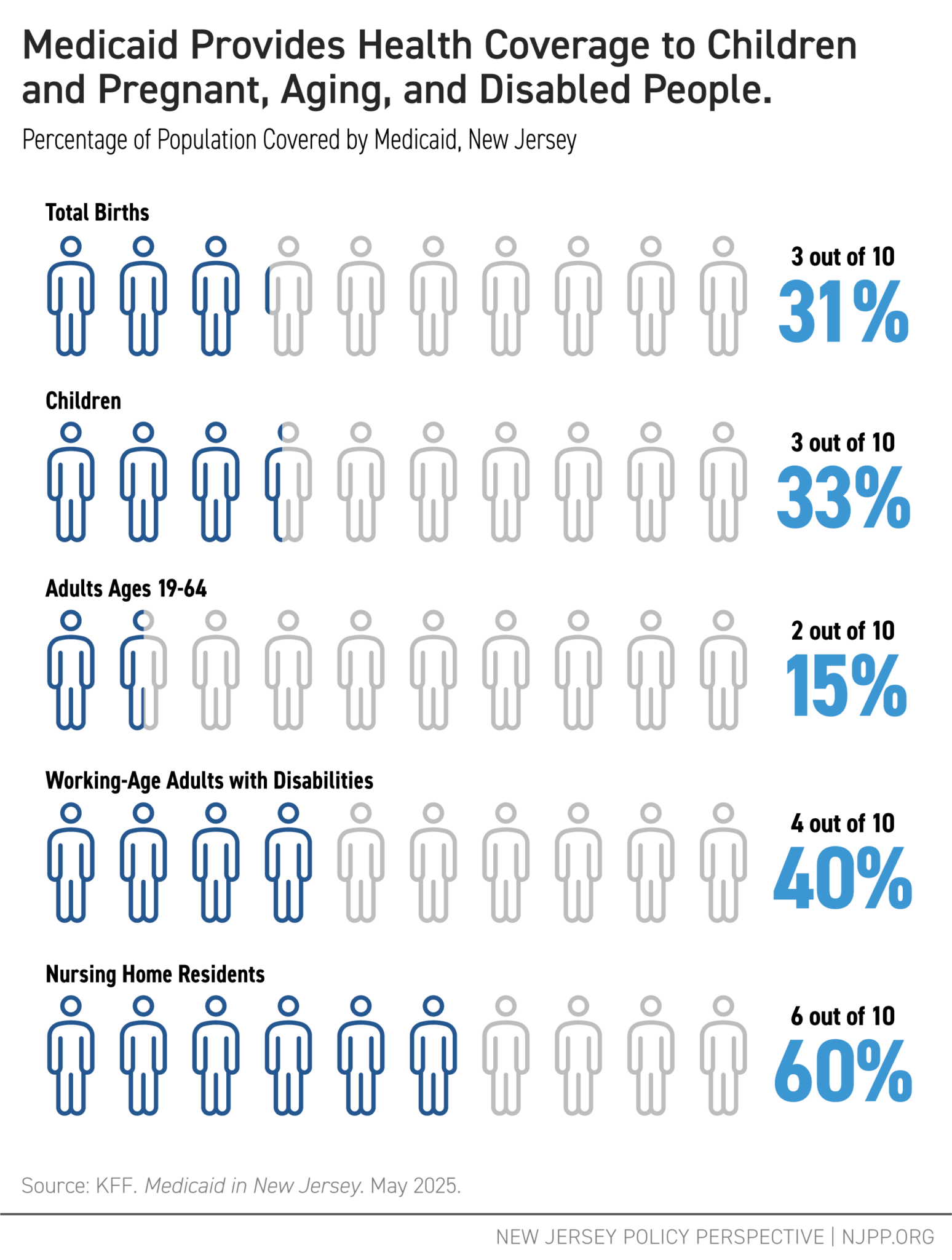
As of July 2026, NJ FamilyCare, which includes both Medicaid and CHIP, covers close to 1.8 million New Jersey residents. That is 1 in 5 people in the state.[10] Medicaid is a major source of coverage for pregnant people and children. One-third of births and one-third of children in the state are covered by Medicaid. Medicaid also covers 3 in 5 nursing home residents and 2 in 5 people with disabilities.[11]
Medicaid enrollment reaches communities across New Jersey — from northern urban areas, to the shore, to rural South Jersey. Cumberland County has the highest Medicaid enrollment per capita, with nearly one-third of residents enrolled, while urban counties such as Passaic and Essex also have high enrollment rates, with more than a quarter of residents enrolled. Shore counties including Ocean and Atlantic have Medicaid enrollment rates of roughly 1 in 4 residents. At the other end of the spectrum, Hunterdon and Morris Counties have the lowest enrollment rates, with about 1 in 11 residents enrolled.[12]
Lower enrollment rates, however, do not necessarily mean lower need. Differences in enrollment can reflect a county’s underlying demographics and economic conditions, along with differences in outreach and enrollment processes.[13] Counties with lower enrollment would benefit from stronger outreach efforts, including partnerships with community organizations, multilingual assistance, and training for enrollment navigators to connect eligible residents to coverage.[14] New Jersey Medicaid enrollment does not follow a simple urban-rural divide. Rates are highest in the state's urban centers and in rural South Jersey, and lowest in its wealthier suburbs.[15]
Who qualifies for Medicaid in New Jersey?
NJ FamilyCare provides health coverage to a diverse range of New Jersey residents, including children, parents, pregnant people, older adults, people with disabilities, and other eligible adults with low incomes. These categories are “means-tested,” meaning that eligible residents have to meet certain income requirements. These income requirements are typically tied to the federal poverty level (FPL), an income guideline established by the U.S. Department of Health and Human Services to determine eligibility for various federal and state assistance programs.[16] The level varies based on household size and, although it is updated annually to keep up with inflation, it does not generally reflect the true cost of living.[17] Immigration status also affects eligibility. See the section “How does immigration status affect Medicaid eligibility” below.
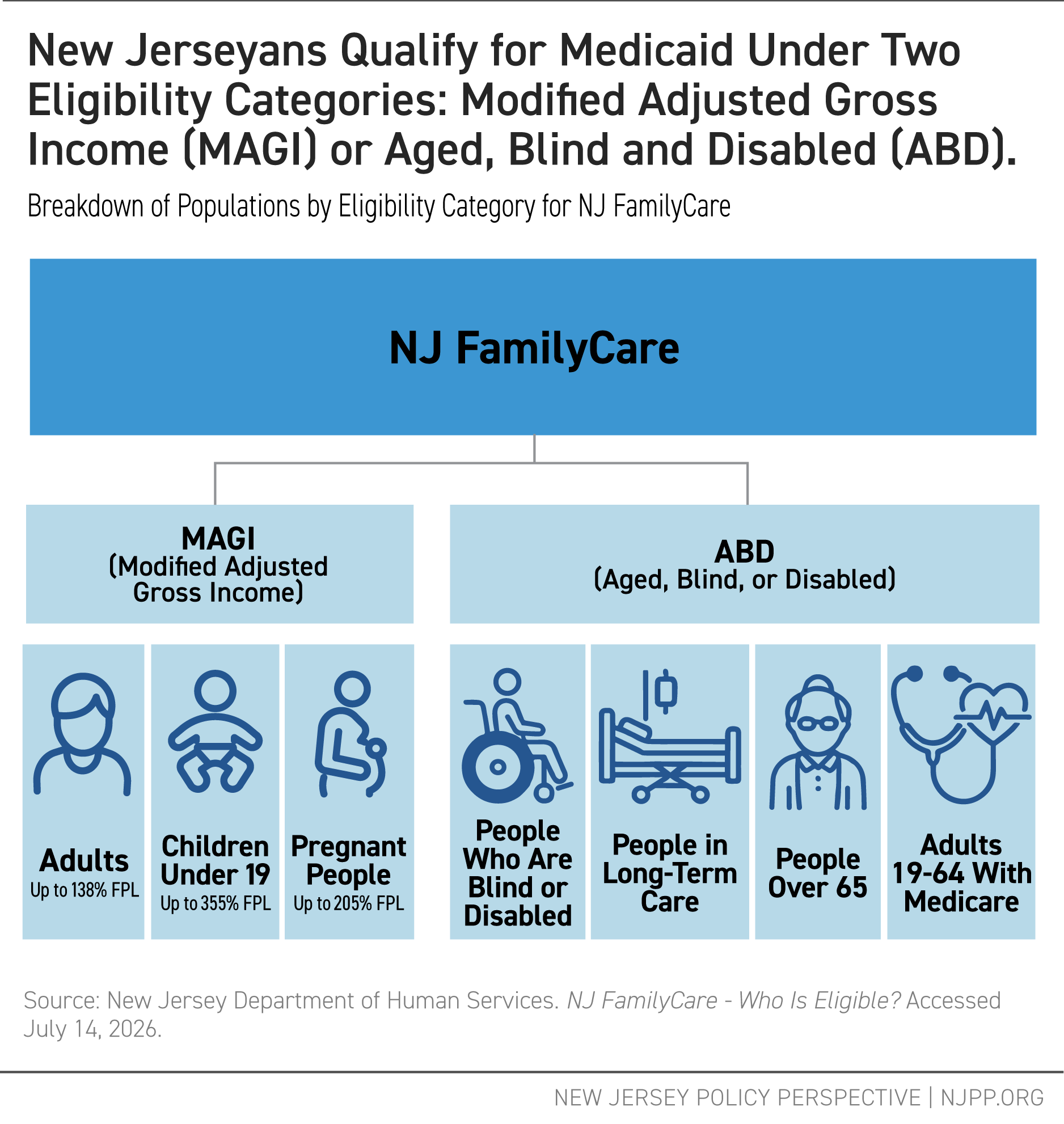
Generally, residents can qualify for Medicaid under two different eligibility categories: Modified Adjusted Gross Income (MAGI) or Aged, Blind and Disabled (ABD).[18] These eligibility pathways matter because each category serves different populations and uses different eligibility criteria, which affects who qualifies for Medicaid and what services they can receive.[19]
The MAGI eligibility pathway looks at current monthly income before taxes when it determines eligibility and includes the following groups:[20]
- Adults ages 19-64 with income up to 138 percent of the FPL (in 2026, less than $1,836 a month for a household of one)
- Children under age 19 with family income up to 355 percent of the FPL (in 2026, less than $8,083 per month for a household of three)
- Pregnant people with income up to 205 percent of the FPL (in 2026, less than $4,668 per month for a household of three)
Residents may also qualify for Medicaid in the ABD category if they are 65 or older, blind, disabled, in long term care, or an adult age 19-64 who is enrolled in Medicare.[21] Because these groups often need more expensive long-term services and supports (LTSS), such as nursing home care or home- and community-based services, income requirements for this eligibility category are more strict. They require an assessment of an applicant’s current income as well as their assets.[22] For applicants who need LTSS, the government will look back at an applicant’s financial record for five years to determine eligibility.[23]
In New Jersey, counties determine Medicaid eligibility. County Boards of Social Services are responsible for processing enrollment applications and sending approved applicant information to the State.[24] To help streamline eligibility determination and enrollment for potential applicants, the State has created resources, including the NJhelps.gov screening tool and a statewide online application portal.[25]
How Does Immigration Status Affect Medicaid Eligibility?
Eligibility for NJ FamilyCare depends on both income and immigration status.[26] While all applicants must meet the program's income requirements, eligibility varies by immigration status. Through the Cover All Kids initiative, children under age 19 can qualify for NJ FamilyCare regardless of their immigration status.[27] Most immigrant adults must be lawful permanent residents, also known as green card holders, for at least five years before becoming eligible for federally funded coverage, although certain immigrants with lawful permanent resident status may qualify without a waiting period.[28] Pregnant people who are lawfully present are also eligible regardless of when they entered the United States.[29]
Beginning October 1, 2026, changes enacted by Congress through H.R. 1, also known as the “One Big Beautiful Bill Act,” narrow the categories of non-citizens who qualify for federally funded Medicaid. As a result, New Jersey will end Medicaid coverage for some immigrants who were previously eligible under federal rules.
Non-citizens who continue to qualify for Medicaid under the new rules include:[30]
- Lawful Permanent Residents, otherwise known as a green card holders, of at least 5 years (calculated from the date of grant of qualifying status)
- Certain Lawful Permanent Residents of less than five years[31]
- Cuban/Haitian Entrants
- Compacts of Free Association (COFA) migrants, who come from Micronesia, the Marshall Islands, and Palau
- Lawfully present pregnant people
- Lawfully present non-citizens who are under the age of 21
- Children under 19, regardless of their immigration status
Non-citizens who have not adjusted to Lawful Permanent Resident status and who will lose Medicaid eligibility as of October 1, 2026 include:[32]
- Refugees
- Asylees
- Temporary humanitarian parolees (those paroled into the U.S. for at least one year)
- Victims of trafficking and their spouses, children, siblings, or parents
- Victims of domestic violence, applying under the U.S. Violence Against Women Act[33]
- Lawfully residing veterans and active-duty service members and certain family members
- Afghan nationals granted parole between July 31, 2021, and September 30, 2023
- People who were paroled into the U.S. between February 24, 2022 and September 30, 2024 under the Ukrainian Humanitarian Parole program
- People whose deportation is being withheld
What is the Medicaid expansion population?
Through the Affordable Care Act (ACA), New Jersey expanded Medicaid eligibility on January 1, 2014, becoming one of 25 states to implement the expansion as soon as the program was available. [34] Before expansion, many adults without dependent children were not eligible for Medicaid even if their income level met the eligibility threshold. Medicaid expansion extended coverage to adults ages 19 through 64 with incomes up to 138 percent of the FPL, regardless of whether they had children, a disability, or qualified for another traditional eligibility category.[35] For example, using 2026 eligibility levels for a family of three, only those making up to $508 a month would have been eligible for traditional Medicaid. With Medicaid expansion, those making up to $3,142 a month are eligible.[36]
The Medicaid expansion population makes up nearly one-third of all enrollees in NJ FamilyCare and primarily consists of low-income adults without dependent children, as well as parents and caretaker relatives whose incomes fall within the expansion eligibility limits.[37] These members qualify under the Modified Adjusted Gross Income (MAGI) eligibility rules.
How is Medicaid funded?
New Jersey's Medicaid program is funded by both the federal government and the state of New Jersey.[38] Medicaid is one of the largest programs in New Jersey's budget. During Fiscal Year 2024, total NJ FamilyCare spending, including Medicaid and CHIP, was about $24 billion, with around $14 billion financed by federal Medicaid funds and $10 billion through the state budget.[39] Because the federal government shares the cost of providing care for many eligibility groups, every state dollar invested in Medicaid coverage for those groups draws additional federal funding into New Jersey's health care system.[40]
The Federal Medical Assistance Percentage (FMAP) sets the federal share, meaning the portion of Medicaid costs the federal government reimburses to each state. New Jersey receives the minimum regular FMAP of 50%. For most traditional Medicaid services, the federal government pays half the cost and the state pays the other half.[41]
The State does not receive the same federal reimbursement rate for all Medicaid members. Some eligibility groups qualify for a higher level of federal support. For example, adults who became eligible through the Affordable Care Act’s Medicaid expansion are funded at a 90 percent federal matching rate, with New Jersey responsible for the remaining 10 percent of costs.[42] When taking into account the entire Medicaid and CHIP population in New Jersey along with the varied reimbursement rates, the federal government assumes a roughly 60 percent blended share of the cost of NJ FamilyCare.[43]
How are federal cuts affecting Medicaid in New Jersey?
When Congress passed H.R. 1, also known as the “One Big Beautiful Bill Act,” in July of 2025, it imposed restrictions on the Medicaid program to reduce Medicaid spending to fund tax cuts for the wealthy.[44] The Medicaid provisions in H.R. 1 will reduce federal funding for New Jersey's health care system by restricting eligibility for immigrants, imposing new work reporting requirements, and reducing federal support for providers that serve Medicaid patients.[45] The New Jersey Department of Human Services estimates that more than 300,000 residents could lose Medicaid coverage because of the law's new administrative requirements and eligibility changes.[46]
Two eligibility changes will most directly affect Medicaid members:[47]
- Immigrant eligibility: Beginning October 1, 2026, federal law narrows which immigrant statuses will remain eligible for Medicaid, meaning some non-citizen adults who were previously eligible will no longer qualify for Medicaid coverage. Children covered through New Jersey's Cover All Kids initiative remain eligible, regardless of their immigration status; it is a state-funded program that does not rely on federal matching funds.[48]
- Work requirements: For the program's first 60 years, the federal government never required states to tie Medicaid eligibility to work.[49] Beginning January 1, 2027, adults ages 19 to 64 enrolled in the Medicaid expansion population will be required to document that they are working, volunteering, attending school, or participating in other qualifying activities to maintain coverage.[50] There will be certain exemptions for pregnant people, parents of children under 14, those who are deemed “medically frail,” and other exclusions that may require additional documentation. The government will also need to recheck eligibility for all expansion members every six months.[51]
Beyond coverage losses, New Jersey is projected to lose billions of dollars in federal Medicaid funding for hospitals and other health care providers, with provider payment reductions increasing over time and total federal revenue losses reaching as much as $2.6 billion annually once the law is fully implemented.[52] These cuts threaten access to care for residents with low incomes while placing additional financial strain on hospitals, community health centers, nursing facilities, and other providers. The strain falls hardest on providers caring for large numbers of uninsured and Medicaid patients.[53]
How does Medicaid support health equity and the providers who serve New Jersey?
Medicaid is more than health insurance for residents with low incomes. It connects 1.8 million New Jerseyans to the health care they need to keep themselves, their families, and their communities healthy. In New Jersey, more than half of Medicaid enrollees are from communities of color.[54] These communities have historically faced barriers to health care rooted in racism, discrimination, and unequal access to economic and social resources, contributing to persistent disparities in health coverage, access to care, and health outcomes.[55] Medicaid expansion has narrowed longstanding racial disparities in health coverage.[56] By connecting people to preventive care, prescription medications, behavioral health services, maternity care, and long-term services and supports, Medicaid improves health outcomes while protecting families from overwhelming medical debt.[57]
At the same time, Medicaid provides a stable source of funding for hospitals, community health centers, physicians, nursing facilities, and other providers that care for New Jersey's most underserved residents.[58] For example, New Jersey's Fiscal Year 2027 budget includes approximately $539.2 million in Medicaid outpatient state-directed payments that will go directly to hospitals to support outpatient care. [59] Medicaid is also the primary payer for nursing home care and finances a large share of maternity and behavioral health care in the state.[60] At University Hospital, New Jersey’s only public hospital, 43 percent of patients are covered by Medicaid.[61] By supporting these providers, Medicaid funding benefits both program members and the broader health care system and the communities it serves.[62]
How can leaders improve the Medicaid program in New Jersey?
As New Jersey implements the federal Medicaid changes enacted under H.R. 1, state leaders have an important role to play in protecting access to health coverage and strengthening the health care system for the residents who rely on it. Some recommended actions include:
Make it easier for eligible people to keep their health insurance coverage.
New Jersey should minimize the administrative burden created by new federal Medicaid requirements and make it as easy as possible for eligible residents to maintain coverage. The State should use administrative data wherever possible to verify eligibility and qualifying activities. It should also send clear, accessible notices and invest in outreach and enrollment assistance to help people understand and meet new requirements. For people seeking exemptions, the State should rely on existing information whenever possible and let people confirm their own status where permitted, rather than requiring repeated documentation that could cause eligible people to lose coverage. These steps can help prevent coverage losses caused by paperwork rather than actual changes in eligibility.[63]
Explore coverage options for people left out of federal Medicaid.
New Jersey should use state resources to maintain affordable coverage options for residents who lose federal Medicaid eligibility, particularly immigrant families and children. This includes continuing to fully fund Cover All Kids and exploring additional state-funded coverage for adults who are excluded from federal Medicaid because of their immigration status. New Jersey should also expand affordable coverage through NJ FamilyCare or the GetCovered NJ marketplace to help fill gaps created by federal cuts. NJPP has previously recommended a subsidized NJ FamilyCare buy-in option and additional state subsidies to replace lost federal assistance.[64]
Invest in the health care safety net.
As federal Medicaid cuts increase the number of uninsured New Jerseyans, the State should make sure hospitals, community health centers, behavioral health providers, nursing facilities, and other safety-net providers have the resources they need to continue serving patients regardless of their ability to pay. Ensuring adequate funding, through Charity Care and the Medical Emergency Payment Program, will help prevent federal cuts from being shifted onto providers, patients, and state programs while preserving access to care in communities that rely most heavily on Medicaid.[65]
Defend Medicaid and affordable coverage at the federal level.
New Jersey's congressional delegation and state leaders should continue to advocate for restoring federal Medicaid funding and opposing policies that make it harder for eligible people to get and maintain coverage. The State has made progress in reducing its uninsured rate over the past decade, and policymakers should keep federal cuts from reversing those gains. Protecting Medicaid is ultimately an investment in New Jersey families, the state's health care system, and the broader health and economic security of its residents.[66]
End Notes
[1] Centers for Medicare & Medicaid Services. Program History and Prior Initiatives. Accessed Jul. 14, 2026.
[2] Center on Budget and Policy Priorities. Policy Basics: Introduction to Medicaid. Updated Nov. 4, 2025.
[3] New Jersey Department of Human Services. NJ FamilyCare - What Does It Cover? Accessed Jul. 14, 2026.
New Jersey Department of Human Services. Division of Medical Assistance and Health Services: About DMAHS. Accessed Jul. 14, 2026.
[4] Centers for Medicare & Medicaid Services. Mandatory & Optional Medicaid Benefits. Accessed Jul. 14, 2026.
[6] New Jersey Department of Human Services. Division of Medical Assistance and Health Services: NJ Medicaid & Managed Care. Accessed Jul. 14, 2026.
[7] New Jersey Department of Human Services. Background Information on NJ FamilyCare. Accessed Jul. 14, 2026.
Centers for Medicare & Medicaid Services. Program History and Prior Initiatives. Accessed Jul. 14, 2026.
[8] New Jersey Department of Human Services. Welcome to NJ FamilyCare. Accessed Jul. 14, 2026.
Note: In NJ legislation, “NJ FamilyCare” refers only to the CHIP program while “Medicaid” refers to the Medicaid program.
[9] New Jersey Department of Human Services. Division of Medical Assistance and Health Services Homepage. Accessed Aug. 11, 2026.
[10] New Jersey Department of Human Services. DMAHS Analytics Homepage. Accessed Jul. 14, 2026.
[11] KFF. Medicaid in New Jersey. May 2025.
[12] New Jersey Department of Human Services. DMAHS Analytics: Eligibility Explorer. Accessed Jul. 14, 2026.
New Jersey Department of Labor & Workforce Development. Labor Market Information: Population and Household Estimates. “County Estimates.” Accessed Jul. 14, 2026.
[13] Artiga, Samantha, Rudowitz, Robin, and Tolbert, Jennifer. KFF. “Outreach and Enrollment Strategies for Reaching the Medicaid Eligible but Uninsured Population.” Mar. 2, 2016.
[14] Podsiad, Kristin, Kukoyi, Olurotimi, Efird-Green, Lea, Thoumi, Andrea, and Plasencia, Gabriela. Health Affairs. “How States Can Improve Medicaid Outreach Among Unenrolled And Eligible Latine Populations.” Aug. 6, 2025.
[15] New Jersey Department of Human Services. DMAHS Analytics: Eligibility Explorer. Accessed Jul. 14, 2026.
New Jersey Department of Labor & Workforce Development. Labor Market Information: Population and Household Estimates. “County Estimates.” Accessed Jul. 14, 2026.
[16] U.S. Department of Health and Human Services. Federal Register: Annual Update of the HHS Poverty Guidelines. Accessed Jul. 30, 2026.
[17] Ibid.
Haider, Areeba and Schweitzer, Justin. Center for American Progress. “The Poverty Line Matters, But It Isn’t Capturing Everyone It Should.” Mar. 5, 2020.
[18] New Jersey Department of Human Services. NJ FamilyCare - Who Is Eligible? Accessed Jul. 14, 2026.
[19] Colello, Kristen J. and Morton, William R. Medicaid Eligibility: Older Adults and Individuals with Disabilities. Dec. 9, 2019.
[20] New Jersey Department of Human Services. NJ FamilyCare Income Chart, effective January 1, 2026. Accessed July 30, 2026. The dollar amounts used here refer to the chart in effect for 2026 only.
Modified Adjusted Gross Income (MAGI) is calculated before taxes are withheld but do not include certain pre-tax contributions such as health insurance premiums and retirement contributions. Some post-tax contributions, such as child support, SSI, and worker’s compensation are also not included.
Brooks, Tricia. Georgetown University Health Policy Institute: Center for Children and Families. Getting MAGI Right: A Primer on Differences that Apply to Medicaid and CHIP. Jan. 30, 2015.
[21] New Jersey Department of Human Services. Division of Medical Assistance and Health Services: Aged, Blind and Disabled. Accessed Jul. 14, 2026
[22] Musumeci, MaryBeth, Chidambaram, Priya, and O’Malley Watts, Molly. KFF. Medicaid Financial Eligibility for Seniors and People with Disabilities: Findings from a 50-State Survey. Jun. 14, 2019.
Countable assets include stocks, bonds, certificates of deposit, savings and checking accounts; second homes or vehicles; life insurance policies greater than $1500; and jewelry, art, and collectibles. Exempt assets that are not counted include an applicant’s primary home and car, clothing and personal items, and essential household furniture and appliances.
Medicallongtermcare.org. What are Considered Assets. Accessed Aug. 10, 2026.
[23] New Jersey Department of Human Services. Division of Medical Assistance and Health Services: Aged, Blind and Disabled. Accessed Jul. 14, 2026
New Jersey Department of Human Services. MLTSS Application Guidance. Apr. 2026.
[24] NJ Rev Stat § 30:4D-3 (2025).
For a list of County Social Service Agencies, see Division of Family Development: County Social Services Agencies.
[25] New Jersey Department of Human Services. Division of Medical Assistance and Health Services: NJ FamilyCare/Medicaid. Accessed Jul. 14, 2026
NJHelps.gov
NJ FamilyCare Online Application Portal
[26] For a copy of the income eligibility chart in Spanish, see Tabla de Ingressos.
[27] P.L. 2021, c.132.
New Jersey Department of Human Services. Cover All Kids: Frequently Asked Questions. Accessed Jul. 30, 2026.
[28] New Jersey Department of Human Services. NJ FamilyCare: Immigrant Information. Accessed Jul. 14, 2026.
[29] Ibid.
For a definition of lawfully present, please see: NJ FamilyCare: Immigrant Information.
[30] New Jersey Department of Human Services. Division of Medical Assistance and Health Services: Non-citizen Eligibility. Accessed Aug. 17, 2026.
[31] For a more complete list of immigration statuses for Lawful Permanent Residents of less than five years, see Non-citizen Eligibility | Division of Medical Assistance and Health Services.
[32] New Jersey Department of Human Services. Division of Medical Assistance and Health Services: Non-citizen Eligibility. Accessed Aug. 17, 2026.
[33] We use the term “victim” to match the terminology in state and federal eligibility guidance. Many advocacy groups prefer “survivor,” which centers the person rather than the harm done to them. National Sexual Violence Resource Center. Language Access: Correct Pronouns & Terms. Accessed Aug. 31, 2026.
Safe Alliance. Words Matter: “Victim” or “Survivor.” Accessed Aug. 31, 2026.
[34] New Jersey Department of the Treasury Office of Management and Budget and Governor Chris Christie. Fiscal Year 2014: Citizen’s Guide to the Budget. P. 109. Feb. 26, 2013.
KFF. Status of State Action on the Medicaid Expansion Decision. May 2026.
[35] New Jersey Department of Human Services. Background Information on NJ FamilyCare. Accessed Jul. 14, 2026.
[36] New Jersey Department of Human Services. MEDICAID COMMUNICATION NO. 26-03. Feb. 26, 2026.
[37] New Jersey Department of Human Services. DMAHS Analytics: Eligibility Explorer. Accessed Jul. 14, 2026. Uses average monthly enrollment from June 2025 to May 2026.
New Jersey Department of Human Services. FY 2025-2026 Discussion Points. P. 3. Accessed Jul. 14, 2026.
[38] New Jersey Department of Human Services. Modeling Impact to NJ Medicaid of Congressional Budget Proposals. P. 1. Feb. 2025.
[39] Ibid.
[40] KFF. Medicaid Financing: The Basics. Mar. 4, 2026.
[41] KFF. Federal Medical Assistance Percentage (FMAP) for Medicaid and Multiplier. Fiscal Year 2027.
[42]Mathers, Jessica, Tolbert, Jennifer, Chidambaram, Priya, and Cervantes, Sammy. KFF. “5 Key Facts About Medicaid Expansion.” Apr. 25, 2025.
[43] New Jersey Department of Human Services. Modeling Impact to NJ Medicaid of Congressional Budget Proposals. P. 1. Feb. 2025.
Because the implementation of H.R. 1 is projected to most acutely impact the expansion population, we expect this blended share estimate to decrease next year.
[44] Johnson, Micah and Ducas, Andrea. Center for American Progress. “$1 Trillion in Medicaid Cuts—$1 Trillion in Tax Giveaways for the Richest 1 Percent: The One Big ‘Beautiful’ Bill’s Budget Math.” Jul. 3, 2025.
[45] New Jersey Department of Human Services. Key Direct Impacts of H.R. 1: New Jersey. May 2026.
New Jersey Department of Human Services. Division of Medical Assistance and Health Services: Federal Changes to NJ FamilyCare/Medicaid: Home. Accessed Aug. 6, 2026.
[46] New Jersey Department of Human Services. Key Direct Impacts of H.R. 1: New Jersey. May 2026.
Hinton, Elizabeth and Rudowitz, Robin. KFF. 5 Key Facts About Medicaid Work Requirements. Feb. 18, 2025.
For a more detailed discussion of the new federal work requirements and their anticipated impact on NJ’s Medicaid population, stay tuned for NJPP’s forthcoming report.
[47] New Jersey Department of Human Services. Division of Medical Assistance and Health Services: Federal Changes to NJ FamilyCare/Medicaid: Home. Accessed Aug. 6, 2026.
[48] New Jersey Department of Human Services. Division of Medical Assistance and Health Services: Federal Changes to NJ FamilyCare/Medicaid: Non-Citizens. Accessed Aug. 6, 2026; New Jersey Department of Human Services. Cover All Kids: Frequently Asked Questions. Accessed Jul. 30, 2026.
[49] Meuse, Dan. State Health & Value Strategies. “Medicaid Work Reporting Requirements: Implementation Basics and State Decision Points.” Aug. 15, 2025.
[50] One Big Beautiful Bill Act of 2025, Pub. L. No. 119-21, 139 Stat. 72.
[51] Meuse, Dan. State Health & Value Strategies. “Medicaid Work Reporting Requirements: Implementation Basics and State Decision Points.” Aug. 15, 2025.
New Jersey Department of Human Services. Division of Medical Assistance and Health Services: Federal Changes to NJ FamilyCare/Medicaid: Home. Accessed Aug. 6, 2026.
[52] New Jersey Department of Human Services. Key Direct Impacts of H.R. 1: New Jersey. May 2026.
[53] Ibid.
[54] KFF. Medicaid Enrollees by Race/Ethnicity. 2023.
[55] Feagin J, Bennefield Z. Social Science & Medicine. Feb. 2014. Vol. 103, pp. 7-14; National Academies of Sciences, Engineering, and Medicine. Chapter 3, Evidence of Racial and Ethnic Inequities in Health Care. In Ending Unequal Treatment: Strategies to Achieve Equitable Health Care and Optimal Health for All. 2024. Pp. 79-124.
[56] Guth, Madeline, Artiga, Samantha, and Pham, Olivia. KFF. “Effects of the ACA Medicaid Expansion on Racial Disparities in Health and Health Care.” Sept. 30, 2020.
[57] Rudowitz, Robin and Antonisse, Larisa. KFF. Implications of the ACA Medicaid Expansion: A Look at the Data and Evidence. May 23, 2018.
[58] New Jersey Department of Treasury and Governor Philip D. Murphy. The State of New Jersey Appropriations Handbook: Fiscal Year 2026. Jun. 1, 2025.
[59] New Jersey Department of the Treasury Office of Management and Budget and Governor Mikie Sherrill. The State of New Jersey Budget in Brief: Summary of Budget Recommendations, Fiscal Year 2027. P. 28. Mar. 2026.
[60] Georgetown University Center for Children and Families. Medicaid is Vital to New Jersey Fact Sheet. 2025.
[61] University Hospital. “2022-2025 Community Health Improvement Plan.” P. 4. Mar. 2026.
[62] New Jersey Department of Human Services. News, Press Releases 2025. "Governor Murphy Holds Second Roundtable Discussion with Medicaid Recipients as Congress Slashes Health Care Funding." May 30, 2025.
[63] Holom-Trundy, Brittany. New Jersey Policy Perspective. Mind the Gap: Keeping New Jerseyans Covered in the Face of Federal Cuts. Feb. 6, 2026.
Spiegel, Jennifer. New Jersey Policy Perspective. Proposed Medicaid Work Rule Puts Coverage for the Medically Frail at Risk. Jul. 30, 2026.
Wagner, Jennifer, Singleton, Symonne, and Stewart, Maani. Center for Budget and Policy Priorities. “A Guide to Reducing Coverage Losses Through Effective Implementation of Medicaid’s New Work Requirement.” Nov. 3, 2025.
[64] Holom-Trundy, Brittany. New Jersey Policy Perspective. Mind the Gap: Keeping New Jerseyans Covered in the Face of Federal Cuts. Feb. 6, 2026.
Chen, Peter, Aguas, Tonanziht, Ambrose, Alex, and Ubel, Marleina. New Jersey Policy Perspective. What to Look for in the New Jersey Budget for Fiscal Year 2027. Mar. 3, 2026.
[65] O’Hagen Karl, Anne, Herring, Avi, and Ofengeym, Yelena. Manatt. “How States Support Safety Net Hospitals through Innovative Funding Approaches.” Oct. 30, 2024.
[66] Castro, Raymond. New Jersey Policy Perspective. Repealing the Medicaid Expansion Would Reverse Health Coverage Gains & Deepen New Jersey’s Financial Crisis. Nov. 28, 2016.
