
Blog

New Jersey’s Minimum Wage To Rise by 16 Cents on Monday


Many workers will benefit from the modest bump in wages, but many more would be helped by a $15 minimum wage.

Published on Dec 27, 2017 in Economic Justice

Inflation adjusted January 1 increase is helpful, but not nearly enough for New Jersey’s low-paid workers or for the state’s economy, as our new report shows.
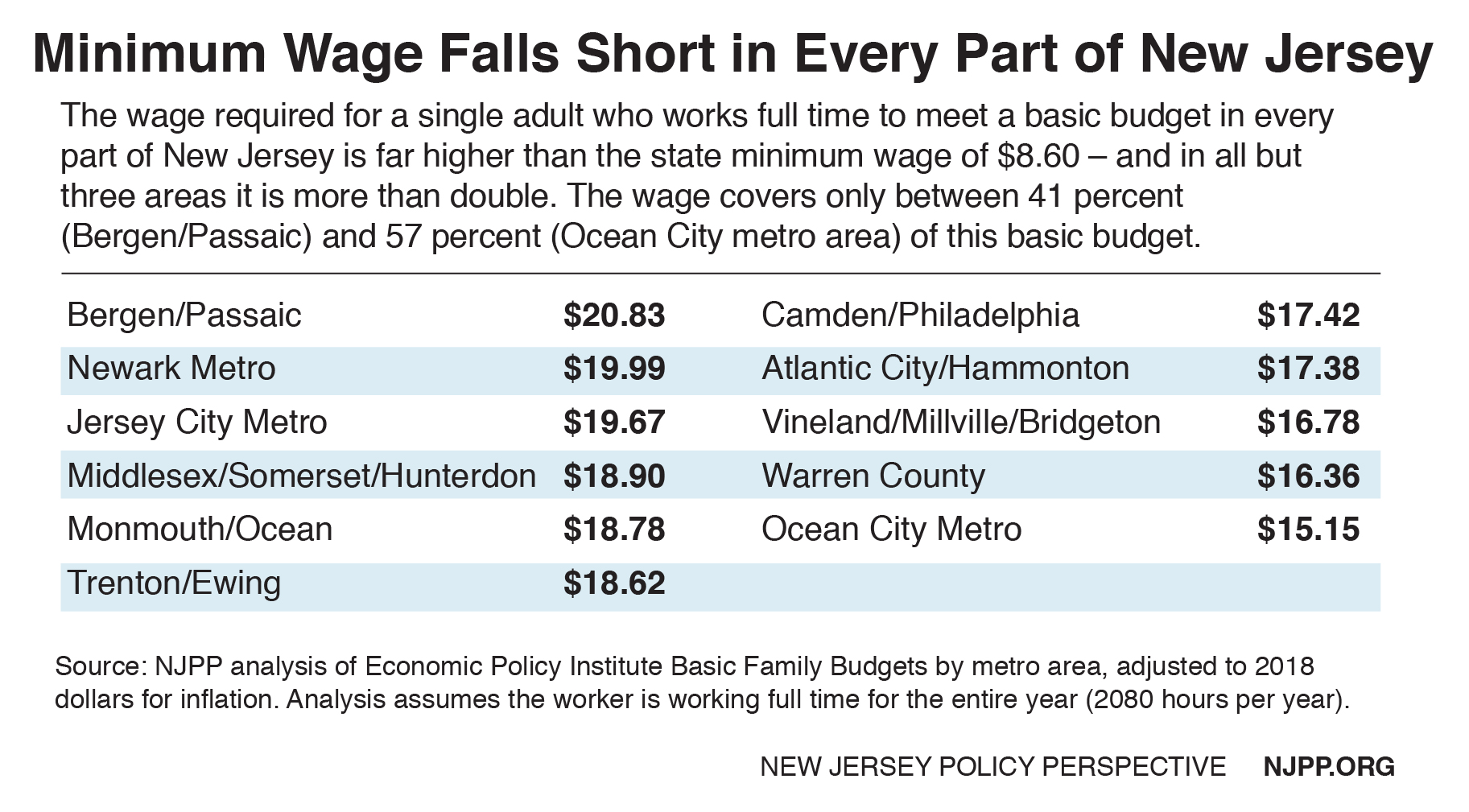
A full-time worker at the minimum wage in 2018 will take home less than $18,000 for the year, assuming they don’t take any time off. According to analysis by the Economic Policy Institute, a single worker in the Garden State needs to make $37,974 in 2018 just to earn a wage that can provide stability.

Fortunately, Governor-Elect Murphy and legislative leaders have made it clear that they intend to increase the minimum wage to $15 per hour, a move that would help a diverse group of workers – nearly 25 percent of the workforce – and improve their chances of being able to provide for themselves and their families in our high-cost state.

Here are some key facts about New Jersey’s January 1 minimum wage increase:

* The January 1 wage increase will boost the pay of 300,000 low-paid New Jersey workers, or 7.5% of the state’s workforce.

* Of these 300,000 workers, 91,000 are directly affected (meaning they currently make between $8.44 and $8.60 per hour) and the remaining 209,000 are indirectly affected (meaning they currently make between $8.60 and $8.76 per hour, and will see an increase in their pay as employers adjust their pay scales upward to reflect the new minimum wage).

* The new minimum wage still falls very short of what it takes to get by. In fact, it covers just 41-57% of the basic household budget for a single adult full-time worker with no children.

* Four of every five workers who will get a raise (81 percent) are at least 20 years old, while most are working either full-time (45 percent) or between 20 and 35 hours a week (33 percent). Almost half – 44.6 percent – have attended or finished college, and an additional 30 percent have finished high school.

* The majority, 56 percent, are women and one in five – 20 percent – are parents. A total of 111,000 New Jersey kids have at least one parent who will benefit from the January 1 increase. When looking at race and ethnicity, 44 percent of affected workers are white, 30 percent are Hispanic, and 18 percent are black.
Author

  • Brandon McKoy, President, is the chief executive of NJPP and leads the organization's efforts in shaping policy debates to advance economic justice for the many, not a chosen few. Prior to being named President of NJPP in February 2019, Brandon served as NJPP's Director of Government and Public Affairs, where he designed and implemented the organization's outreach, advocacy, and government relations activities. He also produces timely, credible and accessible research and analysis on issues including, but not limited to, economic security, the social safety net and economic opportunity.

    Brandon’s research interests include: state tax policy, the minimum wage, paid sick leave, the earned income tax credit, urban planning and criminal justice.

    Before joining NJPP in August 2014 as a national fellow under the State Priorities Partnership’s and Center on Budget and Policy Priorities’ state policy fellowship program, Brandon worked as a Program Associate at The Fund for New Jersey, where he assisted in grantmaking on public policy issues that particularly affect low-income and minority populations in New Jersey. He also worked as an AmeriCorps VISTA at HANDS, Inc., a community development corporation in New Jersey, where he worked to mitigate the negative impact of foreclosures and increase citizen participation in local decision-making.

    Brandon formerly served as the Deputy Chapter Director of New Leaders Council – New Jersey and is an alumnus of the 2013 fellows class. He currently serves on the board of the New Jersey Work Environment Council, Shelterforce and the I Am Trenton Community Foundation. He received a MA in City & Regional Planning and Policy Development from Rutgers University’s Edward J. Bloustein School of Planning and Public Policy and holds a BS degree in Social Psychology from The College of New Jersey.

    Email: mckoy (at) njpp.org | Phone: 609-393-1145 ext. 14


    Follow Brandon on Twitter