
New Jersey does best when all residents can reach their full potential, regardless of their race, ethnicity, or neighborhood. This requires quality public education, safe and affordable housing, jobs that pay well, healthy places to live, reliable transportation, and assurance of just law enforcement practices, among other essentials. Yet many residents across the state still face persistent barriers, despite decades of progress. These disparities are particularly acute for people of color and women who face the compounding effects of racism and sexism. But by having a clearer idea of the challenges we face and where they manifest, we can better plan our efforts for policy advocacy.
Therefore, NJPP created the State of Opportunity Index. This is a multifaceted statewide look and breakdown by all New Jersey counties on how residents are doing in their communities. With the most recent data available, the tool highlights the depth of disparities that exist across the state between communities. The Index will serve as an educational tool for the public and will inform advocates and legislators on the distinct and intersectional areas of health and well-being in the Garden State — and where targeted policy solutions are necessary.
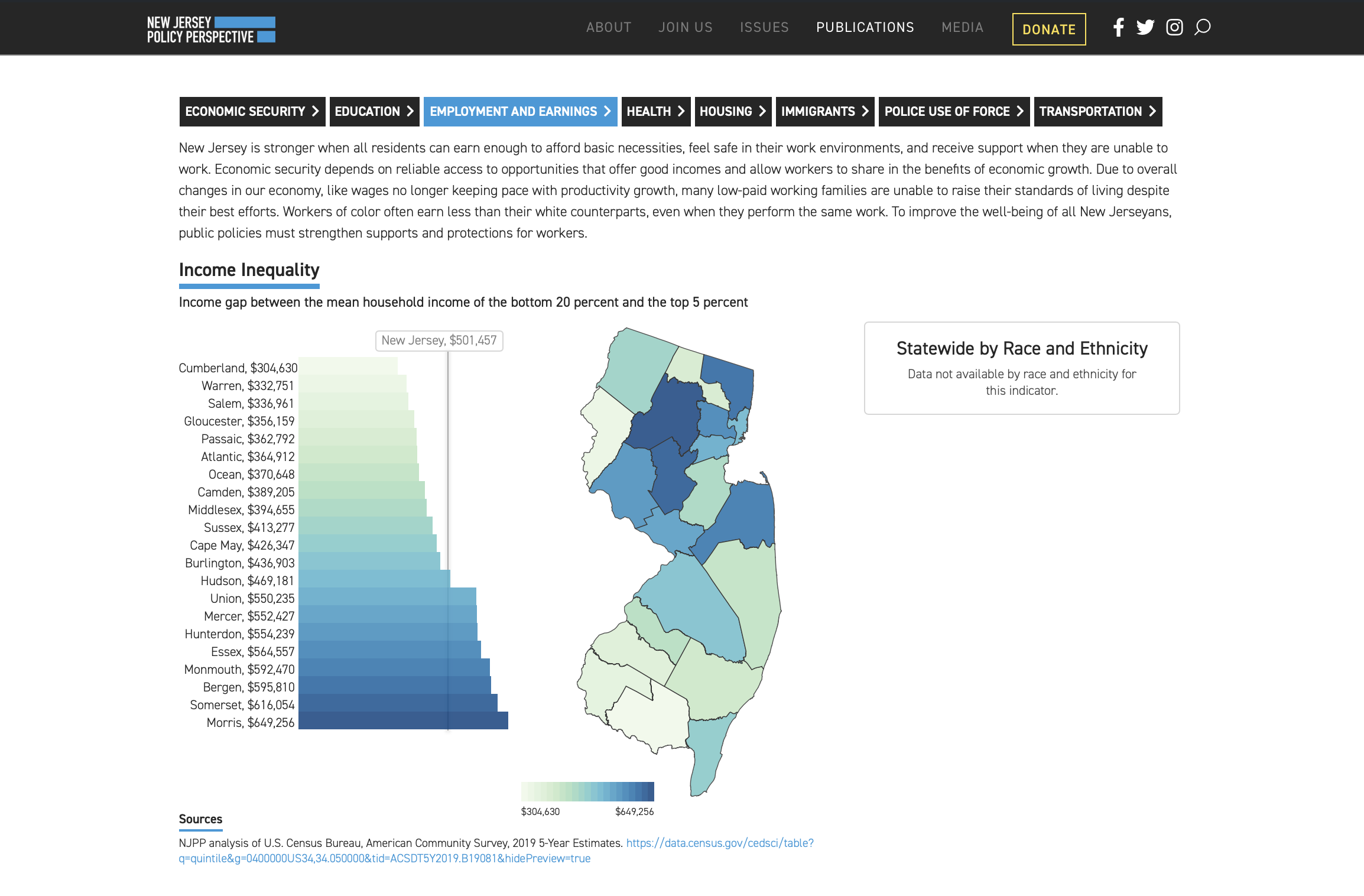
Specifically, this user-friendly, interactive state and county-level index consist of eight categories: Economic Security, Education, Employment & Earnings, Health, Housing, Immigrants, Police Use of Force, and Transportation. Each category includes several data indicators at the county and state level and includes race and ethnicity breakdowns, when available.
As one of the wealthiest states in the nation, New Jersey has the potential to build an inclusive economy that leaves no one behind. NJPP invites all to visit the Index to learn more about how your communities are faring and what policymakers can do to make New Jersey a better place for all residents to live and thrive.
Note on disaggregated race/ethnicity data: Variations within racial and ethnic populations are often overlooked because disaggregated data are not always recorded. Racial and ethnic disparities and inequities can only be eliminated if there is high-quality information by which to track immediate problems and underlying social determinants of well-being. This data is also necessary to guide the design and application of culturally specific policy approaches. As policy decisions are made, disaggregated data must be included in order to truly track progress for all who are impacted.