
This op-ed appeared in the August 9, 2016 edition of the Bergen Record.
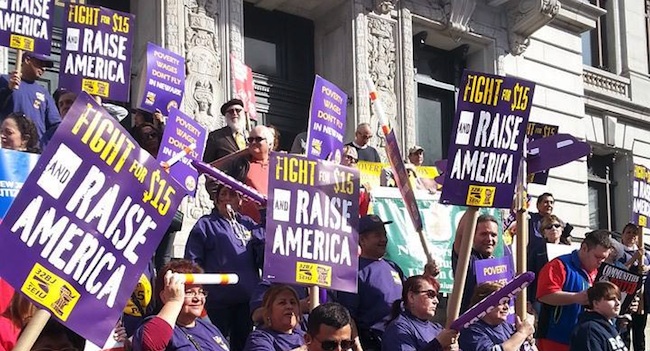 Right now, Gov. Christie has a great opportunity to raise the pay of nearly 1 million working New Jerseyans, bring them closer to a living wage and helping New Jersey communities thrive. By signing the bill to raise the minimum wage, he would be putting New Jersey first by ensuring the state’s working men and women are on a path towards greater economic independence.
Raising the minimum wage to $15 an hour by 2021 is a sensible, steady way to help boost wages for workers and their families across the state, giving them a better shot at success. Our state’s cost of living is very high, and the current minimum wage comes nowhere close to what’s needed to make ends meet, even for a single adult working 40 hours a week. The fact that full-time work alone isn’t enough for a New Jerseyan to support a family and build a future is shameful, and should be reason enough for the governor to sign this legislation.
We aren’t just talking about a few New Jerseyans either, or well-off teens looking for extra spending cash. If we raise the minimum wage to $15, about 1 in 4 New Jersey workers would get a raise. These are workers now paid less than $13.16 an hour — the inflation-adjusted equivalent of $15 an hour in 2021. Contrary to stereotypes, 91 percent of the affected workers are adults. Only 9 percent are teenagers. Most are working full time and many are parents, with more than 1 in 5 New Jersey children having at least one parent who would benefit from raising the wage.
There’s no doubt about the real need for higher wages. And there’s no doubt that there is no correlation between raising wages and widespread job losses. On the contrary, increasing the minimum wage spurs economic activity as working men and women have more money to spend locally and immediately on their daily needs. Comprehensive studies by the federal government, the National Employment Law Project and prominent academics have all reached the same conclusion.
Despite these facts, every time ways are proposed to raise New Jerseyans’ pay, opponents say it will lead to economic disaster. And every time they are proven wrong.
In 2013, business lobbyists claimed that the proposed $1 increase in the minimum wage and future increases with rising costs of living would lead to “over 31,000 lost jobs in New Jersey.”
Thankfully, voters weren’t swayed by the scare tactics, and they overwhelmingly approved raising the wage. Since the hike went into effect in January 2014, New Jersey has added 143,100 jobs — modest growth of 3.6 percent and certainly a far cry from the doomsday predictions of the business lobby. This includes 14,500 jobs added in the low-wage leisure and hospitality sector, which has grown by 4.1 percent since then.
Increasing the minimum wage is nothing new. Decades of experience at local, state and national levels show no correlation between increasing wages and significant price hikes, or widespread job loss.
The simple fact is that having a strong economy requires balance between healthy supply and healthy demand. Over the years, the state has taken many steps to address the supply side of our economy, with big tax cuts for businesses and billions in tax breaks for large corporations. None of those policies put more money into the pockets of working men and women.
But increasing New Jersey’s minimum wage to $15 over five years will. It’s a common-sense policy that will help workers, families, businesses and our economy. It’s time for the governor to sign it into law so the Garden State can start reaping the benefits.