Family Leave Expansion Is Good for Business, Improving Retention and Reducing Labor Costs

Good morning, Chair and thank you to the committee for allowing me to testify today. Despite lobbyist claims to the contrary, family leave expansion is good for business, improving retention and reducing labor costs.

1) When family leave and job protection expand, businesses show no negative effects and report slightly positive impact on employer ability to deal with employee absences. Two large studies on employers in states with paid leave show that the vast majority of businesses show no negative impact on their business operations. Most employers report positive or “no effect” on business outcomes. Smaller businesses were actually less likely to report negative effects.

New Jersey-specific research from the initial implementation of paid leave showed similar results, showing minimal impact on profitability, productivity, or turnover after paid leave

2) Most businesses support, rather than oppose, expansions in family leave protection. Despite business interest group opposition to paid leave expansion, surveys of actual businesses routinely show majority support for increasing paid family leave. In one poll from 2017, surveyed small business owners (who were disproportionately white, male, and Republican) showed 71% support for expanding job protection to smaller businesses.

3) Family leave use helps, rather than hurts, small businesses. Research from other states shows that small firms experience a reduction in labor costs when workers use paid leave.

As prior testimony and legislator statements made clear, turnover at small firms can be much more damaging than at large firms where employees are more easily replaced. But this actually militates in favor of family leave job protection at small firms, because encouraging paid leave lowers turnover and increases retention of employees. When leave was implemented, wage costs did not go up, while turnover rates went down, with no effect on firm closure.

The doomsday scenarios painted by the business lobby have not come to pass in previous family leave and job protection expansion, nor in states without New Jersey’s onerous job protection restrictions.

For the Many NJ: Governor Murphy Gives Ultra Wealthy Corporations $1 Billion, Passes Cost to Transit Riders

New Jersey Transit announced their plan today to make up for budget shortfalls, including a $119 million shortfall in fiscal year 2025, by raising fares. This comes on the heels of Governor Murphy’s decision to deliver a $1 billion tax cut to the wealthiest corporations in the state by refusing to renew the Corporate Business Tax surtax earlier this month. For the Many NJ releases the following statement in response:

Eric Benson, Campaign Director, For The Many NJ:

“Fare hikes on everyday New Jerseyans does nothing to make the state more affordable and shows why we need to have fair sustainable revenue like the Corporation Business Tax surtax. While big corporations are getting $1 billion in tax cuts, New Jersey’s leaders have no plan to fill budget holes and instead are throwing the costs to working families.

If the Governor and legislature don’t get serious about raising revenues from the wealthy and powerful, it will be the working- and middle-class residents of the state who end up paying the price.”

# # #

For The Many NJ is a statewide coalition of more than 30 organizations working to expand funding for essential services and improve budget practices to meet current and future needs, especially for communities that have been historically left behind.

Governor’s Stronger and Fairer Economy Can’t Overlook Fiscal Elephant

Today, Governor Phil Murphy delivered his sixth annual State of the State address, where he focused on ways to make New Jersey the best place anywhere to raise a family. The speech highlighted the critical role of state government in building an economy that works for everyone, but the governor did not address how the state would pay for these investments after lawmakers allowed the Corporate Business Tax surcharge to expire at the start of the year. In response to the address, New Jersey Policy Perspective (NJPP) released the following statement.

Nicole Rodriguez, President, NJPP:

“There’s a lot to like in Governor Murphy’s address, from protecting rights and freedoms to promoting affordability and economic security. This approach to governing recognizes the critical role of state government in making New Jersey the best place to live, go to school, raise a family, or start a business. The last six years are more than enough proof that this model works, and that we can strengthen public services and have a booming economy at the same time.

“But just as the governor attributed this success to confronting New Jersey’s financial challenges, his address overlooks one giant elephant in the room that could unravel it all. As it stands, New Jersey is not raising enough revenue to balance its current budget, and the state’s financial outlook is made worse thanks to a new billion-dollar corporate tax cut that just went into effect.

“By scrapping the corporate tax surcharge for big players like Amazon and Walmart, state lawmakers jeopardize the future of the same investments the governor celebrated in his remarks. To keep up the momentum and build an economy that is truly stronger and fairer for all, Governor Murphy and the Legislature must undo this tax cut for the most profitable corporations in the world.”

# # #

Coalition of 50 Advocacy Organizations and Labor Unions Call on Lawmakers to Stop the Corporate Tax Cut for Amazon and Walmart

On Friday, a diverse coalition of 50 advocacy organizations, labor unions, and community groups sent an open letter to Governor Murphy, Senate President Scutari, and Assembly Speaker Coughlin urging them to extend the Corporate Business Tax surcharge on the world’s most profitable corporations.

With tax collections nearly $400 million behind last year, state lawmakers will need more revenue to balance the state budget and avoid drastic cuts to NJ Transit, public school funding, affordable housing, child care, tax credits for working families, and much more.

“As we approach the end of a legislative session with lower revenues and a potential recession on the horizon, this is exactly the wrong time to be giving the most profitable corporations a $1 billion tax cut. Such a gift for corporations and their shareholders takes away resources from our schools and infrastructure and undermines funding for areas that promote opportunity for all: affordable housing, quality health care, reliable mass transit, and clean energy,” the letter states.

Earlier this month, Assemblyman Tom Giblin (D-Essex) introduced legislation (A5878) that would maintain the Corporate Business Tax surcharge and dedicate it to transit, education, and public employee health benefits. Senate President Nick Scutari (D-Union) also spoke out in support of maintaining the surcharge given the state of New Jersey’s finances.

The Corporate Business Tax surcharge is a 2.5 percent tax on corporations with profits exceeding $1 million. The surcharge is paid by the top 2 percent of the wealthiest corporations and is primarily paid by multinational corporations like Amazon and Walmart that make profits in New Jersey but are not headquartered here.

“Now is the time for more revenue, not less,” the letter states. “The wealthiest 2 percent of businesses should be paying more, not getting a tax cut when everyday New Jerseyans are struggling. We keep hearing about kitchen-table issues and middle-class New Jerseyans. How will corporate tax cuts help them? If we intend to invest in the programs we know make New Jersey an engine of economic growth and opportunity, the wealthy few must pay what they owe.”

The letter calls for lawmakers to extend the Corporate Business Tax surcharge before the end of the lame duck session so the state can continue investing in the public programs and services that benefit New Jersey’s families, communities, and the broader economy.

The letter was signed by 50 policy, advocacy, labor, and community organizations, including: 32BJ SEIU, ACLU of New Jersey, Communications Workers of America, Fair Share Housing Center, Latino Action Network, Make the Road New Jersey, New Jersey Citizen Action, New Jersey Education Association, New Jersey Institute for Social Justice, New Jersey Policy Perspective, New Jersey Working Families Party, Planned Parenthood Action Fund of New Jersey, Salvation and Social Justice, and the Sierra Club.

A copy of the letter can be read here.

# # #

For The Many is a statewide coalition of more than 30 organizations working to expand funding for essential services and improve budget practices to meet current and future needs, especially for communities that have been historically left behind.

New Jersey’s Lowest Income Families Could Lose Their Emergency Assistance

Thousands of low-income families across New Jersey could lose vital cash support in February unless lawmakers extend a provision in the state’s Emergency Assistance program that eased restrictive limits on benefits.[i] A lifeline for families who fall on hard times and risk losing their housing, Emergency Assistance provides direct support to cover the costs of back rent or mortgage payments, utilities, food, clothing, and more to protect residents from the harmful effects of poverty and homelessness.

Like many other cash assistance programs for low-income families, Emergency Assistance is an effective anti-poverty tool that is undermined by outdated and punitive restrictions implemented during the welfare reform movement of the 1990s, including arbitrary lifetime limits on benefits. In 2018, state lawmakers recognized that the 12-month lifetime limit on Emergency Assistance was overly restrictive and created new exemptions for families facing the greatest barriers to stable housing and a secure income. However, the exemptions in this law are temporary and are set to expire in February 2024 unless lawmakers act fast.

The 2018 law lifted the lifetime limit for residents who are: living with a disability; full-time caretakers of children or dependents with disabilities; over 60 years old; receiving Supplemental Security Income (SSI); or facing persistent barriers to employment.[ii] During the current lame duck session, New Jersey lawmakers and Governor Murphy can make sure these low-income residents and their families continue to qualify for the cash support they need by enacting S3960/A5549 and maintaining the exemptions to lifetime limits on Emergency Assistance implemented five years ago.

Arbitrary Time Limits on Cash Assistance are Punitive and Harmful for Low-Income Families

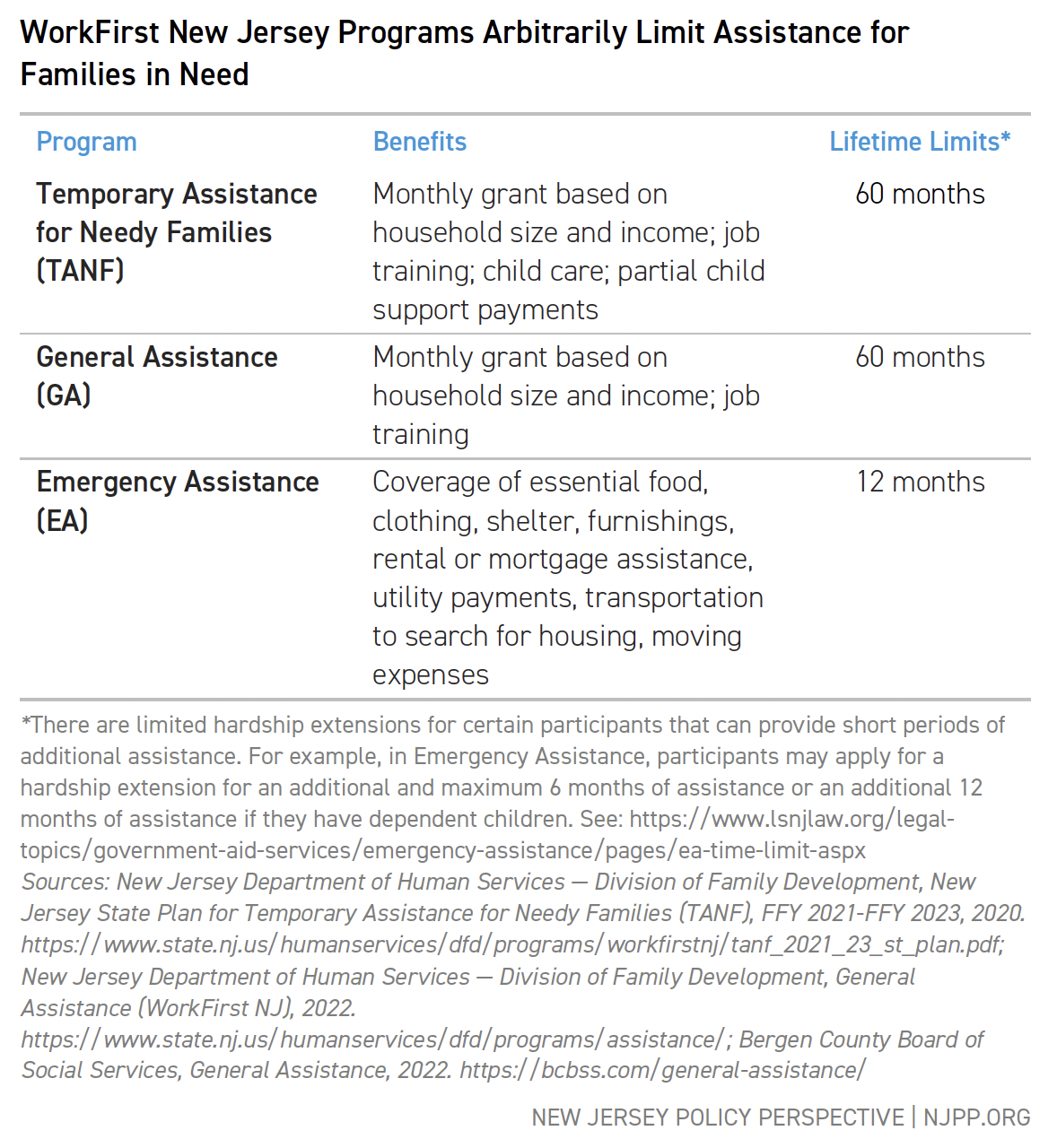
The time limits in New Jersey’s cash assistance programs within Work First New Jersey (WFNJ) are not grounded in evidence but come from outdated and discriminatory stereotypes from the 1990s welfare reform movement.[iii] Lifetime limits on benefits, like the 12-month limit in Emergency Assistance, set arbitrary cutoffs for people who often still need assistance and face an imminent risk of losing their housing. This punitive approach means that assistance is not provided when it is needed most, further contributing to the cycle of poverty and making it harder for families to build a strong foundation and invest in their future.[iv]

Emergency Assistance benefits provide additional support to families participating in other WorkFirst New Jersey programs — Temporary Assistance for Needy Families (TANF) and General Assistance — during crisis situations so they can stay housed, fed, and clothed. The assistance ranges in dollar amounts depending on the circumstances, and families can apply for each month they are in need for up to 12 months total. Continuation of benefits requires regular re-assessments of the participant’s need and development of a plan for recovery.[v] Despite its role in filling a critical gap in the state’s cash support system, Emergency Assistance has the shortest lifetime limit of the WorkFirst New Jersey programs, so most participants are only eligible for one-fifth of the total time they are allowed to access other programs.[vi]

In Fiscal Year 2023, more than 5,700 residents receiving TANF and General Assistance each month also received Emergency Assistance benefits, representing roughly 13 percent of recipients,[vii] with an average grant of $1,032 per month.[viii] Thousands of these families received Emergency Assistance every year due to the 2018 law, further demonstrating how more families can get the support they need without lifetime limits in effect.[ix] With the harm of the pandemic still felt throughout the state and far too many families living in poverty, this additional assistance is essential for low-income families.

Unless lawmakers act soon and pass S3960/A5549, New Jersey risks slipping backward in its support for low-income families. There is no sound policy rationale to maintain arbitrary and outdated lifetime limits on assistance, and this lame duck session is an opportunity to strengthen cash assistance programs and create the robust safety net that New Jersey families deserve.


End Notes

[i] NorthJersey.com, Most vulnerable could become homeless if NJ Legislature fails to extend aid, advocates say, 2023. https://www.northjersey.com/story/news/2023/11/21/vulnerable-could-end-up-homeless-if-nj-legislature-fails-to-extend-aid-shelters/71657027007

[ii] Legal Services of New Jersey, Emergency Assistance and Time Limit Extensions, 2022. https://www.lsnjlaw.org/legal-topics/government-aid-services/emergency-assistance/pages/ea-time-limit-aspx; New Jersey Department of Human Services, Work First New Jersey Emergency Assistance Training, 2019. https://www.nj.gov/humanservices/dmhas/information/provider/Provider_Meetings/2019/DMHAS%20EA_080119_SJM.pdf; N.J. Stat. § 44:10-51 (3). https://casetext.com/statute/new-jersey-statutes/title-44-poor/chapter-4410-reference-to-county-welfare-board-to-mean-reference-to-county-welfare-agency/section-4410-51-provision-of-emergency-assistance

[iii] Center on Budget and Policy Priorities, TANF Policies Reflect Racist Legacy of Cash Assistance, 2021. https://www.cbpp.org/research/income-security/tanf-policies-reflect-racist-legacy-of-cash-assistance. Congressional Research Service, The Temporary Assistance for Needy Families (TANF) Block Grant: A Legislative History, 2023.https://sgp.fas.org/crs/misc/R44668.pdf

[iv] Center on Budget and Policy Priorities, Three Reasons Why Providing Cash to Families With Children Is a Sound Policy Investment, 2022. https://www.cbpp.org/research/income-security/three-reasons-why-providing-cash-to-families-with-children-is-a-sound

[v] New Jersey Department of Human Services, Work First New Jersey Emergency Assistance Training, 2019, pg. 18-19. https://www.nj.gov/humanservices/dmhas/information/provider/Provider_Meetings/2019/DMHAS%20EA_080119_SJM.pdf

[vi] New Jersey Department of Human Services, Work First New Jersey Emergency Assistance Training, 2019, pg. 25. https://www.nj.gov/humanservices/dmhas/information/provider/Provider_Meetings/2019/DMHAS%20EA_080119_SJM.pdf

[vii] NJPP Analysis of New Jersey Treasury – Office of Management and Budget, Governor’s FY2024 Detailed Budget, 2023, pg. D-224. https://www.nj.gov/treasury/omb/publications/24budget/FY2024BudgetDetail-Full.pdf

[viii] New Jersey Treasury – Office of Management and Budget, Governor’s FY2024 Detailed Budget, 2023, pg. D-224. https://www.nj.gov/treasury/omb/publications/24budget/FY2024BudgetDetail-Full.pdf

[ix] New Jersey Office of Legislative Services, Legislative Fiscal Estimate for S866, 2018. https://pub.njleg.state.nj.us/Bills/2018/S1000/866_E2.PDF

Advocates, Unions, and Policy Experts Praise New Bill to Extend Surcharge on Corporate Profits

A week after hundreds of union members and advocates rallied outside the State House to oppose a $1 billion corporate tax cut, momentum is building to extend New Jersey’s Corporate Business Tax surcharge with new legislation (A5878) introduced by Assemblyman Tom Giblin (D-Essex).

Earlier this month, Senate President Nick Scutari (D-Union) spoke out in support of maintaining the surcharge to fully fund NJ Transit, which is facing a looming $1 billion budget shortfall. The surcharge on corporate profits is only paid by the most profitable top 2 percent of corporations and is primarily paid by large, multinational corporations like Amazon, Walmart, and ExxonMobil — not small or midsize businesses located in New Jersey.

Advocates, unions, and policy experts from the For The Many NJ coalition praised the introduction of the bill as a way to promote tax fairness and fund public services, programs, and infrastructure that everyday New Jerseyans rely on.

Nicole Rodriguez, President, New Jersey Policy Perspective (NJPP):
“This bill shows that the Legislature is listening to the many voices across the state saying no to this billion-dollar tax cut for big corporations. The surcharge is a highly targeted tax that pays for the essential public services that keep our communities and economy running. New Jersey needs this revenue to balance its budget and avoid damaging cuts to public transit and programs that working families rely on.”

Antoinette Miles, Interim Director, New Jersey Working Families Party:
“Just a week ago, the voices of workers and grassroots activists echoed throughout the State House, and this bill shows how those voices have been heard. Now it’s time for the rest of the Legislature and the Governor to listen, too, and stop this tax cut for big corporations today.”

Nedia Morsy, Director of Strategic Projects, Make the Road New Jersey:
“New Jersey’s transit riders and workers need a well-funded public transit system, not fare hikes and service cuts. This bill would go a long way towards finally getting a dedicated funding source for NJ Transit, rather than relying on patches and short-term fixes. If Walmart and Amazon are making their profits off of New Jersey consumers and workers, then New Jersey should be making sure they pay us back for the transit and infrastructure that generate those profits.”

Debbie White, RN, President, Health Professionals and Allied Employees:
“Legislators should support the extension of the corporate business tax to protect the financial stability of New Jersey. The revenue generated by this tax on wealthy corporations has supported healthcare, transportation, education and other projects the residents of New Jersey rely on every day. Without this source of revenue, we will see a negative impact on New Jersey’s infrastructure.”

Liz Glynn, Director of Organizing, New Jersey Citizen Action:
“As corporate profits continue to break records, working and middle-class families in New Jersey continue to struggle to make ends meet. The public services they rely on need robust funding, and taxing corporate profits from the world’s biggest companies will help ensure that affordable housing and healthcare, infrastructure, and essential services have sustainable funding into the future. Now is not the time to cut corporate taxes once again.”

Amy Goldsmith, State Director, Clean Water Action:
“New Jersey’s needs are great. On the environment alone, clean energy, lead abatement programs, NJ Transit, and the Department of Environmental Protection are all underfunded while state revenues are down, federal funds are drying up, and a fiscal cliff is looming. Kudos to Assemblyman Giblin for making sure we don’t lose a billion dollars by ensuring mega-corporations pay their fair share. It’s now time for the rest of the Legislature and Governor to step up.”

# # #

For The Many is a statewide coalition of more than 30 organizations working to expand funding for essential services and improve budget practices to meet current and future needs, especially for communities that have been historically left behind.

Family Leave Expansion Would Advance Equity and Eliminate Fear of Retaliation for All of New Jersey’s Workers

Every worker in New Jersey deserves the right to take paid family leave to bond with a new child or care for a loved one. No worker should fear losing their job to care for their ill parent, or spend precious weeks with a newborn. Certainly something as arbitrary as the size of their employer should not dictate whether they can take family leave without fear of discipline or termination.

As NJPP’s June 2023 report More Than One in Five New Jersey Workers Can Still Be Fired for Taking Paid Family Leave noted, over 800,000 workers in New Jersey can be fired for taking family leave. This should never be the case.

A-5611 takes a step towards protecting this right, but the proposed amendment to the bill still leaves businesses with fewer than 5 employees unprotected – nearly 200,000 workers or 5 percent of the total workforce.

Additionally, the Family Leave Act still has gaps for coverage for workers with less than 1,000 hours worked in the last 12 months or workers who have worked for their employer for less than one year. Roughly 400,000 New Jersey workers — or 10 percent of the workforce — worked fewer than 1,000 hours and therefore did not get job protection. Workers with fewer hours nonetheless need job protection to take time to care for their loved ones.

One recent federal proposal, the Job Protection Act, would eliminate the hours requirement and reduce the tenure requirement to 90 days for the federal Family and Medical Leave Act.

Job protection alone also does not solve the many remaining gaps in coverage in the paid family leave insurance program (FLI). The comprehensive A-5703 addresses many of these concerns in one package that should move alongside A-5611 to ensure that all workers who have an ill loved one or new child to bond with have access to paid time off of work.

Without adequate job protection for all workers and other program improvements detailed in A-5703, family leave runs the risk of becoming a luxury product for higher-income workers, rather than a benefit that all workers can use. Every worker in New Jersey should be able to take family leave without fear of economic penalties.

Workers and Advocates Tell Lawmakers: Do Not Cut a $1 Billion Check to Amazon and Walmart

With the end of the legislative session approaching, more than 100 workers, policy experts, and advocates from For The Many NJ rallied outside the State House to tell lawmakers: Do not cut a $1 billion check to the world’s most profitable businesses!

As state tax collections continue to come in lower than projected, members of the coalition warned that not renewing the Corporate Business Tax surcharge would threaten essential public services, programs, and infrastructure that everyday New Jerseyans rely on.

“We cannot give the largest corporations in the world a $1 billion tax cut on the backs of working people across New Jersey,” said Antoinette Miles, Interim Director of the New Jersey Working Families Alliance. “We need this revenue to fund our communities, our schools, our infrastructure, and our environment. The writing is on the wall with the fiscal cliffs on the horizon, and we have a solution right here. Lawmakers need to stop this tax cut and have these big corporations pay what they owe.”

Eliminating the corporate surcharge, a 2.5 percent tax paid only by corporations with annual profits over $1 million, would cost the state $1 billion every year. Governor Murphy said he would allow the tax to expire at the end of the year in his budget address, stating “A deal is a deal.” The state’s financial outlook has dramatically shifted since then, however, as the state is now operating at a structural deficit.

“We’ve heard a lot about a deal being a deal, but why is a deal with big out of state corporations the one that counts?” asked Peter Chen, Senior Policy Analyst at NJPP. “What about the deal to New Jersey’s commuters and students who ride buses and trains to get to work and school? Instead of honoring a deal to fix NJ Transit, we’re writing a check to Amazon and Wells Fargo instead. These are not small businesses or mom-and-pops or pizzerias paying this tax, it’s the world’s largest corporations.”

A report released earlier this year by New Jersey Policy Perspective (NJPP) found that only the most profitable 2 percent of businesses operating in New Jersey — including out of state companies like Amazon and Walmart — pay the surcharge, while 98 percent of businesses do not pay it. The report also found that more than 70 percent of the tax cut would go to companies with more than $10 million in annual profits.

“Public employees saw the damage caused during the Christie era when the state failed to raise revenues to pay for health care, education, and infrastructure,” said Dennis Trainor, CWA District 1 Vice President. “At a time when the state needs to strengthen its investments and ensure vital services to the public and continue to fully fund the pension, our lawmakers should not be robbing the state of $1 billion to hand to the likes of Amazon and Walmart.”

Earlier this month, Senate President Nick Scutari (D-Union) said he was considering maintaining the surcharge to fully fund NJ Transit, which is facing a looming $1 billion budget shortfall. Millions of residents risk losing bus and train service they rely on if the agency’’s budget is balanced through cuts.

“​​New Jersey Transit is facing a massive deficit, and that means fare hikes and service cuts for me and hundreds of thousands of working-class New Jerseyans who use transit to get to work,” said Margarita Rodriguez, Passaic resident and member of Make the Road New Jersey. “But instead of standing up for working families, Governor Murphy, Assembly Budget Chair Eliana Pintor Marin, and Senate Budget Chair Paul Sarlo will give a billion-dollar tax break to mega-wealthy corporations like Amazon, a well-known violator of workers’ rights. Which side are you on? Do you stand with New Jersey workers and students, who need a functioning public transit system, or billionaire corporations? Don’t let NJ Transit crumble. Listen to your constituents and keep the Corporate Business Tax Surcharge. It is time Amazon pays its fair share.”

Members of the coalition also pointed to other programs and services that are underfunded or at risk of being cut, from affordable housing to environmental protection. Six percent of the corporate business tax is dedicated to environmental purposes, for example, funding open space preservation and the upkeep of city parks, farmland, and historic sites.

“Corporate business tax funding is vital to maintaining open space, which is important for outdoor recreation and is also an economic boon. Outdoor recreation in New Jersey was valued at $20.3 billion in 2021 alone,” said Ed Potosnak, Executive Director, New Jersey League of Conservation Voters. “This money should continue to be invested in open spaces, which brings environmental and economic benefits for the entire state. We’re asking Governor Murphy and the New Jersey Legislature to continue our state’s long legacy of support and funding for land preservation and open space by not letting the surcharge expire. The expiration of the surcharge on the 2 percent wealthiest corporations would mean the loss of $480 million in critical open space funding over just 10 years and will do irreparable harm to our beautiful state.”

“We have a lot of talents in New Jersey, and one of them is being able to walk and chew gum at the same time,” said Matthew Hersh, Director of Policy and Advocacy at the Housing and Community Development Network of New Jersey. “We should not have to consider abandoning an immensely important revenue stream at the risk of losing tools that help all New Jerseyans. We’ve seen the effects of austere budgeting and what it looks like when state agencies are not properly funded. We know that fewer resources in housing means fewer affordable homes.”

With a $1 billion novelty check in hand, the coalition called on the Legislature and Governor Murphy to extend the surcharge permanently, and invest those funds in services and programs that working families rely on.

“Since the corporate surcharge was enacted, corporations like Amazon continue to enjoy record-breaking profits every year,” said Liz Glynn, New Jersey Citizen Action Director of Organizing. “But New Jersey working families have struggled to meet essential needs, and these needs continue to grow. The revenue received from the surcharge has helped meet the growing infrastructure and service needs of low-and moderate-income families across our state. Now is not the time to sunset the surcharge. We urge Governor Murphy and our State Legislature to extend the surcharge and help ensure everyday New Jerseyans can prosper during these difficult times.”

Watch a recording of the event here.

# # #

For The Many is a statewide coalition of more than 30 organizations working to expand funding for essential services and improve budget practices to meet current and future needs, especially for communities that have been historically left behind.

StayNJ 2.0: Senior Tax Cut Still 2 Regressive and 2 Expensive

The latest draft of StayNJ, a proposal to credit home-owning seniors for up to half of their property tax bills, would still direct the largest benefits to wealthy households while providing much less to lower-income homeowners and renters. Despite amendments that lower the maximum tax credit and add a much-needed income cap on eligibility, the new proposal still ties the total benefit to property taxes paid, resulting in the biggest tax cuts going to people with high incomes who own the most valuable homes.

As written, the proposal would make New Jersey’s tax code more regressive and worsen the racial wealth gap. It would also come at an enormous cost to the state, with a total price tag of $2.2 billion at a time when the state can ill afford it.

1. Still Regressive

The new StayNJ proposal, a compromise between Governor Murphy and legislative leaders, has been modified to include an income cap of $500,000 and a lower maximum benefit of $6,500. These changes fail to address the fundamental flaw at the heart of StayNJ: By tying benefit amounts to total property tax bills, the program directs larger payments to owners of larger, higher-valued homes. Further, an income cap of $500,000 still includes many high-income seniors with substantial wealth and economic advantages. To put this new income cap in perspective, it is double that of the state’s ANCHOR property tax rebate, which phases out at $250,000 in annual income.

The majority of StayNJ benefits would still go to the top 40 percent of households, leaving lower-income seniors with much less. In total, 28 percent of benefits would go to the top 20 percent of households, while those in the bottom 20 percent would receive only 7 percent of the benefits. As long as the program continues to disproportionately benefit homeowners at the expense of renters, and direct bigger benefits to those with more valuable homes, it will continue to reward the rich at the expense of the rest of the population.

Even with an additional $250 payment for seniors who rent included in the proposal, renters would still receive thousands less than their wealthier home-owning peers. The average benefit for seniors in the top 5 percent (with incomes of at least $360,000) would be $4,508, while seniors in the bottom 20 percent (with incomes less than $26,000) would receive an average benefit of $369. Because renters are disproportionately nonwhite and have lower incomes on average, the new StayNJ program would still widen the racial wealth gap.

2. Still Expensive

Based on modeling of income and homeowner data, NJPP estimates the program’s cost at $1.9 billion for the homeowner component alone, with another $300 million in ANCHOR payments for a total cost of $2.2 billion per year. With declining tax collections, federal pandemic aid set to expire, and no revenue source to pay for StayNJ, this proposal will make it extremely difficult for lawmakers to balance the state budget in future years.

Good Intentions, Poor Execution

The new StayNJ proposal remains too regressive and too expensive, directing the biggest benefits to already-wealthy households. Whatever its good intentions, StayNJ will put more in the pockets of those who need it least, while doing little to support the low-income seniors most at risk of losing their homes.

Film Tax Credit Expansion is a Bad Investment for New Jersey

On Tuesday, the Senate Budget and Appropriations Committee advanced an overhaul of New Jersey’s film and television corporate subsidy program (S3748), increasing the annual maximum tax credits by at least $200 million and watering down the existing program’s accountability provisions. The bill was voted out of committee despite the lack of fiscal note or any indication of the overall cost of the program. In response to the bill advancing through committee and the bill text finally available to the public, New Jersey Policy Perspective (NJPP) releases the following statement.

Peter Chen, Senior Policy Analyst, NJPP:

“Handing union-busting Hollywood studios hundreds of millions of dollars in subsidies is a bad investment for New Jersey. Study after study shows that the cost of film tax credits overwhelmingly exceeds the benefits, as the jobs created are temporary and often go to specialists from out-of-state. At a time when New Jersey is facing upcoming budget shortfalls, cutting a check to movie and television companies will enrich high paid executives and corporate shareholders at everyone else’s expense. And by watering down accountability measures, lawmakers risk turning a bad investment into an even worse one if the proposed jobs and spending never materialize.

“New Jersey’s budget should prioritize public investments that we all rely on and benefit from, rather than lining the pockets of big businesses.”