
Category: Blog
Equal Access to Financial Aid Now Law
Today, New Jersey officially joins 9 other states – from bright blue California to deep red Texas – in allowing undocumented students with New Jersey roots to apply for state financial aid to help secure a college degree. New Jersey becomes the second state on the east coast to enact such policy, and the second to do so since Donald Trump was elected President.
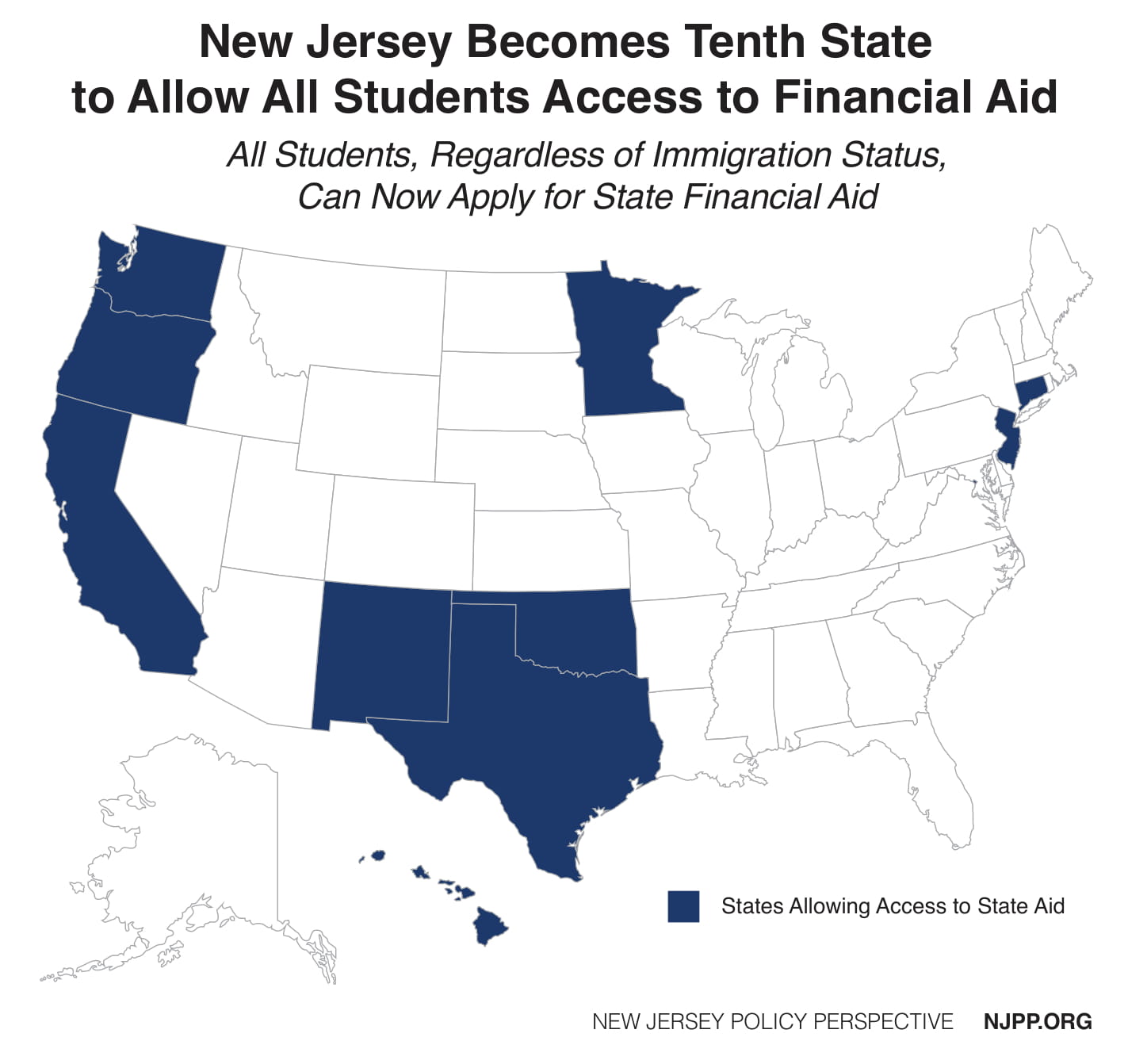
This common-sense policy will put undocumented students – and New Jersey – on the path toward greater economic prosperity while helping build stronger communities. Equal access to higher education for all students, regardless of status, enables undocumented students who graduated from New Jersey high schools to have a real shot at earning a college degree. This will help us develop a more highly-educated workforce, strengthening our economy and building a brighter future for all New Jerseyans.
With this policy, New Jersey sends a clear message that our state can mitigate the federal government’s attacks on immigrants by taking bold action that both honors our history as the golden door for immigrants and maintains our reputation as a welcoming, inclusive place. Considering the fact that more than half of new jobs will soon require a bachelor’s degree, increasing access to higher education by making it more affordable for all students – regardless of immigration status – is a critical step to ensuring the long-term strength and sustainability of our state’s economy.
For more information on equal access to financial aid, read our 2016 report, Access to Financial Aid is Essential to Give Undocumented New Jerseyans a Better Shot at a College Education: https://www.njpp.org/reports/access-to-financial-aid-is-essential-to-give-undocumented-new-jerseyans-a-better-shot-at-a-college-education
"Tax Freedom Day" Analysis is Flawed
Happy “Tax Freedom Day,” New Jersey!
In April, the Tax Foundation released its annual “Tax Freedom Day” report, designed to represent the number of days into the year people must work to earn enough money to pay the average federal, state and local tax bill. According to the Tax Foundation, New Jersey is one of the last states in the nation to achieve this milestone. It is important to note that there are some serious problems not just with this report, but with the entire concept of “tax freedom.”
A healthy debate on taxes is welcomed, but not if it begins with the misconception that New Jerseyans derive no benefit whatsoever from the goods and services that government provides. And it certainly doesn’t help to frame such a complex issue around a campaign that plainly reinforces anti-tax rhetoric at the expense of appropriate levels of nuance.
Here are some important things to keep in mind about “Tax Freedom Day”:
The Idea of ‘Tax Freedom’ is Nonsensical
The Tax Foundation’s report says that people spend part of the year working for the government, and then obtain “freedom” and work the rest of the year for themselves. But the reality is that taxes pay for services that New Jerseyans use each and every day. Few New Jerseyans would feel more “free” if the tradeoff for an earlier-in-the-year “Tax Freedom Day” was paying tolls to use every road, having fewer police officers and firefighters, closed public parks, and no public schools for their kids.
The Tax Foundation’s State Estimates Are Seriously Flawed
The Tax Foundation’s proclamations of state “Tax Freedom Days” are meaningless because the report’s state-by-state estimates are flawed. They are not useful for discussing the level of taxes paid by typical households or for assessing the tax choices made by a given state’s policymakers, for at least four reasons:
- They overstate middle-class tax levels: About two-thirds of the taxes in the Tax Foundation’s calculations are federal taxes. The amount of federal taxes paid by the residents of a state thus has a large impact on that state’s “Tax Freedom Day.” Since the Tax Foundation’s methodology substantially overstates the federal tax burden of middle-class families, the “Tax Freedom Day” figures for each state also substantially exaggerate the tax burdens of middle-class families in that state.
- They reflect state affluence rather than state taxes: Because the federal income tax system is progressive, states with greater numbers of high-income residents – like New Jersey – pay more federal taxes than states with fewer high-income residents. As the Tax Foundation acknowledges, “This means higher-income states celebrate Tax Freedom Day later.” Yet by trumpeting state-level “Tax Freedom Days” that differ across the states, the Tax Foundation’s presentation is likely to lead to the misimpression that state and local policies account for the differences, when that is not the case.
- They include taxes paid in other states: The Tax Foundation uses a procedure to allocate state corporate, severance and tourism taxes that leads to further misimpressions about the impact a state’s policies have on the amount of taxes its residents face.
- They rely heavily on old data: While the Tax Foundation uses Congressional Budget Office (CBO) data to project total federal tax collections, there is no equivalent of the CBO for state and local governments. Rather, the Tax Foundation uses its own proprietary (non-public) model to estimate taxes that will be collected during the year in tens of thousands of state and local jurisdictions around the country. This model is based in part on data that are several years old. If the estimates turn out to be even slightly wrong, the rankings are likely to be completely askew.
For more on the Tax Foundation’s report, see this Center on Budget and Policy Priorities paper: https://www.cbpp.org/research/federal-tax/tax-foundation-figures-do-not-represent-typical-households-tax-burdens-2
States with High Tax Rates on Millionaires Are Doing Just Fine
New Jersey isn’t the only state with a proposal to raise new public revenues needed to pay for the public services and investments that help build a strong state economy. Massachusetts voters are set to vote this fall on a ballot question to fund education and transportation through a tax increase on incomes over $1 million. To counter the inevitable narrative of millionaire tax-flight incessantly pushed by opponents of higher top tax rates, Massachusetts Budget and Policy Center has released a report on the economic experiences of the eight states with the highest tax rates on high incomes including New Jersey. Their straightforward findings make a compelling case for embracing a millionaire’s tax increase here in the Garden State.
The report first argues that states can have both higher tax rates for millionaires and a high concentration of millionaires. In fact, several of the top-tax states are among those with the largest number and share of millionaires – California, New York and New Jersey in particular.
As to whether states with millionaire taxes see reduced growth in the number of millionaire tax filers – addressing the popular notion that high tax rates on the highest earners drive them away – the report finds little to backup that assertion. In fact, these states have seen “at least as strong growth in the number of million-dollar incomes as other states” with California and New York leading the pack. These changes are more likely the result of rising incomes of existing residents than of millionaires relocating from other states.
The report also touches on a large scale study of millionaire tax filers in every county in the nation. A 2016 study found that individuals with very high incomes are less likely than others to relocate to other states. The success of these “embedded elites” often depends upon the business and social networks they have fostered over time. As Cristobal Young, Stanford scholar and co-author of the study, has noted, “Higher income earners show low migration levels because they are not searching for economic success – they’ve already found it.”
The report ends by citing the economic impact of New Jersey’s 2004 enactment of an 8.97 percent tax rate on incomes over $500,000. Opponents of a millionaire’s tax often – and incorrectly – describe the net loss of adjusted gross income since the tax increase went into effect as a blow to New Jersey’s economy. But when compared to the entire state economy, the perceived loss is less than 1 percent of the total income. The report goes on to punch more holes in the tax migration argument as we at NJPP have done repeatedly, concluding that “even in New Jersey” millionaire-tax flight has been “relatively unimportant.”
We couldn’t agree more.
It’s Tax Day: Let’s Commit to Investing in New Jersey
Taxes, and the important services they help finance, are woven into almost every part of our everyday lives. Today, Tax Day, seems like a good day to share some examples of how the tax dollars we pay support a variety of things that help our communities thrive.
It is the school down the street where our kids get their start. It is the neighborhood park where we hang out after work and on weekends with our families. It’s the bike lanes our kids use to ride to school or the train we ride to commute to work.
It’s the new road that takes us out to the airport, where we head out on a business trip. It’s the tax incentives that helped a small business get started. And it’s the community college where thousands of students get educated and trained for success in their careers.
It’s the fire station in town, the 911 operator who’s always there, or the hospital where some of our kids were born. It’s the food assistance that a struggling family needs to put food on the table. It’s the Social Security benefit that retirees rely on to get by and the Medicare coverage they use to get the health care they need.
It’s so easy to be skeptical about government and the elected officials who run it, but how government shapes our tax code is a reflection of us, our values and the priorities we care about.
Sadly, new changes to the federal tax code may make it harder for New Jersey to fund important services and programs. With the state already struggling to meet its obligations, it is now facing current and future spending cuts due to the lopsided nature of the new federal tax plan which gives huge tax breaks to corporations and wealthy families.
According to a new state-by-state analysis of the 2018 tax law, the distributional impact of the new tax plan overwhelmingly benefits the country’s wealthiest families. In New Jersey, it sends 69 percent of the benefits to the top 20 percent of wage earners, and the top 1 percent – those who make $924,600 or more – receive an average tax cut of $21,700. Yet, the poorest 20 percent of New Jerseyans – those who make an average $15,800 in annual income – receive an average tax cut of just $140. Those individual tax cuts are scheduled to expire in 2025.
Now, Congressional Republicans are considering making these tax cuts permanent, claiming they would help the middle-class. However, according to an ITEP analysis, extending the temporary tax provisions in 2026 would not help the middle-class any more than the enacted tax law does in 2018. If that happens, the top 5 percent of New Jersey earners would again receive the lion’s share (68 percent) of the benefit while those in the bottom 20 percent would get an nearly invisible 19 cents a week tax break – essentially a 0 percent share of the benefit.
The implications of this law could not come at a worse time for New Jersey. The reality is that the federal tax plan is fundamentally flawed and poses a significant risk to New Jersey’s economic future. According to the latest analysis from the Center on Budget and Policy Priorities, the federal tax plan exasperates income inequality, weakens tax revenue at a time when the nation will need more to care for the aging Baby Boomer generation and introduces more tax loopholes to be taken advantage of by those with the means to do so. Furthermore, it leaves millions without health coverage with the repeal of the provision that requires individuals to purchase health insurance or pay a penalty.
All told, the new federal tax plan will lead to enormous federal deficits of about $1.5 trillion over the next ten years that are likely to lead to deep spending cuts to important public services that New Jersey families rely upon. Over a quarter of New Jersey’s budget (26.7 percent) is made up of federal grants.
New Jersey’s lawmakers should be vigilant in their long-term response to these fundamental changes by pursuing policies that both shore up the state’s depleted rainy day fund and make our tax code more equitable. They can do so by focusing on the new revenue proposals targeted toward corporations and wealthy households as proposed by both Governor Murphy and Senate President Sweeney. Taxing earnings of $1 million at a higher rate, restoring the sales tax, closing corporate loopholes and making large businesses pay their fair share; these targeted tax changes can help New Jersey make the kind of investments needed to get the state back on its feet and protect itself against harmful federal cuts down the line.
This Tax Day, let’s be honest about one thing: New Jerseyans care deeply about everyone paying their fair share. Supporting the kinds of services and programs that develop and maintain thriving communities is important to the state’s future, and making sure that everyone contributes – particularly those who have significantly benefitted from recent changes in the tax law – is foundational to securing the long-term, sustainable growth and investment that New Jersey needs.
Undocumented Immigrants Pay Taxes: County Breakdown of Taxes Paid
While undocumented immigrants in New Jersey now face greater threats from the federal government than ever before, new data at the state and county level released by the Institute on Taxation and Economic Policy make clear that the Garden State’s undocumented immigrants are an important economic benefit to this immigrant-rich state.
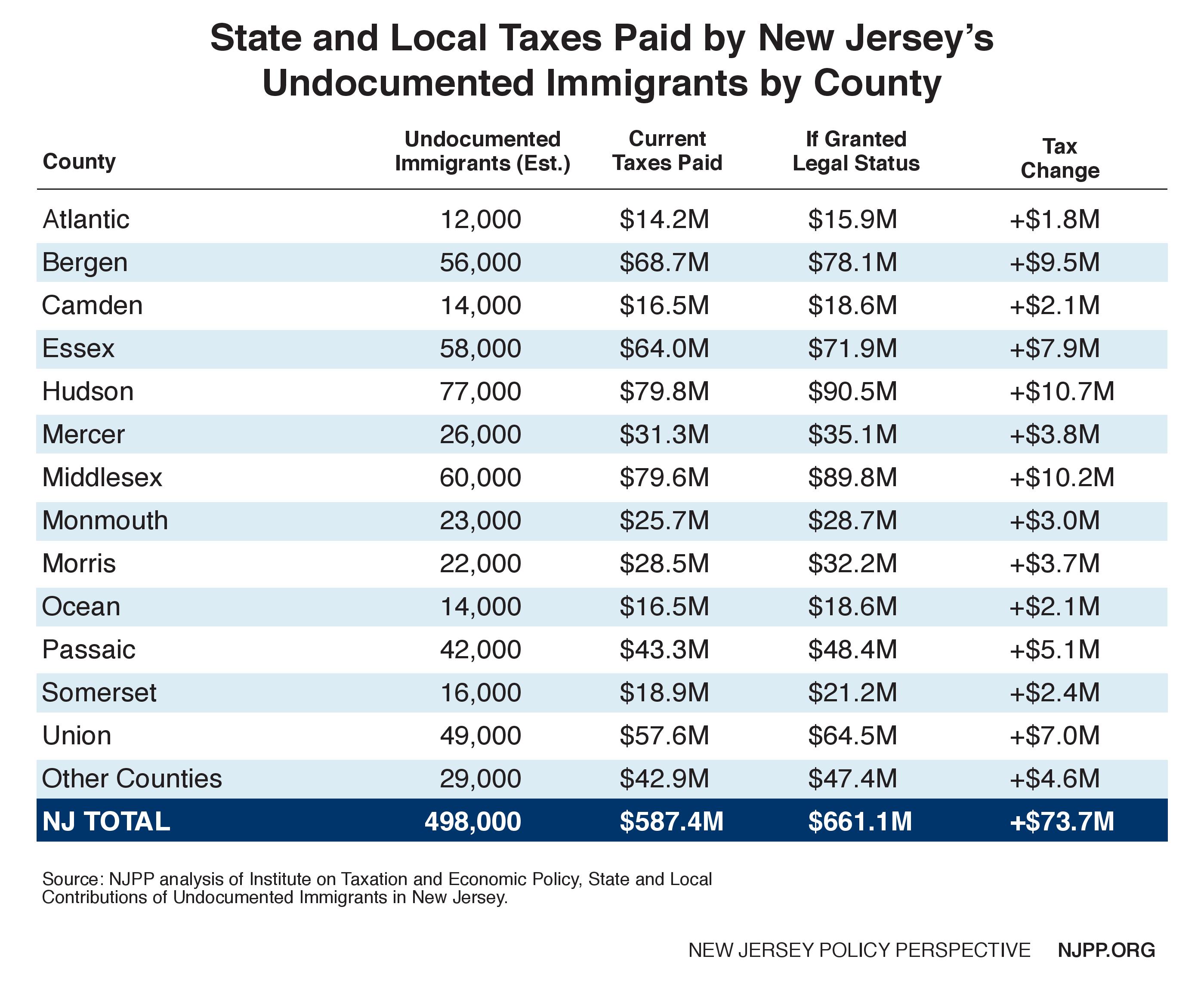
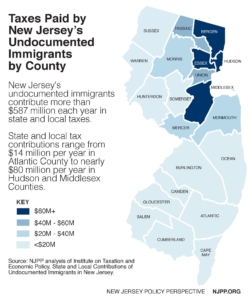 New Jersey’s undocumented immigrants pay about $587 million each year in state and local taxes, the sixth highest level of all states. And the more integrated these neighbors become in our society, the higher their tax contributions. For example, the same undocumented New Jerseyans would pay an additional $73 million – the eighth largest jump of all states – should they be covered by comprehensive immigration reform.
At the county level, undocumented folks contribute from $14 million in Atlantic County, which is home to 12,000 undocumented immigrants, to almost $80 million in the county with the largest count of undocumented immigrants, Hudson County. Hudson County and Middlesex County, the two counties with the highest number of undocumented immigrants, would see the greatest increase in taxes paid if undocumented immigrants were granted legal status.
While inflammatory rhetoric and repressive actions toward immigrants and refugees seem to be the “new normal” in the halls of power of Washington, D.C., the facts still matter – and they show that undocumented New Jerseyans are an integral part of our state’s economy.
New Jersey’s immigrants aren’t “takers” as extremists want you to think, they are taxpayers who are willing to contribute to our state and want to make New Jersey better.
New Jersey Takes A Step Toward Restoring Health Care Mandate
Today’s passage of legislation restoring the individual mandate is essential to keep insurance affordable and sends a powerful message to Washington that New Jersey will not allow the Affordable Care Act to be sabotaged. Despite New Jersey’s progress in reducing the number of uninsured residents, this measure is needed because there are still about 700,000 New Jerseyans without coverage.
This bill is critically important to stabilizing the health insurance market and will help make sure that insurance coverage remains affordable for as many New Jerseyans as possible. The state still has hundreds of thousands of uninsured residents and it is vital that we do all we can to make sure everyone can secure affordable health insurance and improve public health.
If New Jersey does not act the consequences will be dire. NJPP estimates that the number of uninsured in New Jersey will increase by about 300,000 over the next decade; premiums will rise about 10 percent; the state will lose billions in federal Medicaid funds and premium subsidies; and taxpayers will be hit with a much bigger bill for charity care payments to hospitals.
Importantly, the revenues collected from the penalties can be used for a reinsurance plan that will decrease the cost of providing health coverage for very sick individuals, thereby further reducing premiums for these families as well as generating federal funds( if a waiver is approved). This bill (S-1878) also passed today.
The penalty should encourage younger, healthier people to obtain insurance, spreading the risk in the health insurance pool. Without robust participation of these individuals, insurance premiums will climb and the market could destabilize.
This bill will mainly help 150,000 middle-class New Jerseyans who purchase their insurance directly since they are not eligible for federal subsidies under the Affordable Care Act and therefore must pay for the full cost themselves. Since premiums already increased this year in anticipation of the repeal of the mandate, these families would save up to $76 million next year by its restoration.
Currently a four-person family must pay about $23,000 a year; when the maximum out of-pocket costs are added, the total cost increases to $37,700, which guarantees that insurance is unaffordable.
Lower-income families will also benefit because the proposed legislation will encourage many uninsured to seek out more-affordable insurance. National research shows most of these individuals are eligible for federal subsidies and that about half are eligible for a plan that costs less than the penalty they may otherwise have to pay. Due to the mandate, over 100,000 New Jerseyans found out they were eligible for Medicaid – which has no cost sharing – when they searched the Marketplace for insurance.
The bill also applies the penalty to anyone who purchased a plan that does not meet the essential benefits requirements in the ACA or New Jersey law. This measure was added to prevent short term and association plans – sometimes called “junk plans” which are being pushed by the Trump administration to circumvent the ACA – from being sold in New Jersey.
Legislature Passes Bill To Extend Earned Sick Leave to Over 1 Million New Jerseyans
Today, New Jersey achieved a huge victory in supporting workers, families and businesses by passing legislation (S-2171) that will extend earned sick leave to over one million employees. No longer will workers have to choose between staying home to get well – losing a day’s worth of pay if not their job in the process – and going to work, which would put their colleagues and the public at risk for infection. As a result of this legislation, public health and worker productivity will improve, and the state’s economy will be made more resilient.
Currently, about seven out of ten workers in New Jersey already have access to earned sick leave. Making sure that this benefit is extended to just about everyone is simply common-sense and shows that New Jersey believes in supporting family values. It’s a terrible thing when a worker, especially parents with sick children, have to make the difficult choice of going to work or staying home and getting healthy. It’s nice to now say that workers don’t have to choose between their health or the health of their family and their job.
Businesses will benefit from this legislation as workers with access to earned sick leave are more productive and engage in less turnover. Businesses that don’t currently offer earned sick leave would experience savings and reduced costs after implementing this policy. Of the workers who don’t currently have access to earned sick leave, a significant share work in food and retail industries, meaning they interact with the public. Making sure that employees in those sectors have the ability to stay home and get well instead of being forced to go to work will benefit public health and is expected to help cut down on the number of viral outbreaks.
Passage of 'Out-of-Network' Bill a Historic Step Forward
The legislature made history today by finally passing legislation (S-485) that will help to address surprise billing and the high cost of health insurance. This is critical as polls show that a primary concern of New Jerseyans is the high cost of health care. While this legislation is extremely important and welcomed, more legislation will be needed in the future to bring down these costs.
Simply put, insurance is becoming unaffordable in New Jersey, especially for middle class families who are not eligible for public coverage or subsidies. While it took many years to finalize this bill, it demonstrates that the legislature can take on powerful interest groups and establish policies that will benefit consumers.
The average cost for a family with employer-based coverage is about $18,000, the 13th highest amount in the nation. This affects the family, but also the employer which shares in the cost and is one of the main reasons why the number of New Jerseyans covered by small employers has dropped by half since 2010 (from 740,000 to 371,000). This problem is even worse for families who do not have employer- based coverage and must pay the entire cost for coverage in the individual market; a four-person family typically pays about $23,000 in premiums, plus cost sharing, which often represent between a quarter to a third of their gross income.
This bill addresses this problem in two major ways. First, it provides new protections and transparency for New Jerseyans to avoid surprise billing, including a prohibition on balanced billing. In a 2016 report on this issue, NJPP estimated that 168,000 New Jerseyans receive surprise bills from their health providers annually. These bills amount to $420 million and average about $2,500 per person. Under this legislation, many of these individuals would no longer receive a bill or, if they did, they would know about it before they agreed to medical treatment. New Jerseyans who obtain their insurance in the individual or small group market, Medicare or Medicaid, and the health system for public employees already have some – but not all – of these protections, however many of the 3.8 million New Jerseyans in self-insured employer-based plans do not.
The second way in which this bill will reduce costs is that it addresses the problem of health providers that submit claims to insurers for exorbitant, inappropriate costs by requiring a fair and expedited method to arbitrate bills when there is no agreement on what should be paid. In effect a small number of health providers can charge significantly higher bills by going out of network. NJPP estimated that the total claims submitted to insurers for out of network costs amounted to about one billion dollars in New Jersey, much of which are passed along in higher premiums and cost sharing to five million New Jerseyans with commercial insurance. The new arbitration system also benefits many health providers because it provides a quick and fair method to resolve billing disputes.
New Jersey Legislature Passes Tuition Equality Bill
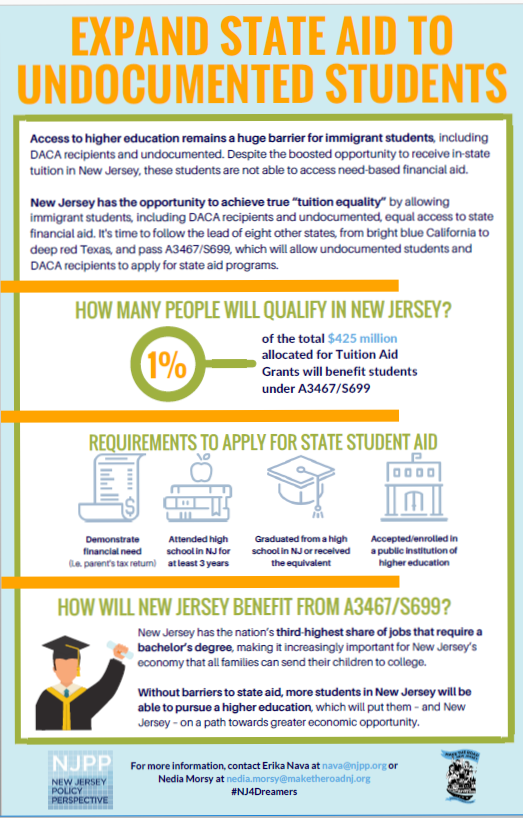
Today, New Jersey achieved true tuition equality and joins 8 other states – from bright blue California to deep red Texas – in allowing undocumented students to apply for state financial aid to secure a college degree. The Garden State becomes the first state on the east coast to have such a policy and is the first state to pass a major progressive immigration bill this year under the Trump administration.
This common-sense policy will put undocumented students – and New Jersey – on the path toward greater economic opportunity and success. It’s an important change that enables undocumented students who graduated from our high schools to have a real shot at earning a college degree. This will help us develop a more highly educated workforce that strengthens our economy and secures a brighter future, and that benefits everyone.
With this policy, New Jersey sends a clear message that our state can mitigate the federal government’s attacks on immigrants by taking actions that both honor our history as the golden door for immigrants and maintain our reputation as a welcoming, inclusive place. Considering the fact that more than half of new jobs will soon require a bachelor’s degree, increasing access to higher education by making it more affordable for all students – regardless of immigration status – is a critical step to ensuring the long-term strength and sustainability of our state’s economy.